The 5 robot types — what each does and where each fits
A sector-neutral taxonomy built for operators evaluating a first deployment, not engineers building one.
In 2021, a healthcare supply chain manager at a large hospital network approved a cobot deployment to handle medication tray assembly — a repetitive, high-precision task performed by pharmacy technicians. The cobot arrived. It could handle the motion precisely. But it required a safety cage that blocked the pharmacy workflow, the integration with the existing dispensing cabinet software took four months longer than projected, and the changeover time between different tray configurations wiped out most of the throughput gain. The cobot was technically capable. It was the wrong category for the operational context.
A mobile robot with vision-guided picking — a mobile manipulator — would have been the right fit: flexible enough to handle tray variation, able to work alongside people without a safety cage, and designed for environments where the task parameters change regularly. The cobot is optimized for high-volume, low-variation, fixed-position work. Pharmacy tray assembly is moderate-volume, high-variation, mobile work.
Category fit is the most consequential early decision in a first deployment. This article gives you a working taxonomy.
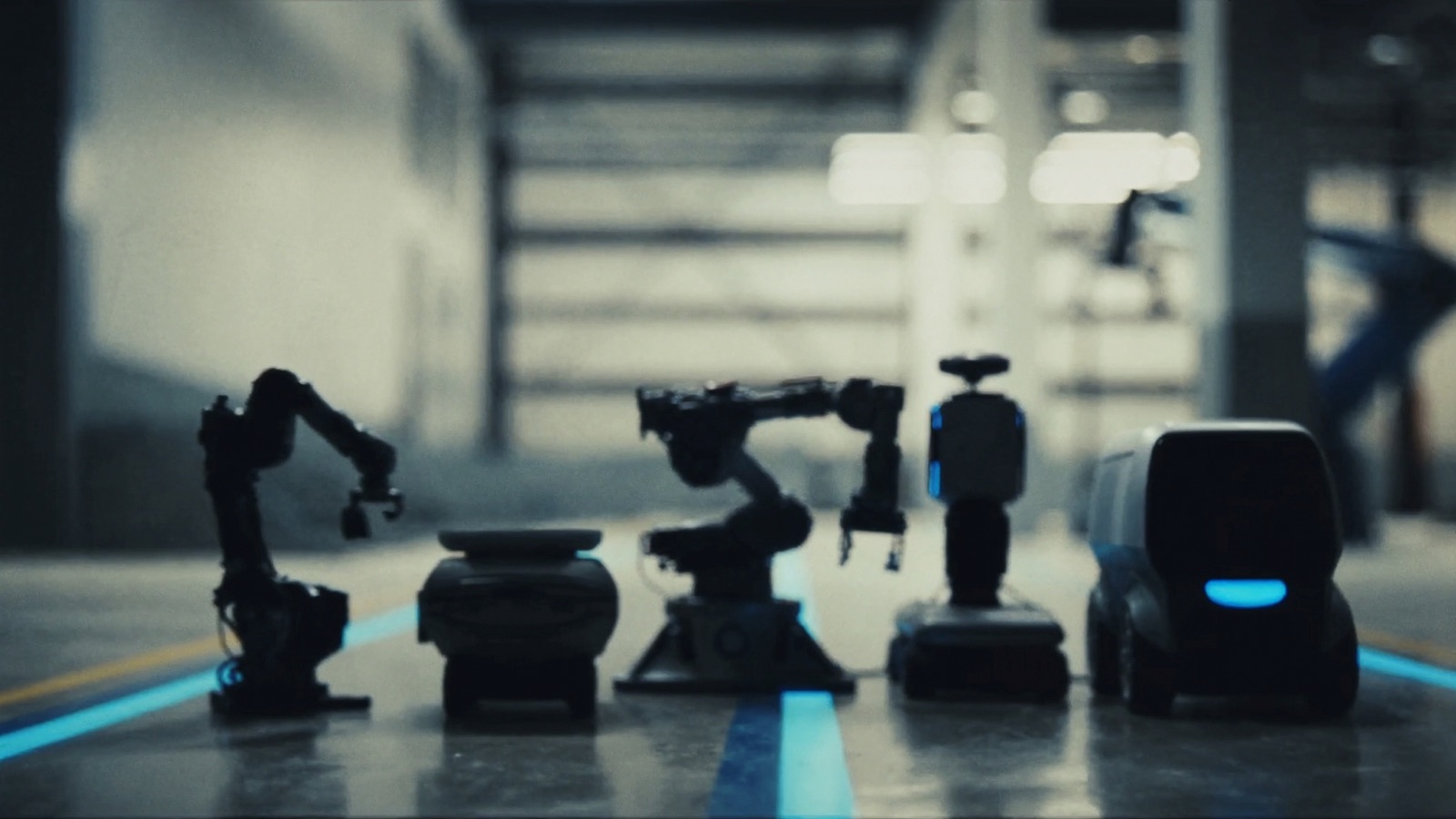
The Five Categories
The robotics industry uses inconsistent terminology. The framework below is organized by operational function — what problem the robot solves — not by mechanical architecture.
1. Collaborative Robots (Cobots)
What they do: Cobots are robotic arms designed to work alongside people without a full safety cage. They handle repetitive, precise, fixed-position tasks: assembly steps, quality inspection, screw-driving, dispensing, palletizing at low throughput. "Collaborative" means they have force-limiting sensors that stop the arm if they encounter unexpected resistance — a human hand in the path, for example.
Where they fit: Manufacturing cells with moderate throughput and high precision requirements. Lab environments. Food processing assembly lines. Electronics assembly. Any task that is repetitive, has consistent fixturing, and is performed at a single fixed station.
Where they don't fit: Tasks with high variation in input orientation or shape. Mobile tasks that require moving between stations. Any environment where the task changes configuration frequently — changeover times for cobots range from 20 minutes to several hours depending on tooling.
Cost range: $30,000–$120,000 for the arm alone. Add $20,000–$80,000 for end-of-arm tooling, fixtures, and integration. Total first-deployment cost typically $80,000–$200,000.
Payback window: 1–3 years at typical manufacturing labor costs.
Key selection question: Is the task performed at a fixed station with consistent input geometry and low variation in the action required?
2. Autonomous Mobile Robots (AMRs)
What they do: AMRs navigate independently through a facility using onboard sensors (LIDAR, cameras, or both), move payloads from point A to point B, and avoid obstacles dynamically. They are not programmed on fixed paths — they build and update maps of the environment and route around whatever is in their way. This distinguishes them from older Automated Guided Vehicles (AGVs), which follow fixed magnetic or optical tracks and stop when blocked.
Where they fit: Internal logistics in warehouses, distribution centers, hospitals, and manufacturing plants. Inventory transport, goods-to-person fulfillment assistance, lineside replenishment. Any environment with predictable A-to-B transport needs at significant daily volume (typically 50+ runs per shift to justify the investment).
Where they don't fit: Environments with highly unpredictable layouts (construction sites, open outdoor spaces). Tasks requiring payload manipulation — AMRs move things but cannot pick them up or place them. Multi-floor deployments without elevator integration (which adds significant cost and complexity).
Cost range: $25,000–$100,000 per unit depending on payload capacity and navigation sophistication. Fleet management software is typically licensed separately ($20,000–$60,000/year for enterprise deployments).
Payback window: 1–2.5 years at warehouse labor costs.
Key selection question: Does the operation have high-volume predictable A-to-B transport on a single floor (or with pre-integrated elevators) with sufficient daily volume to sustain >60% utilization?
3. Fixed Industrial Arms
What they do: Fixed arms (also called industrial robots) are high-speed, high-payload robotic arms designed for continuous high-throughput manufacturing. Unlike cobots, they are optimized for speed and force, not human proximity — they typically require safety fencing. They handle welding, painting, heavy palletizing, press-feeding, and casting operations that require high repeatability at speed that humans cannot sustain.
Where they fit: Automotive and electronics manufacturing. Heavy palletizing at the end of production lines. High-speed pick-and-place for packaging. Any application where throughput and repeatability matter more than flexibility.
Where they don't fit: Low-volume operations where the arm sits idle more than 40% of the time. Tasks requiring frequent reprogramming (changeover cost is high). Environments where people work in close proximity without extensive guarding.
Cost range: $50,000–$400,000+ depending on payload and reach. Safety guarding, tooling, and integration commonly doubles the hardware cost. These are major capital investments.
Payback window: 2–5 years for smaller operations; faster at automotive-scale throughput.
Key selection question: Is this a high-throughput, low-variation task where speed and repeatability outweigh flexibility, and where the volume justifies the capital cost?
4. Mobile Manipulators
What they do: Mobile manipulators combine a mobile base (AMR-style navigation) with an arm on top, allowing the robot to move to different locations and then perform pick-and-place or manipulation tasks at each stop. They are the most versatile category — and the most expensive and complex to deploy.
Where they fit: Environments where both mobility and manipulation are needed: inspection tasks across a facility, lineside material kitting (picking specific parts from inventory), laboratory sample transport with precise handling, and emerging applications in agriculture (harvesting) and construction (brick-laying, survey).
Where they don't fit: First deployments at organizations without experienced robotics integration capacity. Tasks where either pure mobility (AMR) or pure fixed-arm manipulation (cobot/industrial arm) would suffice — mobile manipulators add cost and complexity that is only justified when both capabilities are genuinely needed.
Cost range: $100,000–$500,000+ per unit. Integration costs are high. Most first deployments of mobile manipulators are preceded by separate AMR and cobot deployments that build internal capability.
Payback window: Highly variable; typically 2–5 years when justified.
Key selection question: Does the task genuinely require both moving through the facility AND performing manipulation at the destination — and does your organization have the integration capability to support a complex system?
5. Service Robots
What they do: Service robots are designed to interact with people or perform in people-facing environments. This category is broad: cleaning robots (floor scrubbers, vacuum units), delivery robots (room service, hospital supply delivery, last-mile), food and beverage robots (automated barista, food-running), and greeter/information robots. Unlike the four categories above, service robots are deployed as much for guest experience and brand value as for pure labor displacement.
Where they fit: Hospitality, healthcare, retail, and food service. Environments where the robot's visibility is an asset (not just a necessity). Delivery applications in hotels, hospitals, and office buildings. Autonomous floor cleaning in large facilities.
Where they don't fit: Environments where the novelty effect wears off quickly and no underlying labor case exists. Guest-facing service robots that can't demonstrate an ROI beyond "interesting marketing" typically don't survive budget review cycles.
Cost range: Wide variation. Cleaning robots: $15,000–$60,000. Delivery robots: $20,000–$80,000. Specialty food-service robots: $30,000–$150,000. Service robots typically have the fastest visible ROI in cleaning applications (where square footage per labor hour is easily measurable) and the slowest in pure greeter/information applications.
Payback window: 1–3 years for cleaning and delivery; longer or indeterminate for guest-experience applications.
Key selection question: Is there a measurable labor case, or is this primarily a guest experience investment? Both are legitimate — but the measurement strategy and success definition are different.
Selection Framework: Matching Problem to Category
| Your primary problem | First category to evaluate |
|---|---|
| Repetitive assembly or inspection at a fixed station | Cobot |
| Moving things from A to B at high volume inside a facility | AMR |
| High-throughput, high-speed manufacturing task | Fixed industrial arm |
| Need both mobility AND pick-and-place at multiple locations | Mobile manipulator |
| Customer-facing service, cleaning, or last-mile delivery | Service robot |
When the problem description could fit more than one category, the tiebreakers are:
Throughput volume: High throughput favors fixed arms or AMRs over cobots or service robots.
Variation in task: High variation in inputs or task steps favors cobots (which can be quickly reprogrammed) over fixed arms (which require extensive reprogramming).
People proximity: If the robot must work alongside people in an unguarded space, cobots or AMRs are the options. Fixed arms require guarding.
Operational flexibility: If the robot may need to be redeployed to a different task or location within the deployment horizon, lean toward AMRs or cobots over fixed arms (which are hard and expensive to relocate).
Category Mismatches to Avoid
The most common cross-category mistakes from operators evaluating first deployments:
Deploying a cobot when you need an AMR. Cobots are arms — they don't move. If the problem is internal logistics (moving things around a facility), a cobot cannot help regardless of how capable the arm is.
Deploying an AMR when you need a manipulator. AMRs move payloads but cannot pick them up from shelves or bins. If the task requires both navigation AND picking, an AMR alone will not complete the workflow.
Deploying a guest-experience service robot with no labor case. These investments can be justified — but with a different success framework. If you expect ROI from a greeter robot, you will be disappointed. If you expect brand value, measurable guest experience lift, and marketing return, define and measure those instead.
Choosing a category based on demo impressiveness. Vendors stage demos to show their product at its best. The clearest signal that a robot is the right category for your operation is that its reference customers in similar environments (similar volume, similar layout, similar task mix) have been running it for at least 90 continuous days with measurable results.
The Right Question to Ask Yourself
Before engaging a single vendor, write down a one-sentence description of the problem: "I need to [move/assemble/inspect/deliver/clean] [what] [from where to where or at what location] [how many times per shift] at [what level of variation]."
That sentence maps almost directly to a category. If it doesn't — if you're genuinely unsure which category applies — the problem definition is not tight enough yet, or the task requires a mobile manipulator (the catch-all for complex compound needs).
Get the category right before you evaluate vendors. Every vendor will tell you their robot can do what you need. Category fit is the filter that vendor selection cannot substitute for.