The Real Economics of a Hotel Delivery Robot — Line-Item TCO for a 200-Room Property
The sticker price is roughly half the story. Here's what a full 3-year cost picture looks like.
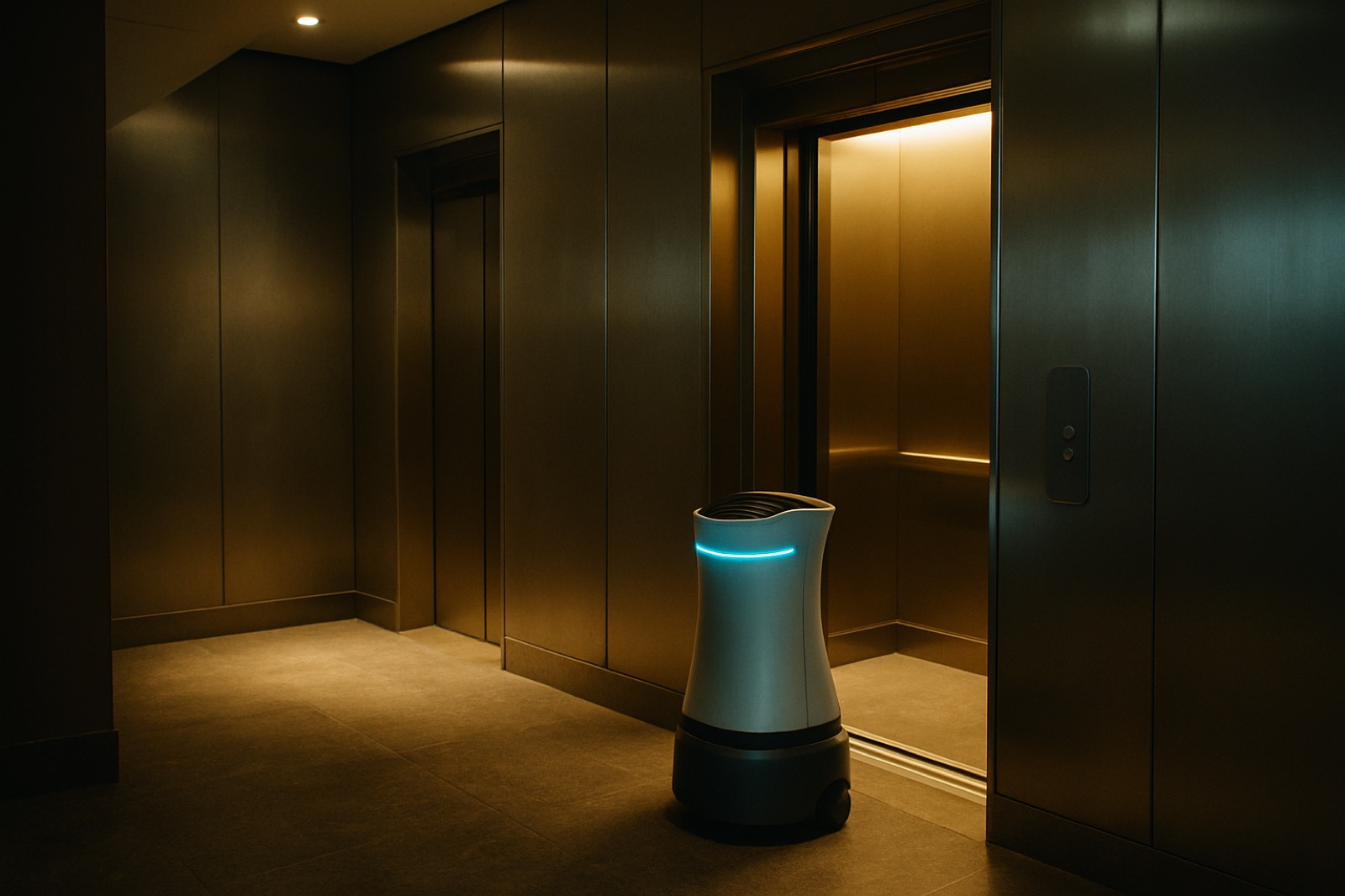
The BellaBot Pro lists at $16,000 purchase on RobotLAB. That number gets quoted in vendor conversations as if it settles the economics. It doesn't — it starts them.
For a 200-room urban hotel, the sticker price is roughly 20–40% of the 3-year total cost of ownership depending on your property's infrastructure. The rest is integration, maintenance, and the opportunity cost of underutilization. Getting the TCO wrong at the evaluation stage is how hotels end up with robots that the GM quietly stops mentioning.
This breakdown uses BellaBot pricing as the anchor because it's the only delivery robot in this class with publicly listed numbers as of 2025-2026. Other vendors — Bear Robotics, Keenon, Savioke — require custom quotes, but their cost structures follow the same line-item pattern.
The Full TCO Table — 200-Room Urban Hotel, 3-Year Horizon
Assumptions: single robot, multi-floor deployment, union-free property, 300-day active operation per year.
| Cost category | Year 1 | Year 2 | Year 3 | Notes |
|---|---|---|---|---|
| Robot purchase or lease | $16,000 | — | — | BellaBot Pro purchase (RobotLAB). RaaS alternative: $335–$2,430/mo — see below. |
| Elevator integration | $20,000–$80,000 | — | — | One-time. Industry estimate. See section below. |
| Wifi remediation | $2,000–$15,000 | — | — | Depends on dead zone severity. May be zero on a recently renovated property. |
| Initial staff training | $500–$2,000 | — | — | Vendor-led onsite. Some vendors include in first year of contract. |
| Annual service contract | $1,500–$3,000 | $1,500–$3,000 | $1,500–$3,000 | Typically 10–20% of purchase price annually. |
| Spare parts / consumables | $300–$800 | $500–$1,500 | $500–$1,500 | Wheels, cleaning sensors, trays. Increases with robot age. |
| Fleet management software | $0–$2,400 | $0–$2,400 | $0–$2,400 | Some vendors bundle it; some charge $100–$200/mo per unit. |
| Electricity | $100–$200 | $100–$200 | $100–$200 | Negligible. Rough estimate $0.30–$0.60/day at US average commercial rates. |
| Insurance rider | $200–$600 | $200–$600 | $200–$600 | Confirm with your property insurer. Most add a rider to existing commercial policy. |
| 3-year total (low) | $40,600 | $3,500 | $3,500 | $47,600 total |
| 3-year total (high) | $115,000 | $7,800 | $7,800 | $130,600 total |
These are estimates. The elevator integration range is the biggest variable — it alone can more than double your Year 1 cost.
The Elevator Integration Problem
Multi-floor delivery is the primary ROI case for hotel delivery robots. A robot that only operates on one floor has a narrow use case: in-room dining runners, maybe housekeeping supply staging. The full value — replacing the overnight staffer who walks every floor with amenity bags — requires elevator access.
KONE offers a developer API (KONE Open API) for its DX-class and newer elevators. The developer access is free, and the architecture is relatively well-documented at dev.kone.com. Building owners pay a monthly fee for live API access — the exact amount is not publicly disclosed, but it's designed to be accessible for commercial deployments.
The problem is not the API license. The problem is integration labor.
Connecting a robot's fleet management system to your specific elevator controller requires a system integrator who understands both the robot vendor's API and the elevator API, and who can test the full call-board-exit cycle reliably. At a hotel, "reliably" means the robot calls the elevator, boards when it arrives, selects the correct floor, exits before the doors close, and recovers gracefully from a passenger who boards mid-trip.
This is a one-time engineering project. Industry estimate for a custom single-property deployment: $20,000–$80,000, depending on elevator brand (KONE is easiest; Otis, Schindler, and Mitsubishi negotiate separately with system integrators), elevator age, number of elevator banks, and whether any middleware is required. Newer hotel renovations with modern controllers are toward the low end. A 1980s building with mixed elevator models is toward the high end.
If your elevator vendor is not KONE and you're evaluating a robot deployment, request a technical pre-assessment from the robot vendor before signing any contract. Some will do this as part of their sales process. If they won't, that's information.
Purchase vs RaaS: Which Wins at a 200-Room Hotel?
BellaBot pricing spans a wide range depending on model and contract:
- Purchase: ~$15,900–$16,499 (BellaBot/BellaBot Pro, RobotLAB)
- RaaS (Robot as a Service): $335–$2,430/month depending on contract length and configuration
The discrepancy between the $335/mo and $2,430/mo figures likely reflects contract length and what's included. A 36-month contract with service and software bundled comes out differently than a short-term arrangement. Always clarify what the monthly fee covers before comparing.
A rough break-even analysis:
| Scenario | 36-month total |
|---|---|
| Purchase ($16k) + service contract ($2k/yr) | ~$22,000 for robot alone |
| RaaS at $335/mo | ~$12,060 |
| RaaS at $1,000/mo (mid estimate, bundled) | ~$36,000 |
| RaaS at $2,430/mo | ~$87,480 |
At $335/mo, RaaS wins decisively over purchase for 3 years. At $1,000/mo, purchase wins if you can handle the upfront capital. At $2,430/mo, purchase wins by a wide margin — but that may reflect a shorter commitment with more service coverage.
The financial question is secondary to the operational one: RaaS gives you a lower exit cost if the deployment underperforms, because you can typically terminate at contract expiration without stranding a capital asset. For a first deployment where you're still validating the use case, that optionality is worth something.
Per-Delivery Cost Model
This is where most vendor pitch decks stop — "the robot costs X per month, divide by deliveries." The problem is that deliveries per month are not fixed. They're a function of utilization, and utilization varies enormously.
Baseline assumptions for a 200-room urban hotel:
- Average daily deliveries: 25 (mix of in-room dining, amenity requests, linen/sundry runs)
- Operating days per year: 300 (accounting for maintenance, low-occupancy closures)
- Annual deliveries: ~7,500
At a $16k purchase + $2k/yr service contract over 3 years:
| Utilization scenario | Daily deliveries | Annual deliveries | Per-delivery cost |
|---|---|---|---|
| Full utilization | 25 | 7,500 | $0.98 |
| Partial (one shift only) | 10 | 3,000 | $2.45 |
| Underutilized (mornings only) | 5 | 1,500 | $4.90 |
When you add a $50,000 elevator integration amortized over 5 years ($10k/yr), the numbers shift significantly:
| Utilization scenario | Per-delivery cost (with elevator integration) |
|---|---|
| Full utilization (25/day) | $2.31 |
| Partial (10/day) | $5.78 |
| Underutilized (5/day) | $11.57 |
A robot doing 5 deliveries a day costs roughly 5× per delivery compared to one doing 25. At $11.57 per delivery, you are not replacing a labor cost — you are adding one.
The utilization trap
Most hotel pilots underutilize because they only deploy the robot on one shift or in one scenario. The overnight shift is often the strongest case — few staff on floor, predictable volume, no guest traffic for the robot to navigate around. But it's also the last shift many GMs think to staff with a robot because "nights are already light."
Push the scenario: if your robot makes 8 deliveries from 10pm to 6am and nothing during the day, your daily count is 8. At that volume, the per-delivery cost is unlikely to beat a housekeeper moonlighting as a runner. The case only closes when the robot runs multiple shifts.
What a Realistic 200-Room Urban Hotel Looks Like
Mid-range scenario for planning purposes (not a forecast — conditions vary widely):
- Robot: BellaBot Pro, purchased at $16,000
- Elevator integration: $35,000 one-time (KONE property, single elevator bank)
- Wifi remediation: $5,000 (two dead zones in service corridor)
- Year 1 total: ~$58,500
- Year 2–3 annualized: ~$4,500/yr (service contract + parts + software)
- 3-year total: ~$67,500
At 25 deliveries/day, 300 days/year: 7,500 deliveries/year, 22,500 over 3 years. Per-delivery cost: ~$3.00.
A fully loaded delivery cost for a staff member (wages + benefits + payroll burden) running to a guest room at an urban hotel is typically in the range of $5–$12 per delivery depending on market wage rates, depending on how you account for split labor. At $3.00/delivery, the robot case is solid. At lower utilization, it doesn't close.
The math is not magic. It's a utilization problem.
What to Verify Before Signing
- Get the elevator brand and model number from your facilities team before you talk to any robot vendor. Confirm that vendor's integration path.
- Run a wifi heat-map. Get a remediation quote if needed. Include that in your TCO.
- Clarify exactly what the RaaS or service contract includes: software updates, on-site repair, replacement units during downtime, annual preventive maintenance.
- Ask the vendor: "What's the uptime guarantee? What happens if the robot is down for more than 48 hours?" Get the answer in the contract.
- Model your actual daily delivery volume for each shift separately. Don't use hotel-wide averages — be specific about which rooms, which requests, which time windows the robot will actually serve.
The robot that looks expensive at $16k sticker is often a reasonable investment with the right infrastructure. The robot that looks cheap at $335/mo can get very expensive if the integration costs weren't modeled. Do the full TCO before you sign anything.