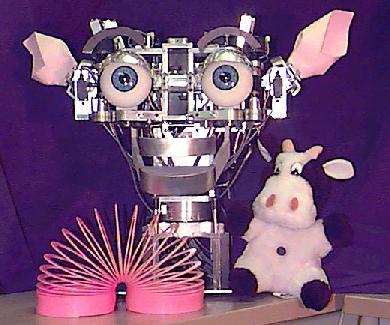
Overview
Kismet is an expressive robot head designed by Cynthia Breazeal at the MIT Media Lab that was one of the first robots able to demonstrate social and emotional interactions with humans. It had a cartoonish face, spoke with a squeaky baby voice, and could display a range of emotions including happiness, sadness, anger, calmness, surprise, disgust, tiredness, and sleep. The robot could perceive various social cues and was an early experiment in affective computing and social robotics.
Key facts
- Payload
- —
- Reach
- —
- Speed
- —
- Weight
- 7 kg
- IP rating
- —
- Battery
- —
- Power
- —
- Autonomy
- partially autonomous
- Launch year
- 1998
- Price
- $25,000
- Status
- active
Detailed specifications
Motion & kinematics1
- Dof Total
- 15
Sensors1
- Sensor Suite
- color CCD camera, facial sensors, auditory sensors
Compute1
- Onboard Compute
- Texas Instruments TMS320C40
Other18
- Height Mm
- 380
- Price Tier
- 20-40K
- Applications
- social interaction, human-robot interaction
- Sub Category
- anthropomorphic_torso
- Datasheet Url
- ai.mit.edu/projects/humanoid-robotics-group/kismet/kismet.html
- Mobility Type
- static
- Company Country
- US
- Deployment Notes
- Currently resides at the MIT Museum in Cambridge, Mass.
- Humanoid Subtype
- anthropomorphic_torso
- Country Of Origin
- USA
- Industries Served
- education, research
- Is Research Grade
- true
- Target Industries
- research_academic
- Availability Status
- research-only
- Deployment Maturity
- prototype
- Primary Applications
- research_development
- Additional Information
- - Engages in meaningful social exchanges with humans. - Learns communication skills through caregiver interactions. - Mimics infant behavior to regulate social interactions. - Capable of emotive facial expressions for better human interaction. - Utilizes a motivational system to maintain drives within homeostatic bounds. - Developed as part of the Cog Project at MIT.
- Deployment Environment
- indoor
Reviews for Kismet
Loading reviews…