Indoor vs Outdoor Delivery: Why the Cost Gap Is Larger Than It Looks
Hospitals and hotels are achieving consistent ROI from delivery robots. Sidewalk deployments are still working out the unit economics. The gap between them is instructive.
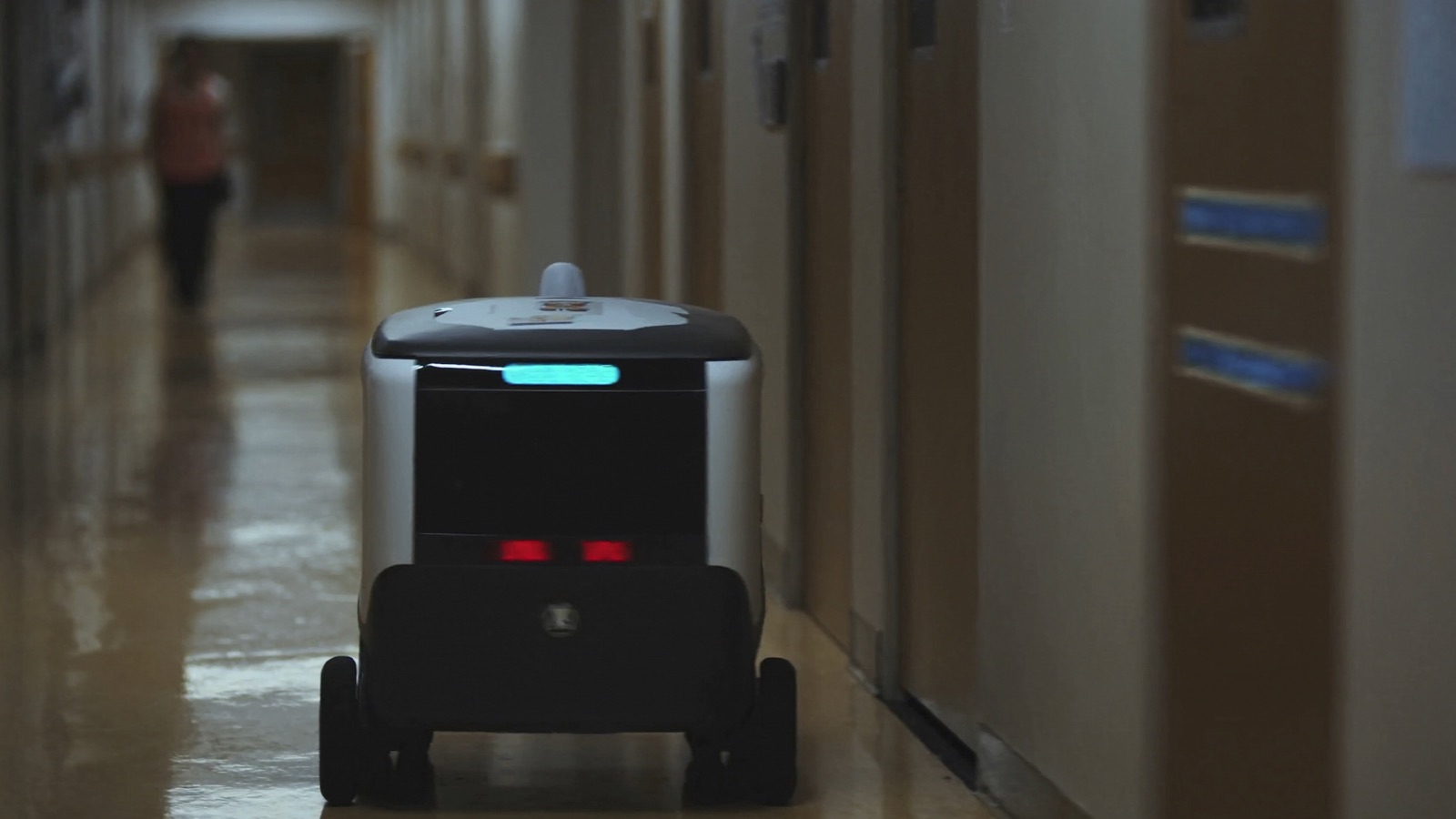
The clearest evidence that delivery robots can close the business case is not Starship on a college campus or Serve in a Dallas suburb. It's Aethon TUG robots in hospitals, where the company reports typical ROI timelines of 18 months, and where systems like the eight-robot fleet at Reading HealthPlex are running 50 half-mile round-trips daily delivering patient meals.
Relay Robotics (formerly Savioke) has completed over 1.5 million deliveries in hundreds of hotels. At Cedars-Sinai Medical Center, nurses were spending up to 30% of their shifts on supply runs before delivery robots took over those tasks. Upstate Medical University runs 14 TUG robots.
Meanwhile, sidewalk delivery operators are still arguing about whether the unit economics close at $1 per delivery.
The divergence is not about the technology — indoor and outdoor delivery robots share most of the same sensor, navigation, and compute stack. The divergence is structural: indoor environments have properties that make the deployment economics fundamentally easier, and outdoor city deployments lack almost all of them.
Understanding the gap tells you something useful regardless of which environment you're deploying into.
What Makes Indoor Delivery Easier
1. Bounded, Controlled Environments
A hospital is a closed environment. The floor plan doesn't change week to week. Obstacles are mostly predictable (carts, gurneys, people in scrubs moving with purpose). Access is controlled. The robot doesn't encounter a toddler darting out from behind a parked car or a delivery truck blocking a crosswalk.
This matters enormously for autonomy level. An indoor hospital robot can achieve high-autonomy operation — minimal human intervention — far earlier in its deployment than an outdoor robot operating on city blocks with unpredictable pedestrian and vehicle traffic. Lower intervention rate means lower supervision cost, and supervision cost is the biggest variable in the per-delivery cost model.
A hotel is similarly bounded: one building, known floor plan, controlled elevator access, limited external factors. The robot's operational environment is effectively fixed on day one of deployment.
Compare this to a sidewalk deployment where every city block is different, construction zones appear overnight, weather changes road conditions, and the robot encounters novel situations constantly. The outdoor operator is running a harder navigation problem and paying a supervision premium to cover for it.
2. Existing Infrastructure (Mostly)
Hospitals already have the connectivity infrastructure delivery robots need. A hospital's wifi network is mission-critical medical infrastructure — it is not the $200 Netgear router that kills a sidewalk robot demo in a restaurant kitchen. Coverage is engineered to handle reliability requirements, and the IT team knows how to maintain it.
Elevator integration — the critical feature for multi-floor delivery in both hospitals and hotels — is a solved problem in these environments. The elevators exist, they're on a service contract, and vendors like Relay and Aethon have integrated with enough hospital elevator systems that the engineering is no longer custom for every deployment. (Some elevator manufacturers have also opened developer APIs — KONE's DX-class elevators offer developer access for free — reducing the custom integration cost that was a barrier five years ago.)
Outdoor sidewalk deployment has no equivalent infrastructure advantage. The robot brings everything with it: connectivity (cellular data), its own maps (generated from scratch for each deployment zone), and its own charging infrastructure (which must be sited, permitted, and installed).
3. Predictable, Recurring Volume
A hospital floor has predictable delivery demand: medication rounds happen on a schedule, lab specimens are picked up on a schedule, meals are distributed at known times, supply rooms are restocked at known intervals. That predictability means the robot's utilization can be planned, not discovered — and it means the fleet size can be sized to demand rather than speculated.
A 14-robot fleet at a hospital serving 400-plus beds knows roughly how many deliveries it will make per day. That predictability is what makes an 18-month ROI projection credible: the numerator (savings) and denominator (deliveries) are both stable.
Outdoor sidewalk delivery demand varies with weather, day of week, restaurant hours, sports events, and any number of other factors. Utilization planning is harder, utilization variance is higher, and the ROI model consequently has more uncertainty.
4. A Clear Labor Substitution Case
The labor displacement case for indoor delivery robots in healthcare is unusually clear. Nurses spending 30% of their shifts on supply transport is a documented problem, and "supply runner" is a low-value task relative to the clinical work a nurse could be doing. A robot that takes over supply running frees clinical time — the ROI case is almost self-evident to a hospital CFO.
Hotel delivery has a similar structure: a robot that runs amenity requests (towels, toothbrush, extra pillows) to guest rooms during the overnight shift substitutes for waking a maintenance staffer or leaving guests waiting until morning. The labor substitution is not controversial.
Outdoor sidewalk delivery is substituting for a human courier — a role that is itself already cost-optimized through gig economy mechanisms. The human courier is already cheap. The substitution case requires the robot to beat a low cost bar, not an expensive one.
The Cost Comparison
The table below shows fully-loaded cost ranges for a single robot unit operating in each environment for one year. These are illustrative ranges based on market pricing — vendor pricing is not publicly disclosed for most of these categories.
| Cost component | Hospital (TUG-class) | Hotel (Relay-class) | Sidewalk outdoor |
|---|---|---|---|
| Hardware / lease (annual) | $25,000–$45,000 | $15,000–$30,000 | $2,000–$6,000 |
| Fleet management software | Included in lease | Included in lease | $1,200–$3,600 |
| Connectivity | Included (hospital wifi) | Included (hotel wifi) | $300–$500 (cellular) |
| Elevator integration (one-time) | $5,000–$30,000 | $2,000–$15,000 | N/A |
| Charging infrastructure | Included / proprietary | Included | $500–$2,000 |
| Supervision (annual labor) | Low (high autonomy) | Low (high autonomy) | $8,000–$25,000 |
| Insurance / liability | $1,000–$3,000 | $500–$2,000 | $600–$1,800 |
| Maintenance | Included in lease | Included in lease | 10–15% of hardware |
The outdoor robot looks cheap on hardware — $2,000–$6,000 vs. $25,000–$45,000 for a hospital system. But the supervision line is where that apparent savings disappears. A sidewalk robot in a city deployment with a 10:1 supervision ratio running two shifts adds $15,000–$25,000 per robot per year in human labor cost. A hospital TUG robot running with minimal supervision against a hospital wifi backbone doesn't have that line item.
The hospital robot costs more upfront. It costs less to operate. Over a 3-year period, the TCO gap often closes or reverses in the hospital's favor.
What Outdoor Operators Are Learning from Indoor
Several observations from the indoor deployment track that are being adopted — with difficulty — in outdoor:
Geofencing as a proxy for controlled environment: Outdoor operators who succeed are essentially creating artificial indoor conditions — bounded geographies (campuses, specific residential blocks, merchant-dense corridors) with predictable demand and controlled access points. The campus model is indoor logic applied outdoors.
Merchant integration as a proxy for predictable volume: Integrating with a small number of high-volume restaurant partners in a defined zone creates a demand profile more similar to a hospital's scheduled runs. The operators who treat outdoor delivery like a campus-dining model (fixed partners, fixed zone, scheduled hours) outperform those who open the platform to arbitrary merchant requests.
Tiered deployment: Starting in the most controlled outdoor environments (gated communities, college towns, suburban retail clusters) before moving into dense urban grids mirrors how indoor systems started at smaller hospitals before scaling to large academic medical centers.
The Right Question for Indoor Operators
If you're evaluating indoor delivery for a hospital or hotel, the question is not whether the economics work — there is sufficient evidence from deployed systems that they can. The questions are:
What is the ROI-positive use case for your specific volume? A 200-bed community hospital making 400 deliveries per day has a different calculus than a 1,200-bed academic medical center making 4,000 deliveries per day. The robot's fixed costs don't scale with you — so the floor on which the economics close varies with your facility's size and delivery volume.
What's the elevator integration cost at your property? If your facility has an elevator system that requires custom integration (older controllers, non-standard APIs), get that quote before you sign anything. The elevator integration cost is the most variable and least predictable line item in an indoor deployment.
Who manages the robot when something breaks? Indoor robots are physical infrastructure in a high-stakes environment. A broken TUG in a hospital hallway is not like a broken printer. What is the vendor's SLA for on-site response? Where is their nearest field engineer?
The next article addresses how to structure a pilot that answers these questions — for both indoor and outdoor deployments — within 90 days.