Cleaning robot TCO: hardware, consumables, and human-in-the-loop time
The purchase price is the smallest number in the total cost equation.
The number that appears in the initial vendor proposal — the hardware price — is typically the least important number in a cleaning robot deployment. Facilities managers who anchor on sticker price consistently underestimate total cost of ownership and then report that the economics "didn't work out" at the 18-month review. The economics didn't work out because the model was built on the wrong inputs.
Here is what a complete TCO model for an autonomous commercial floor scrubber actually looks like over a 36-month operating horizon.
The five cost buckets
1. Hardware acquisition
Purchase prices for commercial autonomous floor scrubbers vary by machine class:
| Machine class | Typical purchase range |
|---|---|
| Walk-behind autonomous scrubber (small commercial) | $15,000–$25,000 |
| Compact ride-on autonomous (mid-market) | $30,000–$50,000 |
| Large autonomous ride-on / industrial | $50,000–$75,000+ |
The Avidbots Neo sits at the upper end of the mid-market range. The Tennant T7AMR falls in the same band. Gausium and ICE Cobotics products cover a wider range depending on configuration.
For RaaS (Robot-as-a-Service) contracts — which are increasingly the preferred entry point for BSCs and mid-sized facilities — the published market range runs $600 to $900 per month per machine, inclusive of the machine, software license, and a base service tier. At $750/month over 36 months, the effective all-in hardware cost is $27,000 — without the capital outlay or the residual value risk.
RaaS makes sense when your facility needs flexibility: short-duration contracts, multi-site scaling, or the ability to swap machine models as the technology improves. It makes less sense when you expect to run the same machine in the same facility for five or more years, where purchase-and-depreciate math often wins.
2. Consumables
This is the most underestimated cost category in vendor proposals, and the one with the largest variance between facilities.
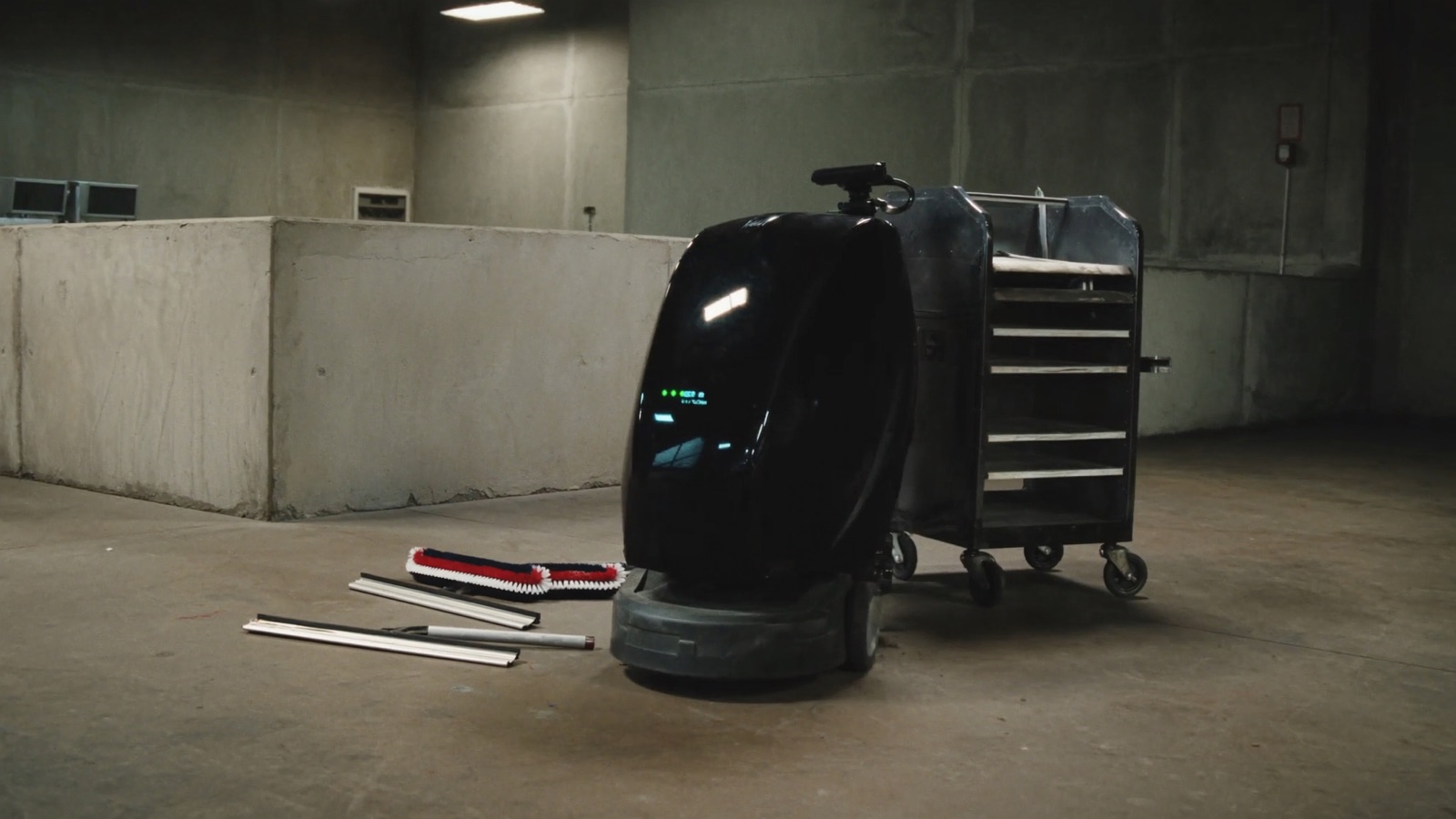
Brushes and pads. A standard commercial scrubber runs brush pads that require replacement on a schedule tied to square footage and floor abrasiveness. Hard concrete wears pads significantly faster than polished tile. Replacement brushes for a mid-size autonomous scrubber typically run $200 to $600 per set, with replacement intervals of 60 to 120 days under regular operation. Budget $1,000 to $3,000 annually per machine depending on floor type and cleaning frequency.
Squeegees. The rear squeegee assembly — which collects the dirty water the scrubber leaves behind — is a wear item that often gets ignored until it starts leaving moisture streaks. Replacement squeegees run $150 to $400 depending on the model. Expect 2 to 4 replacements per year under full utilization.
Cleaning solutions. Autonomous scrubbers use diluted cleaning concentrate, and the consumption rate is governed by the machine's solution delivery system. Many manufacturers include an eco-mode that reduces solution consumption significantly. Budget $800 to $2,000 annually per machine depending on cleaning frequency and solution concentration requirements.
Batteries. Lithium-ion batteries used in most current commercial autonomous scrubbers have a useful life of approximately 3 to 5 years under regular operation. Replacement battery pack costs vary by manufacturer but typically run $2,000 to $6,000. This cost should be amortized over the battery's useful life in a 36-month TCO model even if the replacement doesn't fall within the analysis window.
Water. This is often overlooked as a line item. Autonomous scrubbers use substantially less water than conventional machines — reported at up to 70 percent less — but they still consume water at meaningful scale in high-frequency deployments. At municipal water rates, this is rarely a dominant cost, but it belongs in the model for facilities with water surcharges or wastewater costs.
3. Service contracts and software
Virtually every commercial autonomous scrubber vendor packages the machine with a mandatory software subscription. The software is how the machine receives navigation updates, fleet management data, obstacle logs, and remote diagnostics. No software subscription means no autonomous operation.
Avidbots, for instance, offers a Gold Service Plan that packages software access with maintenance support. Industry-reported service plan costs for mid-market autonomous scrubbers run approximately $500 per month — $6,000 annually per machine.
Over 36 months, service contract costs often exceed the residual hardware value. When evaluating a purchase vs. RaaS decision, factor in whether the vendor's service contract is included in the RaaS rate (usually yes) or layered on top (a warning sign).
Key questions to ask about service contracts:
- What does the SLA cover, and what is the guaranteed response time for on-site service?
- Are software updates included, or billed separately?
- Does the contract include consumable replacement labor, or just parts?
- What happens to the software subscription at contract end — does the machine retain autonomous function, or is it effectively a manual scrubber without the cloud connection?
4. Human-in-the-loop time
This is the cost category that most vendor TCO models either omit entirely or dramatically understate.
Autonomous floor scrubbers are not fully unattended systems. They require a human operator who:
- Performs the pre-shift check (solution fill, battery level, brush inspection)
- Empties the recovery tank and refills the solution tank mid-shift (typically once per 2-hour cleaning window)
- Responds to obstacle-stop events and restarts the machine
- Conducts the post-shift check and machine washout
In a well-optimized deployment — one robot per supervisor — this adds up to 45 to 90 minutes of human time per machine per operating day. That is not zero. At a fully loaded labor cost of $22 to $28 per hour for a cleaning technician, you are looking at $18 to $42 of labor cost per machine per day that belongs in the TCO, not the savings column.
The economics improve significantly when one supervisor manages multiple machines simultaneously. At a 3:1 ratio (one supervisor, three machines), the per-machine human-in-the-loop cost drops to $6 to $14 per machine per day. This is the ratio that makes the ROI case.
The ratio you should demand from your vendor: "Show me a reference customer operating at 3:1 or better." If they can't, your labor model will be closer to 1:1, and the savings calculation changes materially.
5. Fleet management and integration overhead
Autonomous scrubbers that connect to a fleet management platform — reporting coverage area, cleaning time, obstacle stop frequency, solution consumption — require someone to read and act on that data. If no one is reviewing fleet reports, you have paid for instrumentation that produces no insight.
The time cost of fleet management is typically 1 to 2 hours per week per site, for a facilities manager or operations lead who reviews the dashboard, identifies coverage gaps, and adjusts cleaning routes accordingly. At a facilities manager's loaded labor rate, this is $30 to $60 per week — small but non-zero, and worth including for honest accounting.
A 36-month TCO model (single machine, mid-market)
This is illustrative, not a quote. Use it as a structure and plug in your actual vendor proposals and facility specifics.
| Cost category | Year 1 | Year 2 | Year 3 | 36-month total |
|---|---|---|---|---|
| Hardware (purchase, amortized) | $15,000 | $15,000 | $15,000 | $45,000 |
| Service contract / software | $6,000 | $6,000 | $6,000 | $18,000 |
| Consumables (brushes, pads, squeegees, solution) | $4,000 | $4,000 | $4,000 | $12,000 |
| Battery reserve (amortized) | $1,000 | $1,000 | $1,000 | $3,000 |
| Human-in-the-loop labor (at 3:1 ratio) | $2,500 | $2,500 | $2,500 | $7,500 |
| Fleet management overhead | $1,500 | $1,500 | $1,500 | $4,500 |
| Total cost | $30,000 | $30,000 | $30,000 | $90,000 |
Against this, the savings from labor reallocation — at 2.5 hours per machine per day, 250 operating days per year, at $25/hour loaded cost — is approximately $15,625 per year, or $46,875 over 36 months.
At these numbers, the machine does not pay for itself over 36 months at a single-machine, 3:1 supervision ratio. The break-even extends beyond the analysis window.
The economics improve materially in two scenarios:
Higher utilization. A machine running 300+ days per year, two cleaning cycles per day, at a higher supervision ratio (4:1 or 5:1) closes the gap significantly.
Multi-machine fleet. Fixed costs — fleet management overhead, the supervisor's labor — spread across three or four machines rather than one. The per-machine economics improve by 30 to 40 percent in a four-machine fleet vs. a single-machine deployment.
What vendors don't model
Three costs consistently appear in post-deployment reviews that did not appear in vendor-provided TCO proposals:
Facility mapping refresh. When a facility undergoes a significant layout change — a retail reset, a warehouse reorganization, a construction project that temporarily alters floor access — the machine's cleaning map must be rebuilt. This requires a new training run and typically involves a vendor technician. The time and cost of map refreshes are rarely included in initial proposals.
Incremental IT infrastructure. WiFi coverage adequate for mobile devices is often inadequate for autonomous robots, which maintain persistent cloud connections throughout operation. If your facility requires additional access points or network hardware to support the fleet, that cost belongs in the TCO.
First-year productivity ramp. Autonomous scrubbers do not perform at rated efficiency immediately. Staff familiarity with the machine, cleaning route optimization, and obstacle management all improve over the first 90 to 120 days. A realistic TCO model discounts Year 1 savings by 20 to 30 percent to account for the ramp period.
The TCO question to ask every vendor
Before finalizing any proposal, ask for a reference customer at a similar facility — similar square footage, similar cleaning frequency, similar floor type — who has been operating for at least 18 months. Ask that customer directly, not through the vendor: "What did you spend, all-in, in Year 1? What did you actually save?"
The gap between the vendor's TCO model and the operator's actual experience is the most reliable signal you will get about whether the economics are real for your facility.
Next in this series: the deployment math — square footage, surface mix, and the obstacle density problem.