Per-Delivery Cost Economics: Hardware, Supervisors, and Charging
The math behind the <$1 promise — and what you actually pay before you get there.
The number that every sidewalk delivery vendor leads with is some version of "under $1 per delivery at scale." Serve Robotics has said it publicly. ARK Invest published an analysis projecting grocery delivery costs collapsing to $0.40 per trip. Bank analysts in early 2026 called $1 per order feasible in the near term.
That number is not wrong. It is also not a useful input for your budget model today.
The $1 per delivery figure is a projection based on full fleet autonomy (minimal human supervision), high utilization (30+ deliveries per robot per day), and amortized hardware costs spread across a large fleet. Most deployments in 2026 are hitting none of those three assumptions simultaneously. If you're evaluating delivery robots for a 90-day pilot, you need to model what you'll actually pay — and build a separate projection for what the economics look like at scale if everything goes right.
This is how to build both.
Cost Component 1: Hardware
Current sidewalk delivery robots cost between $3,000 and $8,000 per unit to purchase, depending on platform. That range reflects the state of the industry: sensors (LiDAR, cameras, ultrasonic), compute modules, and drive systems are still industrial-grade and priced accordingly.
Hardware cost is declining. New system-on-chip platforms with integrated neural processing units capable of 6+ TOPS of inference now cost under $100 in small quantities — the same inference budget that previously required thousands of dollars in industrial compute. The next generation of robots being developed in 2025–2026 reflects this: the hardware cost structure is expected to collapse materially over a 3-to-5-year horizon.
For your model today, use the purchase price (or amortize it over the vendor's stated hardware life, typically 3–5 years) plus an annual maintenance contract of 10–15% of purchase price. If the vendor sells hardware-as-a-service (HaaS) or robot-as-a-service (RaaS), get the equivalent monthly fee and annualize it — then compare it to ownership cost before committing.
Hardware cost per delivery (illustrative)
| Scenario | Robot price | Useful life | Annual hardware cost | Daily deliveries | Annual deliveries | Hardware $/delivery |
|---|---|---|---|---|---|---|
| Low utilization | $5,000 | 4 years | $1,450 | 10 | 3,650 | $0.40 |
| Target utilization | $5,000 | 4 years | $1,450 | 25 | 9,125 | $0.16 |
| High utilization | $5,000 | 4 years | $1,450 | 40 | 14,600 | $0.10 |
Hardware cost per delivery is nearly irrelevant at high utilization. It's the biggest cost driver at low utilization — which is where most city deployments start.
Cost Component 2: Human Supervision
This is the component that most vendor presentations understate or elide entirely, and it is the most important variable in your cost model.
Every sidewalk delivery robot operating today requires human oversight. The business question is: how much?
Three tiers in the 2026 market:
Full teleoperation (Tier 1): A human operator controls the robot's movements in real time for 100% of its journey. This was Coco's original model. It is the most reliable and the most expensive — equivalent to one offshore operator per robot per shift, at labor costs that vary by country of operation. It adds $4–8 per delivery depending on labor market. This tier is largely transitional; no operator is building a scaled business on full teleoperation.
Semi-autonomous with human escalation (Tier 2): The robot navigates autonomously for 80–95% of its journey. Humans intervene for edge cases: unexpected obstacles, intersection navigation in high-traffic conditions, accessibility incidents. Supervision ratios in this tier run approximately 10–30 robots per supervisor — a wide range that depends on deployment environment complexity. At 10:1, supervision adds $1.50–$2.50 per delivery. At 30:1, it adds $0.50–$0.80.
High autonomy with monitoring (Tier 3): The robot navigates autonomously with a monitoring dashboard for exception alerts. Human intervention is rare. Starship's campus deployments operate closer to this model. Supervision cost approaches $0.10–$0.30 per delivery. This tier is achievable in bounded, well-mapped environments with low traffic variability — campus dining districts are the archetype. City blocks are not there yet for most operators.
What to ask the vendor
"What is the supervision ratio assumed in your per-delivery cost projection?" If they say "3:1 during onboarding, 20:1 at steady state" — ask what their highest steady-state ratio achieved in a live city deployment is. If they've never achieved 20:1 outside a campus, that number is an assumption, not a data point.
Cost Component 3: Charging Infrastructure
Charging stations are not free, and they are not always trivial to permit.
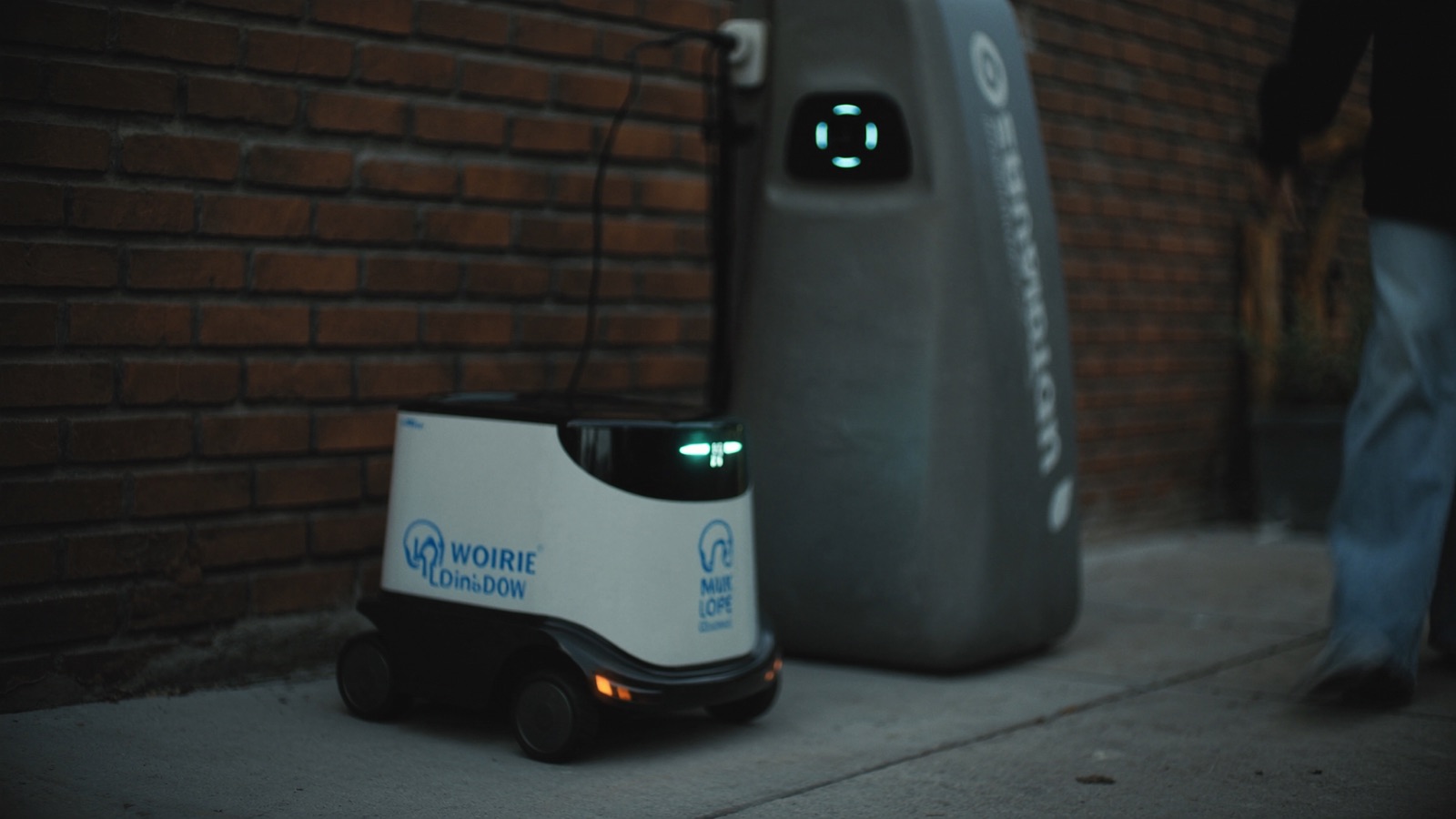
Most sidewalk delivery robots use proprietary charging docks. A basic dock runs $500–$2,000 in hardware cost, plus installation (electrical work, physical mounting, potential sidewalk permit). For a pilot deployment with 3–5 robots running a defined zone, you typically need 1–2 charging stations located within the zone to maintain continuous operations.
The bigger cost is operational: when a robot is charging, it is not delivering. A robot that charges for 2 hours mid-shift is a robot that misses the lunch or dinner peak. Your utilization model needs to account for charging cycles, not just operational hours.
In dense urban environments, charging station placement requires negotiation with merchants (back-of-house power access), property owners (sidewalk or curb zone), and sometimes city permitting. Plan for 4–8 weeks of lead time for charging infrastructure in a new city deployment. In geographies with contested sidewalk real estate — New York, San Francisco — plan for longer.
Cost Component 4: Connectivity and Fleet Management Software
Robots need reliable cellular or wifi connectivity to operate autonomously and send telemetry data. In outdoor sidewalk deployments, 4G/5G connectivity is the standard approach — which means a monthly connectivity cost per robot, typically $15–$40 per unit per month depending on data plan and carrier.
Fleet management software is almost always bundled into the vendor's RaaS or service contract. If you're evaluating a hardware-only purchase, ask for the fleet management SaaS cost separately — it typically runs $100–$300 per robot per month.
Cost Component 5: Insurance and Liability
Sidewalk delivery robots are third-party property and personal injury risk. They operate in public space, interact with pedestrians, and can cause harm if they malfunction. Insurance is not optional, and it is not cheap.
Operators report commercial general liability premiums in the range of $500–$1,500 per robot per year for sidewalk deployments, depending on carrier, geography, and the vendor's safety track record. This number is expected to decline as the industry matures and actuarial data accumulates — but in 2026, insurance is priced at "new risk category" rates.
If you're running a trial through a vendor platform (rather than owning the hardware yourself), ask specifically: who carries the liability? The vendor or the operator? What's the deductible? What incidents does the policy exclude? These questions are not negotiating theater — they matter for your risk exposure.
Putting It Together: Full Cost Model
Here is a model for a 5-robot pilot deployment in a medium-density city corridor, running 8 hours per day, 6 days per week.
| Cost component | Monthly cost | Per-delivery cost (15 del/robot/day) |
|---|---|---|
| Hardware (amortized, $5K robot, 4-year life) | $520 | $0.23 |
| Supervision (15:1 ratio, $18/hr supervisor) | $1,200 | $0.53 |
| Connectivity ($25/robot/month) | $125 | $0.06 |
| Fleet management software ($150/robot/month) | $750 | $0.33 |
| Insurance ($80/robot/month) | $400 | $0.18 |
| Maintenance (10% of hardware, annualized) | $208 | $0.09 |
| Charging infrastructure (amortized) | $100 | $0.04 |
| Total | $3,303 | $1.46 |
At 15 deliveries per robot per day, the true fully-loaded cost is approximately $1.46 per delivery. At 25 deliveries per robot per day, that drops to approximately $0.88. At 30+ deliveries, you approach the $0.70 range.
The $1 target is achievable. But it requires 25+ deliveries per robot per day at a supervision ratio above 15:1 — a combination most city deployments have not yet sustained.
The Comparison That Actually Matters
The relevant comparison is not "delivery robot vs. $0" — it's "delivery robot vs. your current last-mile cost."
If your current model is third-party courier delivery at $8–10 per order and you can get robot delivery to $2–3 per order in a pilot — even without reaching the theoretical minimum — you have a compelling case for the locations where robots work. The question is whether those locations represent enough of your volume to matter.
A useful discipline: before running your pilot, pull your current per-delivery cost for the specific zone and time windows where robots would operate. Don't compare robots to your blended fleet average; compare them to the specific delivery segment they'd replace. That's the number that determines whether the pilot is worth running at scale.
The next article in this series covers the regulatory landscape — because the per-delivery economics only matter in cities where you can actually deploy.