Why Sidewalk Delivery Robots Are Still Mostly a Pilot Story
The technology works. The business model is harder than it looks.
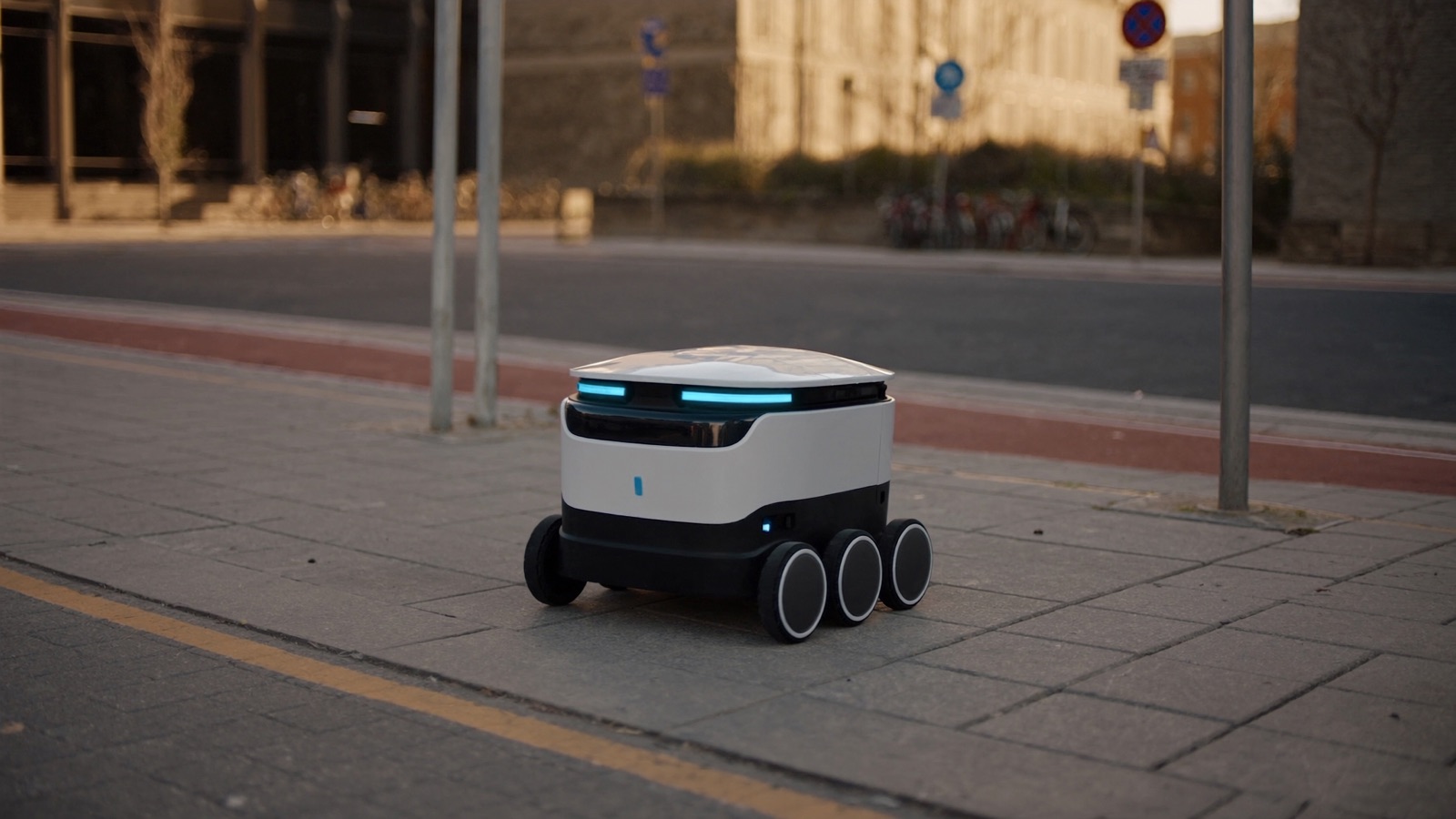
In October 2025, Starship Technologies closed a $50 million Series C, bringing its total funding past $280 million. The company has more than 2,700 robots running across 270-plus locations in seven countries, has completed over nine million deliveries, and holds a 97% approval rating among students on the 65 U.S. campuses where it operates.
That is a company with a working product and proven demand.
It is also a company that announced its U.S. city expansion — beyond campuses — as a 2027 target.
That gap between "working product" and "scaled city deployment" is the defining tension of sidewalk delivery robotics in 2026. The technology clears the bar. The business model around it remains fragile in ways that are not visible from a vendor demo or a press release. If you're evaluating sidewalk delivery for your operation — whether you're a restaurant group, a last-mile logistics provider, or a retailer exploring on-demand fulfillment — understanding exactly where that fragility lives is more useful than another overview of the market size.
Here are six structural tensions that explain why this category is still mostly a pilot story.
1. The Unit Economics Only Work at Volume You Can't Yet Guarantee
The case for sidewalk delivery robots is fundamentally a cost arbitrage argument: replace an $8–10 per-order human courier trip with a robot that costs $5–7 per delivery today and under $1 at scale. That math is real — the variable cost per trip does collapse as fixed hardware and operational costs spread across more deliveries.
The problem is the denominator.
A robot doing 8 deliveries a day in a dense residential corridor is a very different asset than a robot doing 30 deliveries a day in a campus dining district. The hardware cost doesn't change. The fleet management overhead barely changes. The insurance and permitting fees don't change. But the per-delivery cost changes dramatically — and in most city deployments, robots are not yet getting the utilization density that makes the math work.
Starship's campus model is the clearest proof of concept because campuses solve the utilization problem by construction: bounded geography, captive user base, predictable demand patterns, centralized restaurant partners. When you take the same robot into a city grid, you lose all three of those advantages and have to reconstruct them through geography selection, merchant aggregation, and demand shaping — none of which is easy.
Serve Robotics' 2025 Dallas-Fort Worth launch covered 22,000 households via Uber Eats. That sounds like scale, but 22,000 households spread across a suburban DFW geography is a very different density picture from a campus quad. The cost per delivery in that deployment has not been publicly disclosed, and you should be skeptical of any operator who projects "sub-$1 per delivery" without specifying the utilization rate assumption behind it.
2. Supervision Costs Are Still Being Figured Out
Every sidewalk delivery robot on the market in 2026 requires some level of human supervision. The question is: how much?
Coco Robotics built its early business on full teleop — a human operator controlling 100% of the robot's movements in real time. That is expensive (roughly equivalent to an offshore gig worker per robot), but it is also extremely reliable: a human is making every navigation decision. Coco has been shifting toward semi-autonomous operation as its AI stack matures, but the transition is ongoing.
Serve Robotics operates semi-autonomously with human fallback teleop for edge cases. Starship's campus deployments run with remote monitoring rather than real-time control. But neither company publishes supervision ratios, which makes independent cost modeling difficult.
The industry rule of thumb circulating in 2025 was roughly one supervisor per 10–30 robots, depending on autonomy level and deployment environment. That is a wide range. At the low end, 30 robots per supervisor makes economic sense. At the high end, 10 robots per supervisor adds $3–5 per delivery in labor cost that the unit economics math typically ignores.
When a vendor presents you with a cost-per-delivery projection, ask them specifically: what supervision ratio is assumed in that number? What happens to the per-delivery cost if local regulations require a higher ratio?
3. Regulation Is a Patchwork That Can Change Under You
Sidewalk delivery robots are legal in a growing number of U.S. states — Pennsylvania, Virginia, Idaho, Florida, and Wisconsin have all passed enabling legislation. But state authorization does not mean city authorization, and the gap between those two levels of government is where most operator risk lives.
San Francisco requires permits for each sidewalk deployment zone. Pittsburgh paused Starship's campus operations after a single wheelchair user tweeted that a robot had partially blocked a curb ramp; the program resumed only after a software fix. Chicago has generated meaningful community friction around Coco deployments. Toronto has seen similar regulatory resistance.
The pattern that is emerging: robots that look like a novelty attract positive press. Robots that start to look like infrastructure attract regulatory scrutiny. The transition from the first state to the second is non-linear and often triggered by a single incident — a robot blocking an accessibility ramp, a collision with a pedestrian, a school zone complaint — rather than by any sustained pattern of harm.
For a fleet operator or a retailer considering sidewalk delivery, this means your regulatory status can change between the day you sign a vendor contract and the day the robots deploy. It also means that cities with disability-advocacy communities, narrow sidewalks, or active neighborhood political cultures carry substantially more regulatory risk than the enabling state legislation would suggest.
ADA compliance is the primary liability trigger in the U.S. market. Any robot that operates on a sidewalk must reliably yield to wheelchair users, not block curb ramps, and navigate around accessibility infrastructure without intervention. Vendors will tell you their obstacle avoidance handles this. Ask them for their incident log from real deployments — not test environments — before you believe it.
4. The Geofenced Merchant Problem
A sidewalk delivery robot without merchant partners is hardware. The density of merchants willing to integrate with a given platform determines whether the robot can generate enough delivery volume to matter.
This creates a chicken-and-egg problem that every sidewalk delivery operator is managing differently:
- Starship solved it on campuses by going directly to university dining services, which operate a small number of locations with very high captive demand.
- Serve and Coco in cities solved it by plugging into existing delivery aggregators (Uber Eats, DoorDash) — which gives them access to existing merchant relationships at the cost of platform dependency and margin sharing.
- Cartken has partnered with Uber Eats in Miami, running a similar aggregator-integrated model.
The aggregator model is logical but introduces a structural risk: if the platform changes its merchant terms, geographic focus, or algorithm in ways that reduce delivery volume to your robot zones, your utilization drops and your per-delivery cost rises — without any corresponding change in your robot hardware costs.
For a retailer or restaurant group evaluating sidewalk delivery for their own operation, the merchant aggregation problem looks different: you control your own order flow, so you can project volume more reliably. But you also lose the cross-merchant density that helps a robot make 30 deliveries a day instead of 8. Whether your order density alone can justify a dedicated robot deployment depends on your specific geography and order volume — and most operators overestimate both.
5. The Battery and Recharging Infrastructure Gap
Sidewalk delivery robots are battery-powered, and battery range limits per-shift deployment range. Most current-generation robots operate for 4–8 hours on a full charge, which sounds generous until you map out charging logistics for a dense urban deployment.
Charging infrastructure for sidewalk robots is not standardized. Unlike EV charging (which has rapidly standardized around a small number of connector formats), sidewalk robots from different vendors use proprietary charging stations that require physical real estate — a sidewalk cutout, a merchant back-of-house space, or a dedicated curb zone. In cities where sidewalk real estate is contested between pedestrians, cyclists, outdoor dining, and delivery staging, finding compliant locations for charging stations is a genuine constraint.
The implication for ops leaders: when a vendor quotes you a coverage area for their sidewalk deployment, ask what the charging station plan looks like. How many stations? Where are they permitted? What's the recharging time and how does it affect fleet utilization during peak delivery windows?
6. Public Acceptance Is Not Stable
Sidewalk delivery robots started with a novelty advantage — people found them charming, shared videos, gave them names. The Urban Robotics Foundation's research documents how that acceptance has shifted as robots scale past the novelty phase. Robots that look like a science project get street credit. Robots that look like a logistics operation attract resentment.
This shift is not hypothetical — it is already visible in cities where robot density has increased. The complaints are not that the robots break down (though they do) or block sidewalks (though they sometimes do). The complaints are that the sidewalk is being privatized for commercial use, that gig workers are being displaced by hardware, and that the public infrastructure of the sidewalk is being used to subsidize a private delivery business.
Those are legitimate policy arguments, and they are increasingly being heard by city councils. An operator building a sidewalk delivery program in 2026 needs to have a community engagement plan that goes beyond "our robots are cute." The operators who survive the public acceptance transition are the ones who treat the sidewalk as shared infrastructure, not a free logistics lane.
What This Means for Your Evaluation
The case for sidewalk delivery robots is real but conditional. The technology is proven. The unit economics close at sufficient volume and autonomy level. The regulatory environment is permissive in a growing number of jurisdictions.
What is not resolved is whether you can get to sufficient volume, sufficient autonomy, and permissive regulation simultaneously in your specific geography, with your specific merchant mix, at a cost structure that beats your current last-mile model.
The articles in this series work through each of those conditions in detail:
- Per-delivery cost economics — what the full TCO looks like when you include hardware, supervision, charging, and maintenance
- Regulatory landscape — which cities allow what in 2026, and how to assess jurisdictional risk
- Indoor vs outdoor delivery — why the cost gap between hospital/hotel indoor delivery and sidewalk outdoor delivery is larger than it looks
- 90-day pilot playbook — how to structure a delivery robot pilot that produces a decision, not an extension
- Vendor selection — the questions about insurance, telemetry, and fallback procedures that most RFPs miss
Start with the economics. The math either works for your operation or it doesn't, and finding out early is cheaper than finding out after you've signed a contract.