Why exoskeleton pilots fail to stick
What warehouse and clinic programs get wrong — and how to run one workers actually wear
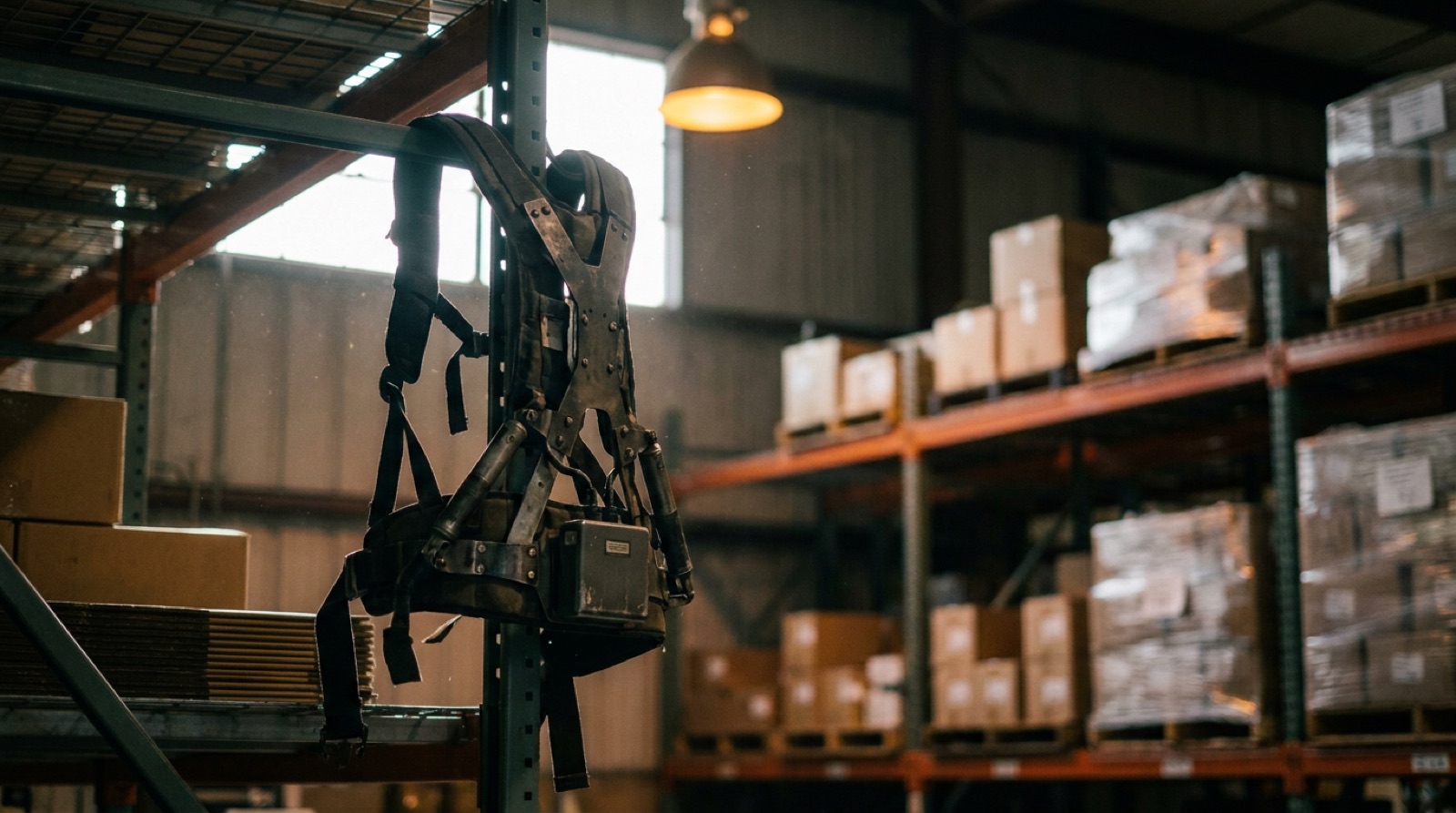
The shelf is where most programs end
A mid-size fulfillment center in the Midwest bought eight back-support exoskeletons after a spike in musculoskeletal disorder (MSD) claims in its pick-and-pack line. The devices were powered, priced at roughly $40,000 total, and delivered with a half-day onboarding session. Ninety days later, six were in a cabinet. Workers said the straps dug into their hips during the lateral reach moves the job actually required. Two workers with wider torsos never found a comfortable fit. One complained it slowed her down on the fast-conveyor section.
Across town, a physical rehabilitation clinic purchased two lower-limb gait-training exoskeletons for stroke recovery patients. Within a year, utilization had dropped to two sessions per week per device — well below the break-even threshold for a device that cost over $100,000 per unit. The barrier was not clinical; it was logistical. Donning and doffing took 20 minutes per patient, and the clinic's 45-minute session slots left almost no therapeutic time.
Neither program was a technology failure. Both were program design failures. The devices worked as designed. The programs around them did not.
Why programs fail before they launch
Most exoskeleton pilots are purchased on the strength of a vendor demo and an injury-reduction aspiration. The failure modes appear before a worker ever puts one on.
Task mismatch
Exoskeletons are highly task-specific. A passive lumbar support device (one with no motor, like a spring-tension back-assist) that works well for static forward-bending tasks — manual palletizing, order picking at waist height — will resist lateral flexion and rotation. If your highest-MSD job involves reaching across a conveyor or twisting to place items, a lumbar device may actively impede the movement pattern and increase fatigue rather than reduce it.
The most common mismatch pattern in industrial settings: buying a lumbar device for an overhead or shoulder-intensive job (auto assembly, overhead welding, overhead picking above shoulder height). Shoulder and overhead tasks require a shoulder-unloading or arm-support exoskeleton — different device architecture entirely. Article 4 in this series covers the passive/powered and body-region decision in full.
In clinical settings, the mismatch is often between device capability and patient population. A powered gait-training exoskeleton designed for post-stroke hemiplegia rehabilitation has different hip-width adjustment ranges, weight limits, and session protocols than a device designed for spinal cord injury patients. Purchasing one device for a heterogeneous patient population often means it fits — and works safely — for a fraction of the patients you expected.
Fit failure
Exoskeletons are worn equipment. Fit is not a minor comfort issue; it is a safety and efficacy issue.
Most industrial exoskeletons adjust along one or two torso dimensions. If your workforce has significant variation in height, torso length, hip width, or body mass index, a single device model may not fit everyone in the task group. Devices that do not fit correctly transfer load incorrectly — potentially increasing lumbar compression rather than reducing it, or placing pressure on nerve sites.
Fit failure is the leading cause of early abandonment in industrial programs. Workers who feel discomfort within the first week do not come back to the device. And because exoskeleton fit issues are not always immediately painful — the discomfort may build over a shift — workers often cannot articulate "bad fit" as the cause. They say "it's awkward" or "it slows me down."
Fit assessment is a clinical and ergonomics skill, not a logistics task. Programs that rely on workers self-fitting from an instruction sheet have much higher abandonment rates than programs where a trained ergonomist does a baseline fitting and follow-up check within the first two weeks.
Adoption debt
Adoption debt accumulates when a program launches without genuine worker involvement in the selection process. Workers who did not participate in device selection, who feel the program was imposed as a productivity monitoring initiative, or who work in a culture where wearing assistive equipment is seen as a weakness, will not wear the devices.
EHS managers sometimes discover this only after purchase. The workers who feel the program was designed for them — because they were consulted, because it directly addresses their highest-strain tasks, because they understand the WC and MSD injury data — have meaningfully higher wear rates.
There is also a simpler form of adoption debt: task friction. If putting on an exoskeleton requires a key, takes more than three minutes, has donning steps that require a second person, or is difficult to remove quickly when a worker needs to use a restroom or switch to a different task, compliance drops. Adoption is elastic — small friction has large effects.
The framework for a program workers actually wear
Getting to durable adoption requires answering four questions before procurement.
1. What is the actual injury mechanism in this task?
Pull your OSHA 300 logs and workers' comp claims for the last three years. Identify the specific body region and movement pattern driving MSD claims. "Lower back" is not specific enough — is it compressive load during static bending, lateral reach, or lift-and-twist? Is it fatigue-based (end-of-shift incidence) or acute (early in shift)? The answer determines whether a passive or powered device is appropriate, and which body region to address.
If your MSD claims are diffuse across body regions, an exoskeleton program is probably not your highest-leverage intervention. Address workstation ergonomics and task rotation first.
2. Does this task have a device fit?
Before shortlisting vendors, document:
- Task duration (continuous hours per shift in the high-strain posture)
- Required range of motion (does the task need full lumbar flexion, lateral bend, rotation?)
- Required mobility (does the worker need to run, climb, kneel?)
- Workforce anthropometrics (height/weight distribution of the task group)
- Hygiene constraints (shared equipment, food-safe environment, heat exposure)
Take this list into vendor conversations. Ask them to show you the device performing the specific movement, not a curated demo movement.
3. Have the workers been consulted?
Hold a pre-pilot session with workers in the affected job role. Show them devices. Let them handle one. Ask what they find uncomfortable or inconvenient before you commit to a purchase. Workers will surface fit and friction issues that a vendor demo will not show you.
Commit to acting on what you hear. If workers identify a concern and you purchase the device anyway without addressing it, you will lose credibility for every future pilot.
4. What does the measurement protocol look like?
Define success metrics before launch. Typical industrial metrics:
| Metric | Measurement approach |
|---|---|
| Device wear rate | Badge or device log data (minimum target: 80% of eligible shifts) |
| Subjective strain rating | End-of-shift survey (Borg scale or NRS) at baseline and 30/60/90 days |
| Productivity throughput | Output units per hour at task, isolated to exo users vs. control period |
| Incident rate | OSHA recordable MSD incidents in task group, rolling 12 months |
For clinical programs, outcomes measurement is typically structured by the clinical protocol associated with the device (functional gait assessments, 10-Meter Walk Test, ASIA impairment classifications). Work with your device vendor and clinical team to establish the baseline and measurement schedule before the first patient session.
What a 90-day pilot that works looks like
The programs that transition from pilot to permanent have a common structure:
Weeks 1–2: Ergonomist-led baseline. Document current strain levels using standardized assessment (REBA, RULA, NIOSH Lift Equation as applicable). Identify the three to five specific jobs or tasks to include in the pilot. Do not try to include the whole workforce.
Week 3: Fit and training. All pilot workers individually fitted by trained personnel. Donning/doffing practiced until under three minutes. Written quick-reference guide posted at the workstation. Named point of contact for fit questions.
Weeks 4–8: Active wear period with bi-weekly check-ins. Short surveys at shift end. Fit adjustments as needed. Track wear rate from day one.
Weeks 9–12: Data review. Compare wear rate, strain ratings, and throughput against baseline. Make a go/no-go recommendation backed by the data. If the pilot is not hitting 80% wear rate, diagnose why before scaling.
Article 5 in this series covers the full 90-day industrial deployment playbook in step-by-step detail.
The one thing that determines whether devices come off the shelf
Worker adoption is not a communication problem you can solve with a poster. It is a design problem you solve before purchase, by involving workers, matching the device to the actual task, and building a fit program that treats sizing as a first-class operational concern — not an afterthought.
Programs that skip that work will put devices on a shelf. Programs that do the work will find that workers ask for the device when they forget it at their station.
Next in this series: The real cost and payback of an industrial exoskeleton program — a full TCO breakdown and injury-reduction payback model for EHS and operations managers.
Discussion
0 commentsNo comments yet. Sign in to be the first.