Safety Zones, Scanners, and Fencing: The Integration Cost Most Buyers Underestimate
ISO 10218-2:2025 demands a documented risk assessment for every cell. Budget the compliance work before the hardware PO.
A food manufacturer in the UK installed a palletizing arm to handle 25 kg bags at the end of a packing line. The cell passed its initial commissioning. Six months later, a Health and Safety Executive inspection found that the risk assessment documentation was insufficient under EN ISO 10218-2, the scanner zone geometry hadn't been validated against the arm's worst-case stopping distance at maximum speed, and the emergency stop circuit had not been independently verified by a competent person. The cell was taken out of production while the documentation and validation were completed. Total downtime: eleven days.
The arm cost £62,000. The safety remediation — consultant time, additional validation hardware, scanner reconfiguration, documentation — cost £28,000. None of this was in the original project budget, because safety compliance had been treated as the integrator's problem rather than a shared budget item.
It remains the integrator's engineering responsibility. It is not free, and it cannot be priced after the fact.
What ISO 10218-2:2025 Actually Requires
ISO 10218 is the international safety standard for industrial robots. Part 1 covers the robot itself (published in 2025 revision); Part 2 covers robot systems and integration — meaning the complete installed cell, including its safeguarding, operating modes, and interfaces with other equipment.
The 2025 revision of ISO 10218-2 introduced several changes relevant to buyers evaluating new installations:
Risk assessment is mandatory and documented. The integrator must perform a formal risk assessment of the complete robot cell before it is placed into service. The assessment must follow the hierarchy in ISO 12100 (hazard identification → risk estimation → risk reduction). An undocumented risk assessment does not satisfy the standard.
Safeguarded space is now explicitly flexible. The 2025 revision introduced the concept of a "safeguarded space" that can change dynamically — for example, shrinking the protection zone when the arm is operating in a slow collaborative mode and expanding it at full production speed. This enables scanner-based approaches that weren't cleanly covered in the 2011 version.
Stopping time and distance requirements for scanner placement. If you're using area scanners rather than physical fencing, the scanner's protective field boundary must be placed far enough from the hazard zone that a person entering the field will stop the robot before they can reach the hazard. The calculation requires the arm's stopping time at maximum speed — information the OEM provides — and the approach speed assumption from ISO 13855. The geometry must be documented, not estimated.
Collaboration types are now explicitly categorized. ISO 10218-2:2025 formalizes four types of collaborative operation: safety-rated monitored stop (SRMS), hand guiding (HG), speed and separation monitoring (SSM), and power and force limiting (PFL). Each has specific requirements. This matters because a cobot marketed as "collaborative" is not automatically safe in every operating mode — the specific collaboration type deployed in your cell must meet the relevant requirements.
Fencing vs. Scanners: The Decision Is Economic, Not Technical
Both physical fencing and area scanners can achieve compliant guarding for a robot arm cell. The choice is economic.
Physical Fencing
Traditional hard guarding — welded steel or aluminum profile with polycarbonate or mesh infill panels — is the lowest-technology, most proven approach. For a single-arm cell requiring a 4×3 m protected zone, fencing typically costs:
- Materials: $4,000–$10,000 (aluminum extrusion + panels)
- Safety door interlock (safety-rated switch + key-lock): $800–$2,000
- E-stop buttons (2–4 per cell): $300–$800 total
- Safety relay or safety PLC module: $1,500–$5,000
Total installed cost for a basic fenced cell: $8,000–$20,000, including all hardware and wiring but excluding the risk assessment documentation.
Fencing is inflexible. Once installed, changing the cell layout requires modifying the guard structure. It occupies floor space permanently. And it doesn't allow any human entry while the robot is operating — meaning maintenance tasks that require cell access require a full power-down-and-isolate sequence, which takes 3–8 minutes per access event.
Area Scanners
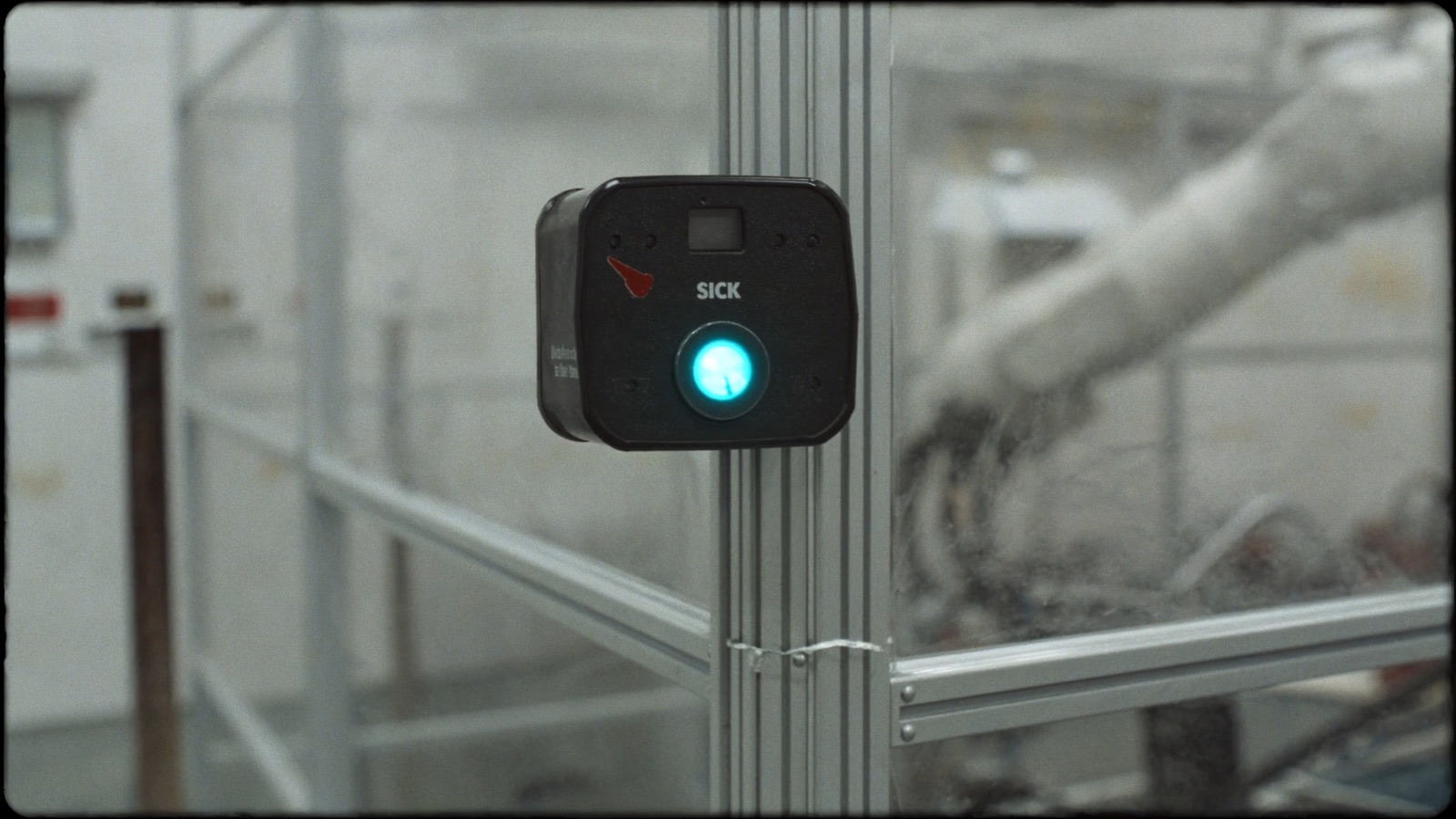
Safety laser scanners — from SICK, Pilz, Omron, Keyence, and others — create a 2D protective field in the floor plane. Personnel entering the field trigger a protective stop. Multiple configurable zones are possible: a warning zone that reduces arm speed, an inner zone that triggers a full stop.
Scanner-based guarding eliminates the physical fence, freeing floor space and allowing more flexible cell access. It is the right solution for cells where:
- Frequent manual access is required (quality checks, material loading)
- The cell layout may change as production requirements evolve
- Adjacent work areas need to remain accessible without accessing the full robot cell
Scanner hardware and installation costs more than fencing:
- Safety laser scanner (e.g., SICK S3000 or Pilz PSENscan): $4,000–$8,000 per unit
- Coverage often requires 2–4 scanners per cell for complete boundary coverage
- Safety controller configuration and validation: $5,000–$15,000 per zone
- Protective field geometry calculation and documentation: $3,000–$8,000
Total scanner-based guarding for a single-arm cell: $20,000–$50,000. The higher cost reflects the additional engineering work required to validate scanner field geometry and document stopping-distance compliance.
The Hybrid Approach
Many modern cells use a combination: physical fencing on the sides of the cell that are structurally permanent (against a wall, facing machinery), with scanner-based guarding on the access side where humans interact. This reduces scanner count and simplifies the geometry validation while maintaining access flexibility where it matters.
What the Risk Assessment Actually Involves
Plant managers who haven't been through a formal robot risk assessment before often underestimate the scope. It is not a walk-through and a sign-off. It is a systematic identification and documentation exercise that typically takes a competent safety engineer 2–4 days for a single-arm cell and 5–10 days for a multi-arm line.
The assessment must identify:
- Every hazardous motion the arm can make, and what happens when a person is in the path
- Every pinch point — between the arm and a machine, between the arm and its own structure, between the arm and fixed infrastructure
- Every mode of operation (automatic, teach, maintenance, clearing jams) and the specific hazards associated with each
- Every foreseeable misuse — what happens when an operator reaches into the cell to retrieve a dropped part, or when a forklift clips the fence
- The probability and severity of each hazard, combined to produce a risk level
- The risk-reduction measure applied, and the resulting residual risk level
ISO 12100 defines the risk reduction hierarchy: first eliminate the hazard by design, then add safeguarding, then provide information and training. The documentation must show why each measure was chosen and what residual risk remains after it's applied.
An integrator who delivers a cell without this documentation is not delivering a compliant installation. Many do — particularly smaller integrators who treat the formal risk assessment as optional. The legal and liability consequences of an incident in an undocumented cell fall on the plant owner, not the integrator.
Cobot Guarding: Less Visible, Not Cheaper
The appeal of collaborative robots for plant managers is often framed as "no cage required." This is partially accurate — a cobot operating in PFL (power and force limiting) mode doesn't require a physical fence around it. It is not accurate to say cobots eliminate safety costs.
PFL cobots (UR e-Series, FANUC CRX, ABB GoFa, KUKA LBR iisy, Techman TM) must operate within force and speed limits defined in ISO/TS 15066 to be compliant as collaborative. The limits are application-specific and depend on the part being handled. A cobot gripping a sharp metal part is not automatically in a PFL-compliant application — the risk assessment must evaluate contact hazards with the gripped object, not just the robot arm itself.
Additionally, cobots operating in SSM (speed and separation monitoring) mode — where they run at full speed when no person is present and slow down when someone approaches — require area scanners that perform the same safety function as a fence. The scanner cost is the same.
The real saving with cobots is reduced fencing material and floor space, plus faster access for operators. The safety engineering cost — risk assessment, validation, documentation — is comparable to a conventionally guarded cell of similar complexity.
Budgeting Safety Correctly
Safety infrastructure costs should be established before the robot hardware is specified. In practice, they should appear as a line item in the project feasibility model, estimated based on the cell type.
| Cell type | Safety approach | Estimated safety cost |
|---|---|---|
| Single arm, fixed layout, minimal human access | Physical fencing with door interlock | $10,000–$20,000 |
| Single arm, frequent manual loading/unloading | Scanner-based guarding | $25,000–$40,000 |
| Cobot cell, PFL collaborative mode | Risk assessment + EOAT evaluation | $12,000–$25,000 |
| Multi-arm cell, 3+ robots | Zone management, multiple scanners | $45,000–$90,000 |
| Full line integration, 5+ robots | Safety PLC, safety network, full RA | $80,000–$150,000 |
Include the risk assessment documentation cost ($5,000–$15,000 for a single-arm cell) as a separate line. Some integrators include it in their integration quote; others treat it as a scope addition. Either way, it needs to appear in the project budget.
Verification: What Acceptance Testing Must Cover for Safety
Before a robot cell enters production, the safety system must be verified. Verification is distinct from the risk assessment — it confirms that the implemented safeguards function as designed.
Required verification tests for a typical fenced or scanner-guarded cell:
- Stop time validation: confirm that the arm stops within the required distance when the safety input is triggered, under maximum speed and maximum load conditions
- Scanner field geometry validation: physically walk the field boundary with a reflecting target at knee, hip, and shoulder height; confirm the scanner detects intrusion at all positions
- E-stop function test: activate each e-stop; confirm arm stops and the safety circuit does not allow restart until reset is completed
- Restart interlock: confirm the arm cannot be restarted without a deliberate manual reset after any safety stop — automatic restart on safety clear is not compliant
- Mode-change verification: if multiple operating modes exist (automatic, teach, maintenance), verify that the safety function changes correctly when modes are switched
These tests must be documented with results. The documentation is part of the technical file for the machinery directive (EU) or the OSHA compliance record (US). It should be retained for the life of the cell.
Next: Programming approaches: teach pendant, offline, AI-assisted — what each costs you →
Discussion
0 commentsNo comments yet. Sign in to be the first.