Industrial Arm Vendor Selection: Capability Matrices and Proof Points
OEM selection is a 10-year decision. Evaluate the ecosystem and the support network, not just the spec sheet.
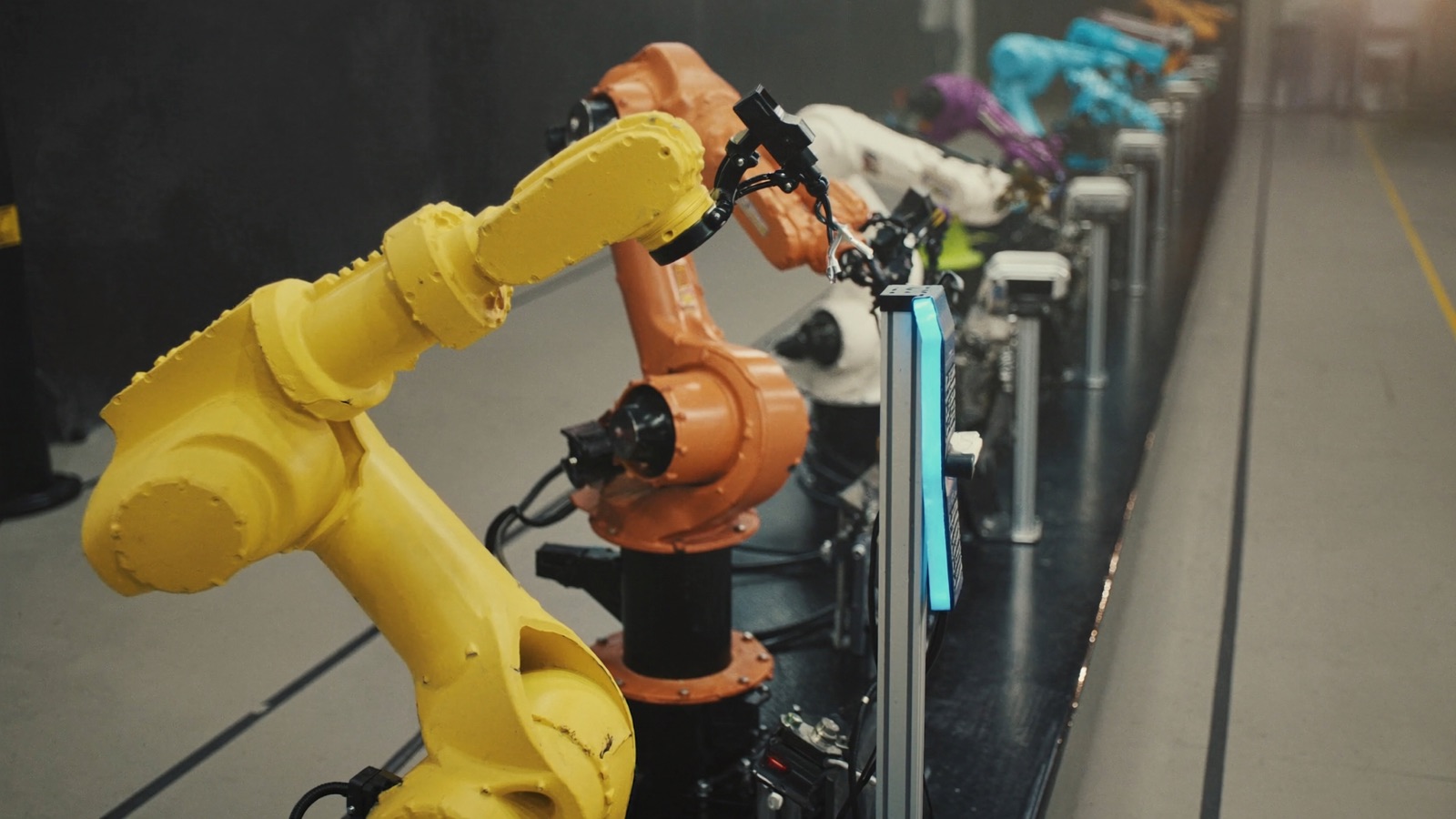
The Big Four industrial robot OEMs — FANUC, KUKA, ABB, and Yaskawa — collectively account for approximately 60% of global industrial robot installations. They manufacture arms across nearly identical payload ranges, with overlapping reach envelopes, comparable repeatability specs, and technically interchangeable capability for the majority of applications. The spec-sheet comparison between a FANUC M-20iD/25 and an ABB IRB 2600 or a KUKA KR 20 R1810 will not tell you which one to buy.
The decision factors that actually matter are harder to put in a table: the depth and geography of the service network, the quality of the OEM's application engineering support, the richness of the software ecosystem for your application type, and the integrator supply — how many qualified integrators in your region have deep experience with that OEM.
This article covers how to evaluate vendors on those dimensions, and what proof points to demand before committing.
The Capability Matrix: Where the OEMs Actually Differ
On the dimensions that matter to a plant evaluation, the OEMs are meaningfully differentiated in specific areas:
Mainstream 6-axis Arms (10–50 kg payload)
| Dimension | FANUC | ABB | KUKA | Yaskawa | Stäubli |
|---|---|---|---|---|---|
| Speed (comparable payload, typical path) | High | High | High | High | Very High |
| Repeatability (±mm) | 0.02–0.05 | 0.02–0.05 | 0.02–0.06 | 0.02–0.05 | 0.01–0.03 |
| Controller open interface | Moderate | Moderate | Good | Moderate | Moderate |
| Software ecosystem maturity | Very High | Very High | High | High | Moderate |
| OLP tool quality (OEM native) | Very High (Roboguide) | Very High (RobotStudio) | High (KUKA.Sim) | High (MotoSim) | Moderate |
| Integrator supply (North America) | Very High | High | High | High | Limited |
| Integrator supply (Europe) | High | Very High | Very High | High | Good |
| Integrator supply (Asia) | Very High | High | Moderate | Very High | Limited |
| Clean-room / IP69K variants | Good | Good | Moderate | Moderate | Best-in-class |
| Collaborative variants | Good (CRX) | Good (GoFa, SWIFTI) | Good (LBR iisy) | Good (HC series) | Good (TX2 Touch) |
| Price (entry 6-axis) | Mid | Mid-High | Mid-High | Mid-Low | High |
This matrix does not declare a winner. It identifies the selection criteria that vary between vendors and helps buyers identify which dimensions matter most for their application.
Specialized Applications: Where the Differentiation Sharpens
Palletizing (high payload, 100–500 kg): FANUC's M-900 series and the FANUC M-410i palletizing variants are dominant in North American food and beverage applications and have the deepest integrator supply for palletizing-specific cells. ABB's IRB 760 and IRB 660 are comparable technically; Yaskawa's MPL series is the third credible choice for high-volume pallet lines.
Welding: ABB has historically been the dominant choice for arc welding, with deep application engineering support and the most mature seam-tracking and touch-sensing ecosystem. FANUC is a close second in North America for automotive spot welding. KUKA has significant market share in European automotive bodies-in-white.
Assembly and precision handling (low payload, high speed): Stäubli's TX2 series is consistently benchmarked fastest for assembly applications in the 1–15 kg range. FANUC's SR and LR-Mate series are strong alternatives with better integrator supply.
Food-grade / washdown: Stäubli's HE (humid environment) and WD (washdown) variants dominate for ISO Class 6+ requirements. Both are IP69K rated with stainless steel and USDA-accepted lubricants. No other OEM has a comparable offering at the same completeness level. For less stringent food environments (dry area handling, non-contact applications), any OEM with their IP67 variants is adequate.
Electronics and semiconductor: Stäubli and Yaskawa have the strongest offerings. Stäubli's TS-series SCARA arms and the TX-HE clean-room variants handle Class 5 environments; Yaskawa's EPH series addresses semiconductor handling.
Integrator Supply: The Factor Buyers Underweight
A robot OEM sells you a technology platform. The integrator sells you a working cell. The quality of the integrator determines the outcome more than the quality of the arm in most applications.
Integrator quality varies enormously — not just between firms but between OEM specializations within a firm. A FANUC Gold integrator with 15 years of machine-tending experience is not the same as a shop that happened to install a FANUC arm twice. The OEM certification programs (FANUC System Integrator Network, ABB Authorized Value Provider, KUKA System Partner) are minimum bars, not quality guarantees.
The practical question: for your application type and geography, which OEM has the deepest pool of experienced, capable integrators you can actually reach?
How to find out:
- Ask the OEM's regional application engineer to give you three recommended integrators for your application type. Then ask each integrator how many cells of that type they've commissioned in the past 24 months, and ask for reference contacts at two of them.
- Search the OEM's partner directory with your geography and application as filters. Count the results — the count is a rough proxy for ecosystem depth.
- Ask your industry peers. The integrator supply picture is well-known within a given vertical or geography. An automotive supplier in Michigan will know which integrators are credible for transfer cell work; a food manufacturer in the Southeast will know who does palletizing well.
Service Network: What to Ask, Not What to Assume
All four major OEMs have global service networks. That network description becomes meaningless if the nearest field service engineer is a 6-hour drive from your plant.
Ask the OEM:
- "Where is your nearest authorized field service location?"
- "What is your SLA for on-site response — not phone support, on-site response — for a production-critical arm down fault?"
- "What parts are stocked locally vs. shipped from a regional depot vs. shipped from the factory?"
For controller faults, critical joints, and servo drives, the stocking location determines your downtime. An OEM that stocks servo amplifiers 2 hours away from your plant will repair a controller fault in the same day. An OEM that ships servo amplifiers from a single regional depot may have you down for 3–5 business days.
Spare parts stocking is directly related to the OEM's installed base in your region. FANUC's dominant position in North American and Asian markets means very high local parts availability in those regions. ABB and KUKA have stronger stock coverage in Europe. Yaskawa has strong parts availability in Asia.
Get the SLA in writing. Response time commitments that aren't in the support contract aren't commitments.
Evaluating OEM Software Ecosystem
The robot arm is controlled by software you'll interact with for 10+ years. Software ecosystem quality affects:
- How quickly your team can diagnose faults
- How well the OEM integrates with your MES or production monitoring system
- Whether real-time monitoring and predictive maintenance data is accessible
- How complex version management becomes as the OEM releases controller software updates
FANUC: FANUC's ZDT (Zero Down Time) cloud monitoring service provides vibration data, torque trends, and predictive alerts for joint health. It's a mature offering used widely in automotive. FANUC's PMC (Programmable Machine Controller) gives strong integration to machine tool I/O. The controller software is FANUC-proprietary and well-documented but requires FANUC-trained technicians.
ABB: ABB's RobotStudio is the industry's most sophisticated simulation and offline programming environment and is widely used by academics, which creates a large pool of engineers with some RobotStudio familiarity. ABB's OmniCore controller (introduced 2023-24) provides open API access to real-time robot state data and integrates with OPC-UA industrial networks more cleanly than older controller generations.
KUKA: KUKA's KUKA.WorkVisual is the cell commissioning and configuration environment. KUKA.Sunrise is the Java-based programming interface for the LBR series. KUKA has the most open controller architecture of the Big Four — the KUKA.ROS package (ROS 2 compatible) allows direct integration with robotics research and vision toolchains, which has made KUKA a preferred platform for innovation projects that need to interface with external computing.
Yaskawa: Yaskawa's Cockpit software provides production monitoring and predictive maintenance dashboards. Yaskawa's controller ecosystem is less differentiated than FANUC or ABB for advanced connectivity, but is highly reliable and broadly supported by the integrator community.
Emerging Vendors: When to Consider, When to Wait
Chinese-branded industrial arms — ROKAE, JAKA, Estun, Inovance, Han's Robot — have reached technical parity with Big Four specifications in the mainstream payload classes. JAKA's S series and ROKAE's XB series quote specs comparable to mid-range ABB and FANUC arms at 40–60% lower hardware cost.
The practical constraints for North American or European buyers considering Chinese OEMs:
Support: Field service networks in North America and Europe are thin for Chinese OEMs. The hardware may be technically comparable; the support infrastructure for production-critical cells is not. For a 24/7 automotive or food manufacturing plant, an 8–10 business day parts lead time from China for a controller failure is a business risk.
Software ecosystem: Integration with North American and European MES platforms, safety controller interfaces, and OLP tooling is less mature. RoboDK supports several Chinese OEMs' kinematics, but OEM-native simulation tools are less developed.
Regulatory: CE marking and the compliance documentation chain for European machinery directive requirements is achievable with Chinese OEMs but requires careful diligence from the integrator.
Where it works: for non-critical applications in price-sensitive environments — a light pick-and-place cell in a secondary operation, a pilot application in a facility without 24/7 uptime requirements — Chinese OEMs present a legitimate option. For primary production-critical cells, the support gap currently outweighs the hardware cost saving.
The RFP: Proof Points, Not Promises
The right RFP process for an industrial arm procurement goes beyond spec comparison. It demands proof of performance on your application type.
Proof points to request in writing:
Reference cells: at least two commissioned cells of similar configuration (payload class, application type, industry) that have been in production for at least 12 months. Names, site contacts, and permission to call.
Cycle time validation: programmed simulation of your specific production path in the OEM's simulation environment, with documented EOAT and I/O assumptions. Not a generic cycle time claim.
Support SLA documentation: contractual commitments for response time, parts availability, and software version support for the controller you're purchasing.
Integration partner qualification: the names and certification levels of the integrators they recommend for your application, with integrator reference checks available.
TCO model: a full-system quote including integration, EOAT, safety infrastructure, and first-year maintenance — not just the arm hardware.
Questions that reveal vendor quality:
- "Show me your last three formal root-cause analyses for field failures on this arm model."
- "What is the failure rate for servo amplifiers on the R-2000iD/165F at the 3-year and 5-year marks?" (or equivalent model)
- "How do you handle a controller board failure during third shift at a plant with no on-site robotics staff?"
- "What is your policy on controller software updates — how are customers notified, and are updates tested before release?"
An OEM that can answer these concretely — with data, not marketing language — is demonstrating the operational maturity that justifies a 10-year platform commitment.
Making the Final Call
For the majority of applications in mainstream payload classes, no single OEM is definitively superior. The selection comes down to:
- Application fit: is there a specialized variant (clean-room, welding, collaborative) that one OEM does materially better for your use case?
- Integrator supply: who has the best-qualified integrators available for your application, in your geography, available within your project timeline?
- Service coverage: who has the deepest parts stock and fastest field service response nearest your plant?
- Software ecosystem: does your team already work with one OEM's tools? Switching costs for training and tooling are real.
- Commercial terms: volume discounts, service contract structures, and upgrade path commitments often matter more than list price differences between OEMs whose hardware is comparably priced.
Platform lock-in is real in this industry — controller software, programming languages, and EOAT tooling mounts are not interchangeable between OEMs. The platform decision is effectively a 10-year commitment. Evaluate accordingly.
This article concludes the Robolist Industrial Arm Guide series. Start at the beginning: Why 40% of industrial-arm projects miss their cycle-time targets →
Discussion
0 commentsNo comments yet. Sign in to be the first.