Drone-in-a-box economics and payback
When autonomous docked drones pencil out against manned inspections and guard patrols
The pitch and the reality
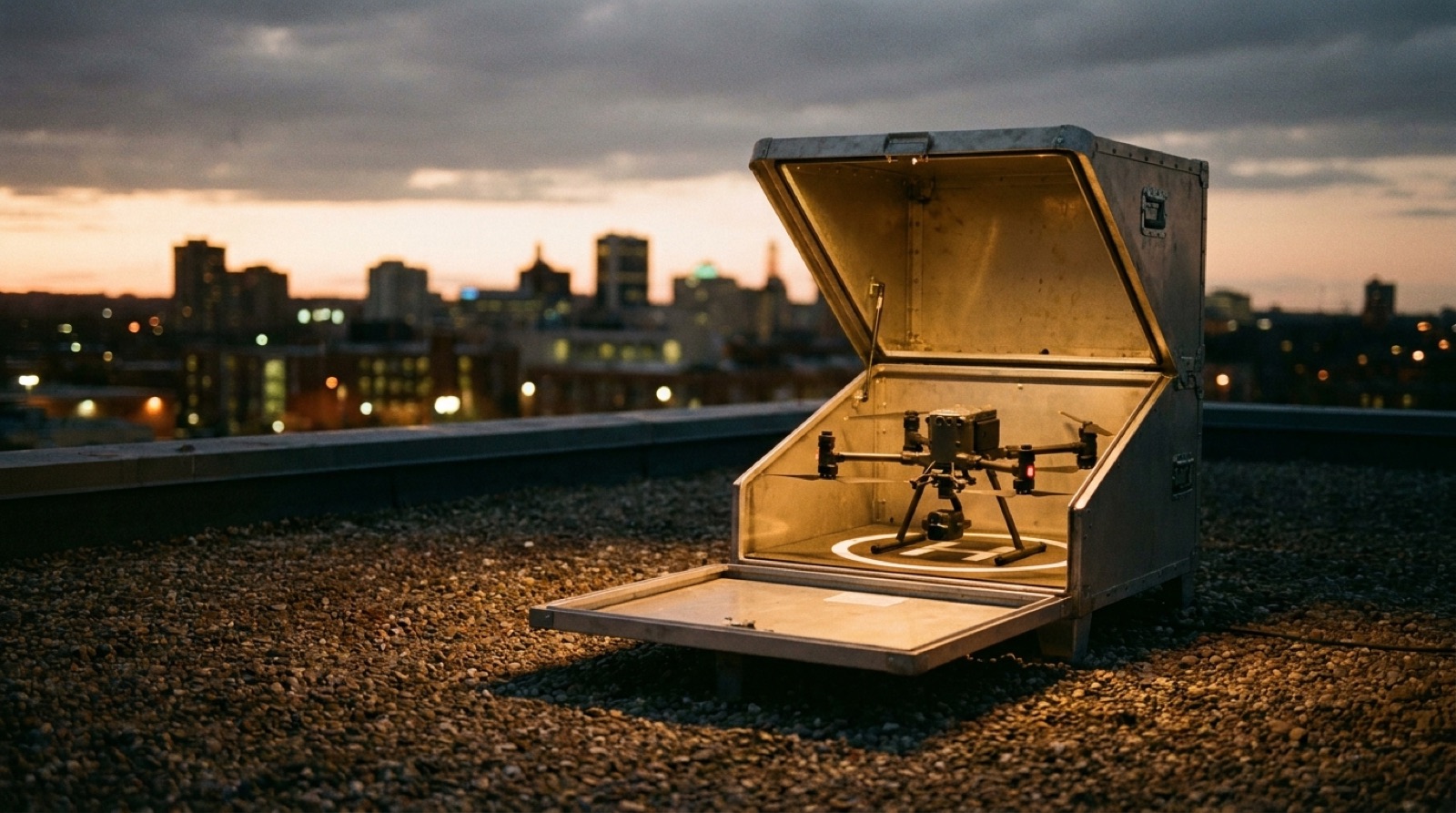
The sales case for a docked autonomous drone program — sometimes called drone-in-a-box, or a dock-based system — is straightforward: eliminate per-flight pilot labor, fly recurring missions on a schedule, and generate consistent data without scheduling a crew. For perimeter security, the argument is that a drone can patrol a 200-acre site in 15 minutes, transmit live video to a remote monitoring center, and cost a fraction of a uniformed guard shift. For recurring inspection, a weekly autonomous roof or solar-array scan sounds far cheaper than quarterly manned inspection visits.
The pitch is not wrong. But the payback timeline depends on variables that vendors rarely include in their deck. This article builds the full model so you can run the numbers for your site before signing a dock agreement.
What a docked drone system actually is
A dock-based autonomous drone system consists of three components: the drone itself (typically a multirotor with collision avoidance and a precision landing system), the dock (a weatherproof housing that charges the battery, protects the aircraft between flights, and communicates mission data to the cloud), and the software layer (a fleet management and mission planning platform that schedules flights, monitors aircraft health, and routes data to downstream consumers).
The key operational difference from a conventional drone program is BVLOS automation. BVLOS (beyond visual line of sight) means the aircraft flies without a remote pilot maintaining visual contact. For dock-based programs to operate without a dedicated on-site pilot for each mission, BVLOS authorization from the FAA is required. In the United States, this either means a site-specific BVLOS waiver or operating under an FAA-approved Beyond Visual Line of Sight (BVLOS) operational authority — a process that has become more accessible in recent years but still requires documented safety cases and in some cases third-party audit.
Vendors in this segment include Skydio with its X10 dock-based offering, Autel's Dragonfish Nest system, and Asylon's Guardian Drone platform (marketed toward perimeter security). These products differ in aircraft class, endurance, payload options, and the maturity of their BVLOS authorization support. None of them come with regulatory clearance pre-installed; the buyer is responsible for obtaining the required authorizations for their site.
The cost model for a dock installation
A dock-based program has a different cost structure from a conventional drone program. Pilot labor — the largest recurring cost in a manned program — is reduced substantially (though not to zero; remote supervision, maintenance, and mission review still require staff time). In exchange, dock hardware, installation, connectivity infrastructure, and a higher-complexity software stack add upfront and recurring costs that a simple two-aircraft program does not have.
Typical dock installation costs (planning ranges, not vendor quotes):
| Component | Representative range |
|---|---|
| Dock hardware (per dock) | $20,000–$60,000 |
| Drone (aircraft, included or separate per vendor) | $8,000–$20,000 |
| Connectivity (LTE failover, site network integration) | $2,000–$8,000 |
| Installation labor and civil works (power, mounting, cabling) | $3,000–$15,000 |
| BVLOS waiver support (if required, one-time) | $15,000–$50,000 |
| Software platform (annual license per dock) | $8,000–$20,000/year |
| Insurance (UAS hull + liability, dock-based program) | $4,000–$10,000/year |
Total Year 1 cost for a single-dock deployment, excluding BVLOS waiver support: roughly $50,000–$120,000. Including a BVLOS waiver process: $65,000–$170,000 at the high end for a full safety case with legal support.
Payback against a guard patrol scenario
Security patrol is the use case where dock-based systems build the strongest economic argument, because the alternative — uniformed guard patrols — has a well-defined and rising cost.
Uniformed guard labor in the United States typically runs $18–$32 per hour for contracted services, with total program cost (including oversight, relief shifts, management, and vendor margin) often running $25–$45 per hour of coverage. A 24/7 perimeter patrol for a mid-size site (100–300 acres) requiring two patrol shifts typically costs $800,000–$1,500,000 per year in guard contract spend.
A dock-based autonomous drone program covering the same perimeter on a defined schedule — say, four flights per day on a patrol pattern, with real-time alert capability — does not replace all of this coverage directly. A drone cannot detain, respond physically, or provide the legal deterrence of a visible uniformed presence. The realistic substitution model is partial: the drone replaces some number of patrol hours by providing remote visual coverage, and guard staff is redeployed toward response and access-control functions.
Using a conservative substitution rate of 30–50% of patrol labor hours replaced by drone coverage:
| Scenario | Annual guard cost | Drone program year 1 cost | Drone program year 2+ cost | Break-even (years) |
|---|---|---|---|---|
| Small site, 1 patrol shift replaced | $350,000 | $80,000–$130,000 | $30,000–$45,000/yr | 0.3–0.5 years after go-live |
| Mid-size site, partial patrol replacement | $500,000 | $100,000–$160,000 | $40,000–$60,000/yr | 0.3–0.5 years after go-live |
| Large campus, 30% labor substitution | $200,000 savings/yr | $120,000–$170,000 | $50,000–$70,000/yr | ~1 year |
The break-even calculation looks compelling — and for large sites with 24/7 patrol requirements, it often is. But it depends on the substitution rate actually being achievable, which in turn depends on the BVLOS authorization being in place and the client (or regulator) accepting drone coverage as equivalent for the purpose being measured.
Payback against a recurring manned inspection scenario
For recurring inspection use cases — solar array thermal surveys, roof condition monitoring, construction progress, linear infrastructure — the comparison is against manned inspection visits or internal inspection labor.
A typical third-party manned inspection visit for a large industrial or commercial roof system might cost $3,000–$8,000 per visit (including mobilization, safety equipment, reporting labor, and overhead). At four visits per year, that is $12,000–$32,000 annually per site.
A single-dock deployment amortized over five years, plus annual operating costs, might run $25,000–$40,000 per year all-in. At those numbers, a single-site quarterly inspection use case does not pay back the dock installation — the manned inspection alternative is cheaper.
The dock model for inspection pays when:
- Mission frequency is high (weekly or more), not quarterly
- Multiple sites are served by centralized monitoring (reducing per-site overhead)
- The inspection produces real-time or near-real-time data value (catching a battery fire or roof leak before it escalates)
- The dock is deployed in an environment where mobilizing manned crews is expensive (remote sites, hazardous access, offshore or elevated structures)
Inspection payback model (representative):
| Mission frequency | Annual manned inspection alternative | Annual drone program cost (single dock, 5-yr amortization) | Payback achievable? |
|---|---|---|---|
| Quarterly (4x/year) | $15,000–$30,000 | $28,000–$40,000 | No — dock exceeds alternative |
| Monthly (12x/year) | $45,000–$90,000 | $28,000–$40,000 | Yes — payback in 1–2 years |
| Weekly (52x/year) | Not practical with manned crews | $28,000–$40,000 | Yes — strong case |
| Daily or on-demand | $200,000+ (if feasible at all) | $28,000–$40,000 | Yes — compelling |
When the dock model does not pay
The dock model fails to pencil out in several common scenarios:
Low mission frequency. If you fly 10 missions per year, a dock installation amortized over five years costs $5,000–$10,000 per mission before operating costs. A drone service provider with a manned platform is almost always cheaper at that volume.
Single-site, low-stakes inspection. A once-per-quarter roof condition check on a single building is a poor fit for a $60,000 dock installation. Lease the airspace to a DSP instead.
Sites without BVLOS clearance. If the program cannot obtain BVLOS authorization, the dock is a supervised-flight device — the economic case collapses back to something close to a conventional drone program, without the pilot cost savings that justify the dock premium.
Sites with poor connectivity. Dock-based systems rely on reliable high-bandwidth uplinks for real-time video and telemetry. Sites with marginal cellular coverage or without a dedicated data link have significantly higher integration cost and reliability risk.
High civil works cost. In older facilities, running conduit, providing weatherproof power, and mounting the dock securely can cost more than the dock hardware. An on-site survey before procurement is mandatory.
Questions to ask before signing a dock agreement
- What airspace authorizations are included in the vendor's deployment support? Who bears the cost and risk of the BVLOS application?
- What is the realistic flight-days-per-year commitment in your climate? (High wind, heavy precipitation, temperature extremes all ground the system.)
- Does the dock software platform integrate natively with your downstream reporting or alerting system, or does data post-processing require a separate workflow?
- What is the vendor's hardware replacement policy if the aircraft or dock fails during the warranty period? What are the out-of-warranty repair costs?
- What is the connectivity redundancy architecture? What happens if the primary LTE link drops during a mission?
The next article in this series, A decision framework for choosing a platform class, covers the broader build-versus-buy and platform-class decision for drone programs at all scales — including when to use a dock, a conventional multirotor, a fixed-wing, or a third-party service provider.
Discussion
0 commentsNo comments yet. Sign in to be the first.