Why most commercial drone programs stall after the pilot
The regulatory and data-pipeline gaps that stop promising pilots from becoming scaled operations
The pilot that went nowhere
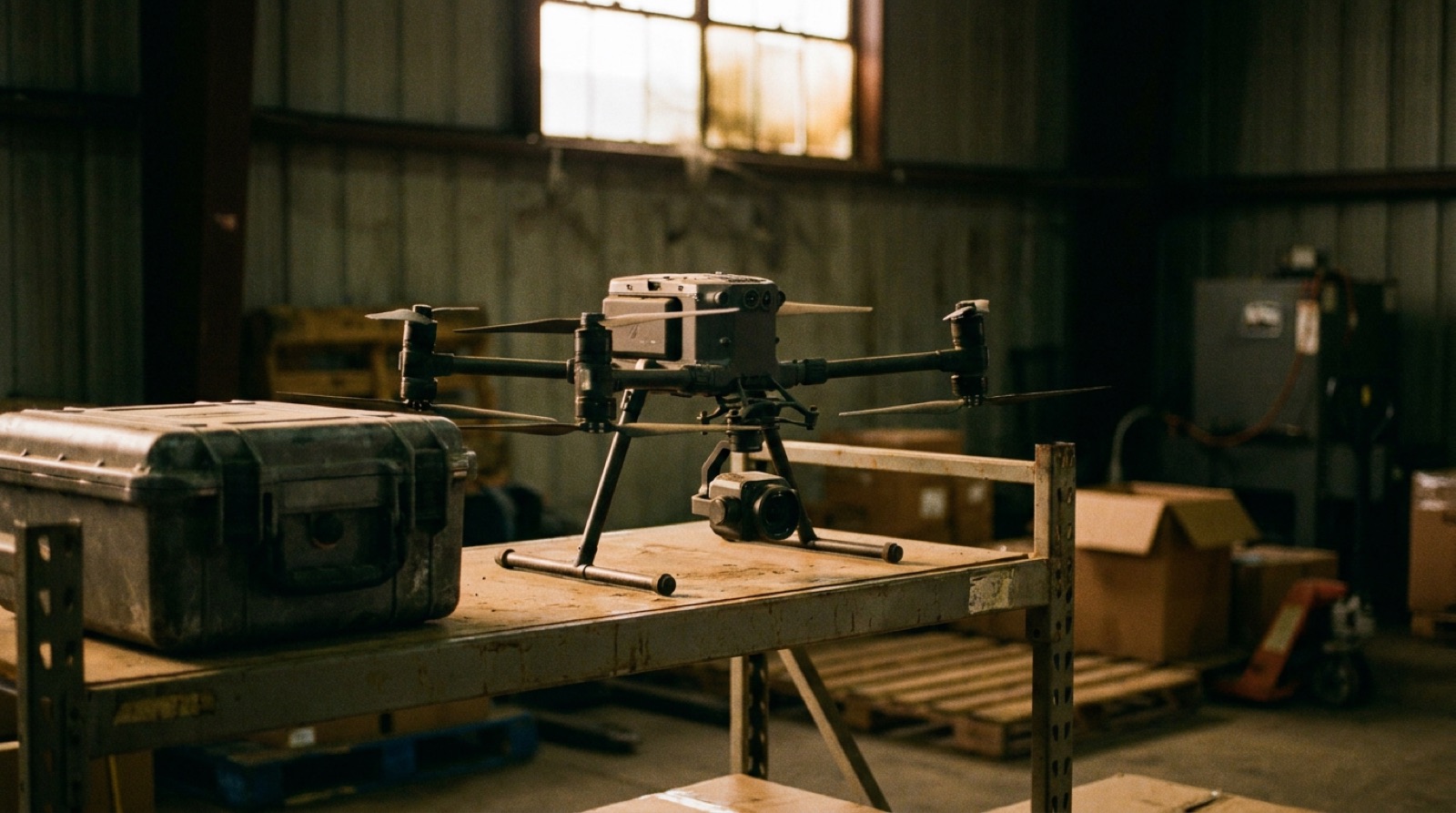
A facilities engineering team at a mid-size manufacturing campus runs a three-week drone inspection pilot. A qualified Part 107 remote pilot — a person who holds an FAA Remote Pilot Certificate, the minimum credential to operate a commercial drone in the United States — flies a multirotor over the plant roof, generates a dense point cloud, and delivers a crack-detection report. Leadership is impressed. The facilities director requests a quarterly inspection cycle.
Eighteen months later, the program has flown twice. The certified pilot moved to another team. The data from the two flights lives in two different formats in two different folders, with no consistent naming convention. The company's GIS software can't ingest the point cloud directly. The insurer who was supposed to accept drone-based reports as a substitute for manned scaffolding inspections never formally agreed to the substitution. Nobody owns the airspace authorization renewal.
This is not an unusual outcome. It is, by most accounts, the modal outcome for enterprise drone pilots in asset-heavy industries.
What actually failed
The technical flight was fine. What failed was everything else — and "everything else" clusters into three distinct gaps that predictably kill drone programs between pilot and scale.
Gap 1: Regulatory continuity
Part 107 certification gets a program airborne, but it does not authorize every mission a real inspection program needs. Flying beyond visual line of sight (BVLOS — operating a drone outside the range where the pilot can see it unaided), flying near controlled airspace, or automating recurring flights on a fixed schedule all require either a waiver, authorization through the Low Altitude Authorization and Notification Capability (LAANC — an FAA system that provides near-real-time airspace authorization for recreational and commercial flights below 400 feet in controlled airspace), or a more complex operational approval.
Most pilots earn Part 107, fly the demo, and leave the BVLOS pathway unexplored. When the organization later wants autonomous dock-based flights or larger survey coverage, it discovers a 12–24 month waiver process it never started. The program waits.
Common regulatory continuity failures:
- Pilot certification held by one individual with no succession plan
- No LAANC authorization workflow built into the operations calendar
- BVLOS waiver not initiated until the autonomous-flight use case is already funded
- Airport notification requirements misunderstood or skipped entirely
- State or local restrictions (utility corridors, critical infrastructure buffers) not mapped
Gap 2: Data pipeline
Drone data is raw material, not a deliverable. A single inspection flight on a 10-acre industrial site can produce 2,000–8,000 high-resolution images, a GPS track, IMU logs, and potentially LiDAR or thermal imagery. Turning that into something an engineer can act on — an orthomosaic (a stitched, georeferenced 2D aerial map with uniform scale), a 3D model, a thermal anomaly report — requires photogrammetry software, calibrated workflows, and someone who owns that process.
Organizations that run pilots usually borrow a pilot's personal workflow. That workflow is not documented, not repeatable by anyone else, and often depends on a cloud subscription the pilot pays for personally. When the pilot leaves, the pipeline leaves with them.
Common data pipeline failures:
- No standardized file-naming or folder hierarchy across flights
- Photogrammetry processed in a personal account, outputs not archived to enterprise storage
- No defined ground sample distance (GSD — the real-world size represented by one pixel in the output image, a key accuracy specification) standard for different inspection types
- Outputs delivered in formats the receiving system (CAD, GIS, asset management) cannot natively ingest
- No established integration between drone data and the maintenance or EHS ticketing system
- Thermal or LiDAR data collected but no analyst trained to interpret it
Gap 3: Organizational ownership
Who owns the drone program? In a successful pilot, the answer is often "the enthusiast who proposed it." That person managed the vendor relationship, held the certification, processed the data, and wrote the report. When they move on or the program needs to scale across multiple sites, there is no institutional knowledge, no budget line, no documented SOP, and no assigned owner.
Aviation programs — even small commercial UAS operations — require organizational infrastructure that pilots don't spontaneously create: a safety management framework, an operations manual, a maintenance log, a training records file, a vendor contract with SLA terms, and an insurance rider that specifically covers UAS operations.
What separates a stalled pilot from a scaled program
The organizations that successfully scale drone programs share a pattern. None of it is about the aircraft.
They define success in terms of an outcome, not a flight
A scaled program answers the question: "What decision or action does this flight enable?" Before the first flight, the team has mapped the output format back to a consuming system — the asset management database, the insurance renewal checklist, the regulatory filing. The drone is the sensor. The mission is the workflow.
A pilot that produces a point cloud nobody can open is a demonstration, not a program. The organizations that scale have a named downstream consumer for every data product before the first flight is scheduled — a maintenance engineer who will act on the thermal anomaly report, a GIS team that will ingest the orthomosaic, an insurance contact who has agreed in writing that drone-derived data satisfies their inspection requirement.
They treat regulatory compliance as infrastructure, not a checkbox
The BVLOS pathway is initiated in Year 1, not Year 3. LAANC authorization is a standing operational process, not a per-flight scramble. The operations manual is written before scale, not after the first incident. Airspace authorization is renewed on a calendar, owned by a named person.
Regulatory compliance also means proactive engagement with state and local requirements that sit alongside the FAA framework. Some states impose additional notification requirements for drone operations near utility infrastructure, transportation corridors, or critical facilities. These are not captured in the FAA's authorization system and are not visible until an operator or site security contact asks a question the program has no documented answer to.
They separate the pilot from the program
Certification is distributed across at least two people. The photogrammetry workflow is documented and runs on enterprise-licensed software with shared credentials. The vendor relationship (hardware, software, insurance) is a company contract, not a personal relationship.
Succession planning for a drone program is not complicated, but it requires deliberate action. The certification, the software licenses, the cloud storage account, and the operations manual all need to be held institutionally, not personally. A program where all of this is in one person's name is a program that is one resignation letter away from starting over.
They staff the data pipeline before they staff the flights
In inspection applications, the limiting factor is usually not flight hours — it's analyst capacity. A two-hour survey flight can generate 40–80 hours of processing and interpretation work if the pipeline is manual. Scaling means either automating the pipeline (dedicated photogrammetry platforms, AI-assisted defect detection) or staffing the analyst function as a defined role.
The analyst gap also matters for data quality validation. A program that produces outputs nobody checks is a program that will eventually produce a wrong output — a missed defect, a misregistered orthomosaic — that surfaces only when an incident reveals it. Building a quality review step into the data pipeline, however lightweight, closes this gap before it costs something.
A framework for auditing your program's maturity
Before committing budget to scale, run your program against this four-domain audit. Any domain scored "not started" is a blocking dependency.
| Domain | Not started | In progress | Operational |
|---|---|---|---|
| Regulatory | No Part 107, no LAANC process | Part 107 held, LAANC case-by-case | LAANC standing authorization, BVLOS pathway initiated or waived |
| Data pipeline | Ad hoc, pilot-owned | Documented workflow, enterprise storage | Integrated with asset/maintenance/GIS system, automated QA |
| Org ownership | Single enthusiast | Named program owner, backup pilot | Dedicated budget line, operations manual, safety review cycle |
| Insurance/legal | No UAS rider | Rider requested, pending | Rider confirmed in writing, liability scope reviewed |
A program with three "in progress" ratings and one "not started" is one personnel change away from collapse. An "operational" across all four domains is the minimum for multi-site scale.
The takeaway
Drone pilots fail to scale not because the technology doesn't work, but because organizations treat the aircraft as the product and everything else as overhead. The aircraft is cheap, reliable, and improving fast. The regulatory, data, and organizational infrastructure required to fly it consistently is where programs get stuck — and where the real investment needs to go.
The next article in this series, The real cost of a drone inspection program, breaks down the full three-year total cost of ownership for a commercial inspection program, including the line items that surprise most buyers: waiver consulting, data processing software, spare parts, pilot attrition, and insurance riders.
Discussion
0 commentsNo comments yet. Sign in to be the first.