Medical and rehabilitation exoskeleton economics
Clinic throughput, reimbursement realities, and how to evaluate the financial case
Important note on clinical content
This article addresses the operational and financial considerations of deploying rehabilitation exoskeletons in a clinical setting. It does not make clinical efficacy claims or assert specific patient outcomes. Clinical evidence for rehabilitation exoskeletons is an active area of research, and regulatory clearance status varies by device, indication, and geography. Readers should consult the primary clinical literature, their device vendor's regulatory documentation, and their own clinical governance processes before making clinical decisions. References to regulatory clearance in this article describe the general regulatory landscape; they do not constitute verification of any specific device's current clearance status.
The deal that doesn't quite add up — yet
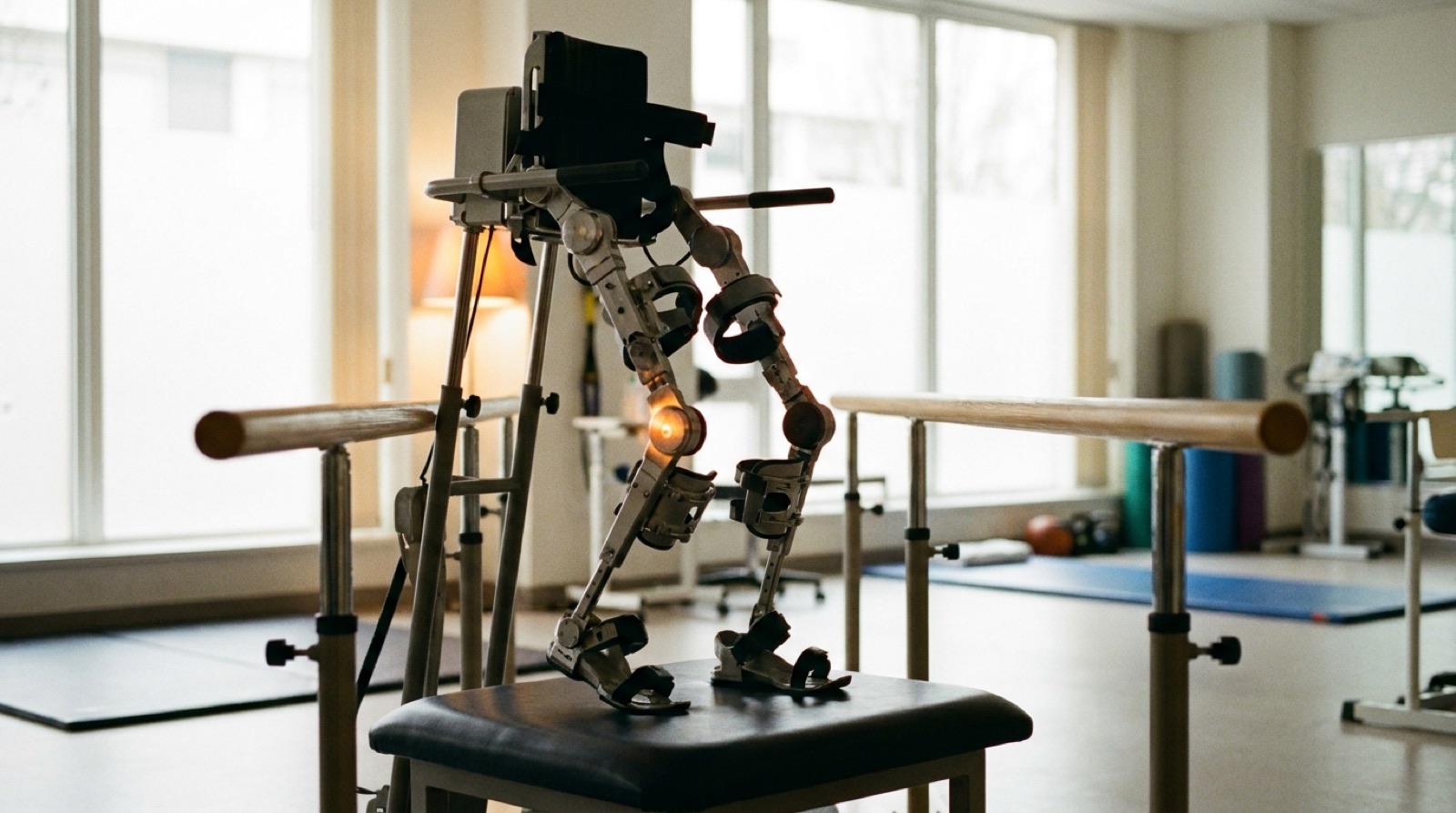
A rehabilitation hospital invested in two powered lower-limb gait-training exoskeletons for its inpatient stroke unit. The clinical rationale was sound: the devices enable repetitive, task-specific gait training that is difficult to deliver manually at sufficient volume. The equipment was FDA-cleared for its intended use. The clinical team was enthusiastic.
Eighteen months in, the CFO asked for the financial review. The numbers were uncomfortable. Each device required a 25-minute donning and doffing process (plus 15 minutes of device preparation by a technician). Standard stroke rehab sessions ran 45 minutes. Net therapeutic time per session: under 10 minutes. The devices were used twice per day per device on average — far below the three to four sessions per day needed to approach break-even against the capital cost at any realistic reimbursement rate.
The program was not a failure. Patients showed meaningful progress. The clinical team considered it valuable. But the financial model had never been stress-tested against actual session structure, and the CFO's review created a funding crisis.
This scenario is not unusual. Rehabilitation exoskeleton programs are among the most capital-intensive in physical therapy, and the reimbursement landscape remains one of the most uncertain in medical technology. Understanding both before you commit capital is not pessimism — it is due diligence.
Regulatory and clearance basics
In the United States, rehabilitation exoskeletons used in clinical settings generally require FDA clearance under the 510(k) pathway as a Class II medical device, or in some cases FDA authorization under a De Novo pathway. Clearances are indication-specific: a device cleared for use with spinal cord injury patients is not automatically cleared for stroke rehabilitation, even if the hardware is similar.
Buyers should request:
- The specific FDA clearance number and indication language for the device they are evaluating
- Whether the device is cleared for their intended patient population (e.g., pediatric vs. adult, SCI vs. stroke vs. acquired brain injury)
- Whether the clearance covers the clinical setting (inpatient acute, inpatient rehab, outpatient, home)
In the European Union, rehabilitation exoskeletons are regulated as Class IIa or Class IIb medical devices under the MDR (Medical Device Regulation), requiring CE marking. In other geographies, regulatory pathways vary. Always verify current clearance status with the vendor and with your own regulatory affairs or compliance team — clearance status can change, and marketing materials may not reflect the most current status.
Devices marketed for occupational or wellness use rather than medical rehabilitation typically do not require FDA clearance. The distinction matters: a wellness exoskeleton used in a clinical setting for therapeutic purposes may create liability exposure if it is not properly cleared for that indication.
Throughput math: the honest version
The financial model for a rehabilitation exoskeleton lives or dies on one number: billable units per device per day.
A CPT billing unit in physical therapy is typically 15 minutes of skilled direct contact time. Most rehabilitation exoskeleton sessions are billed at 2–4 units (30–60 minutes), depending on the session protocol and payer.
For the math to work, you need to know:
| Variable | Questions to answer |
|---|---|
| Donning/doffing time | How long does setup and removal take for your intended patient population? (Patients with lower-limb spasticity or poor trunk control typically require more time than healthy volunteers in a vendor demo.) |
| Clinician-to-device ratio | Does your protocol require one PT per device, or can a PT manage two devices with a tech? |
| Session preparation time | Does the device require calibration, patient programming, or pre-session fitting adjustments? |
| Cleaning time between patients | What is the per-session sanitation requirement? |
| Patient availability | What percentage of your intended patient population will be cleared for the device on a given day (accounting for wound care, other therapy, meal times, medical holds)? |
A realistic session throughput model:
Effective sessions per device per day =
  (Total clinical hours) ÷ (Avg. session time + Donning/doffing + Prep/clean time)
Run this calculation with your actual patient population, not with vendor-provided session time estimates from optimal conditions.
For a device where donning takes 25 minutes, session runs 45 minutes, and cleaning/prep takes 10 minutes, each session cycle is 80 minutes. In a 7-hour clinical day, that is approximately 5 sessions per device per day under ideal conditions — and realistically 3–4 after scheduling gaps and patient holds.
Reimbursement landscape (US context)
Reimbursement for rehabilitation exoskeleton therapy varies significantly by payer, setting, and indication. The landscape as of this writing includes several important realities:
Medicare. Medicare does not have a dedicated reimbursement code for robotic or exoskeleton-assisted therapy. Most programs bill exoskeleton sessions using standard therapeutic exercise and neuromuscular re-education CPT codes (typically 97110, 97112, 97530), which are reimbursed based on time units regardless of whether assistive technology was used. The exoskeleton device cost is not separately reimbursable; it must be amortized into program overhead.
Medicaid. Varies by state. Some state Medicaid programs have limited coverage pathways for specific devices or patient populations. Most do not. This is a significant constraint for programs serving a high-Medicaid patient population.
Private insurance. Coverage and reimbursement rates vary by carrier and plan. Some commercial payers have begun issuing coverage determinations for specific devices and indications; many others classify robotic-assisted rehabilitation as investigational for some conditions. Prior authorization requirements are common. Billing staff should verify coverage for each payer before beginning a program — not once at program launch, but periodically as payer policies evolve.
Veterans Health Administration (VA). The VA has historically been a meaningful purchaser of rehabilitation exoskeleton technology, particularly for spinal cord injury populations, and has defined coverage frameworks for specific devices and indications. If your patient population includes a significant VA-referred or VA-enrolled segment, this is worth investigating as a program support pathway.
Workers' compensation. Some WC programs have reimbursed rehabilitation exoskeleton therapy for work-related injuries, particularly for high-cost cases where faster functional recovery has a measurable cost offset. This is a case-by-case negotiation in most jurisdictions.
The honest summary: for most US outpatient and inpatient rehab programs, the device cost cannot currently be recovered through separate reimbursement. The financial case rests on session billing efficiency (volume × rate × margin) and potentially on outcomes that reduce total episode cost for payers who have global payment arrangements.
Capital cost and depreciation model
Rehabilitation exoskeletons for clinical use currently range from approximately $70,000 to over $150,000 per unit, depending on capability and configuration. Ongoing costs include:
- Annual maintenance and service contract: typically 10–15% of purchase price per year
- Consumables: hygiene kits, replacement pads, custom orthotic inserts (for devices requiring custom fitment per patient)
- Staff training: initial and annual recertification, typically $1,000–$3,000 per clinical user
- Physical space: dedicated treatment bay, often 200–300 square feet minimum for safe device operation
- IT integration (for devices with data platforms): network connectivity, data management
A simplified break-even model for a single device:
| Input | Planning figure |
|---|---|
| Device cost | (Your vendor quote) |
| Annual maintenance | 12% of device cost |
| Annualized capital cost (5-yr depreciation) | Device cost ÷ 5 |
| Avg. billing units per session | 3 units (45 min) |
| Avg. net reimbursement per unit | (Your payer mix average) |
| Sessions per device per day | (Your throughput calc) |
| Clinical days per year | ~240 |
Break-even sessions per year = (Annual capital + maintenance) ÷ (Net revenue per session)
Model this at 3, 4, and 5 sessions per device per day. If you cannot reach break-even at 4 sessions per day in your payer environment, the program requires a different financial justification — research grant support, philanthropic endowment, value-based payment arrangement — or a reconsideration of device count.
The non-financial considerations that affect the financial case
Staff engagement. Physical therapists who are enthusiastic about a device and skilled in its application use it more efficiently and achieve better session throughput. Staff who feel the device was imposed, or who received inadequate training, use it less and more slowly. Engage your PT staff in device selection; their buy-in is an operational asset.
Patient population size and stability. A device optimized for stroke patients in a facility with a small, unpredictable stroke census is a high-risk investment. Size the program to a patient population large enough to support consistent utilization. Some programs begin with a shared-device model across multiple units or campuses to build sufficient patient volume.
Research and outcomes data infrastructure. Programs that systematically collect outcomes data (using validated functional assessments) create a dataset that supports grant applications, value-based payment negotiations, and clinical credibility. Build data collection into the program design from day one, not as an afterthought.
Vendor clinical support. The strongest vendors in rehabilitation exoskeletons provide meaningful clinical implementation support: protocol development, clinical specialist site visits, peer networking with other programs. This is not just a service differentiator — it affects how quickly your team becomes proficient and how efficiently you reach full utilization.
Pediatric and specialty populations
Rehabilitation exoskeletons designed for pediatric patients — such as those used for pediatric neurological conditions, spinal cord injury, or acquired brain injury in children — represent a distinct market segment with different device requirements (weight ranges, hip width, torso proportions) and different regulatory and clinical considerations. Programs serving pediatric populations should evaluate devices specifically designed and cleared for that population rather than assuming an adult device can be adapted.
Devices like the Atlas Pediatric Exo by Marsi Bionics represent this specific segment. Evaluating pediatric devices requires the same throughput and reimbursement framework above, with additional attention to the narrower patient population size and the longer, more intensive clinical relationship typical of pediatric neurological rehabilitation.
Next in this series: Decision framework — passive vs. powered, back vs. shoulder vs. lower-limb — a structured approach to matching device type to task, patient, and program.
Discussion
0 commentsNo comments yet. Sign in to be the first.