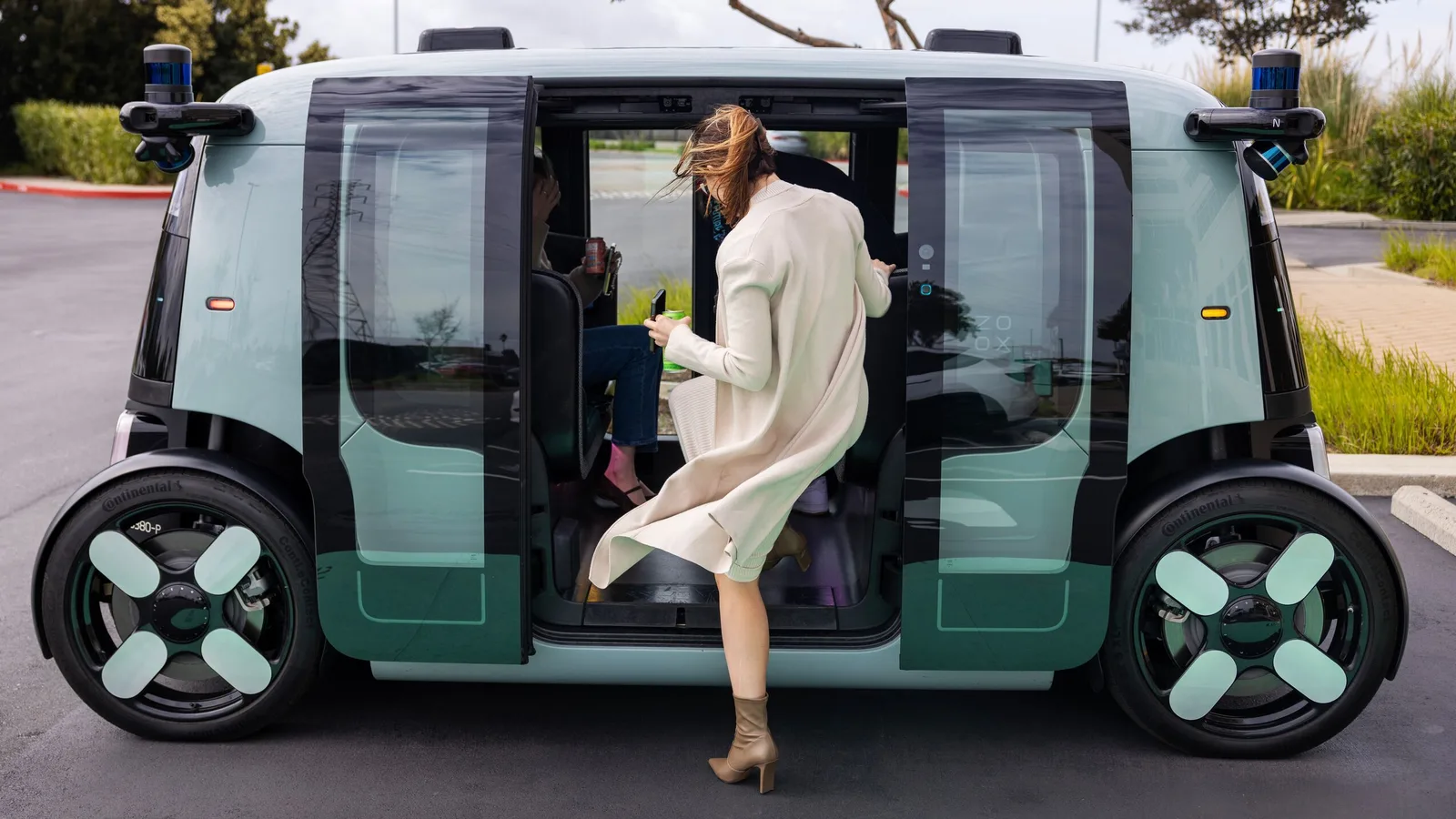
Why Zoox trended in Q3 2026
Reuters reported that Zoox won the first US approval for paid robotaxi rides in a vehicle with no human controls, and CNBC reported it expanding into more US markets.
Zoox reached a regulatory first this quarter. In late July, Reuters and NBC News reported that Amazon's Zoox had won the first US approval for paid robotaxi rides in a vehicle with no human controls, and AP reported that some robotaxis had been approved to operate without steering wheels. Zoox began charging for rides on the Las Vegas Strip in August, FOX5 reported, and began serving Harry Reid International Airport on 3 September. CNBC reported Zoox expanding into more US markets. The New York Times ran the headline "Can This Self-Driving ‘Toaster on Wheels’ Charm San Francisco?"
Safety was the other theme. In August, Axios reported on how Zoox decided its robotaxi was safe, and Fox Business reported the CEO saying autonomous vehicles need regulation, months after a Zoox drove into a Las Vegas fire scene in June. In late September, KSNV reported that a Zoox crash on the Las Vegas Strip raised questions about driverless safety.
What is still unclear is what caused the Strip crash.
Demo forensics
Partially verifiableSome axes were disclosed. The important gap is named below.
Zoox's biggest moment this quarter was a claim, not a video. On 30 July it announced that NHTSA had granted it the first commercial exemption for a purpose-built robotaxi with no steering wheel or pedals, so it could start charging fares. NHTSA confirmed the approval to Reuters. Paid rides then began on the Las Vegas Strip in August and at Harry Reid International Airport on 3 September, and members of the public rode on the airport's launch day. Zoox describes the service as autonomous, and its safety page also says remote TeleGuidance operators "provide guidance to vehicles". Its 30 July exemption post does not mention TeleGuidance or remote operators, and Zoox does not say how often that guidance happens on a paid ride.
The claim that the approval came first is backed by the regulator. Two other statements are less settled. Zoox ties the exemption to its "diligent safety approach" but has not published the data behind it. Its rider numbers also do not agree: its own post says "more than half a million riders", while FOX5 reported 12 days later that Zoox said "nearly 1 million".
Was the viewer told whether the robot was autonomous, teleoperated, or a mix?
“Mission Control monitors fleet health and efficiency, TeleGuidance provides guidance to vehicles, and Zoox Support assists riders in real-time.”
“All remote operators must be located in the United States, NHTSA said. Zoox must publish maps of areas indicating where the vehicles are operating.”
“a remote operator monitoring the vehicle's status — guided it backward out of the scene by teleguidance, allowing firefighters to place cones and close off two of the three travel lanes.”
Was the footage real-time, and was any speed change or cut disclosed?
“Dozens of people were seen taking rides Thursday. While many expressed excitement about the new service, some travelers voiced cautious optimism.”
“Zoox will begin offering rides at Harry Reid International Airport in Las Vegas on Thursday, Sept. 3, 2026. (Image courtesy Zoox)”
A staged set, or the real place the robot is meant to work?
“With this latest commercial exemption, Zoox can now move toward charging fares. Our teams have been working closely with regulators in Nevada and California, where we currently operate our service, to complete all necessary requirements for commercial operations.”
“Zoox has begun charging passengers for rides in its driverless vehicles on the Las Vegas Strip, with permission from the National Highway Traffic Safety Administration.”
“The service launched today, with designated pickup and drop-off locations at both Terminal 1 and Terminal 3.”
One take, or evidence it works more than once?
“Zoox currently carries passengers in parts of Las Vegas and San Francisco as part of testing. The exemption would allow Zoox to charge them fees, subject to state and local approvals.”
“Since then, it has expanded the number of U.S. testing locations and allowed members of the public to hail free driverless rides in parts of San Francisco and Las Vegas.”
Did anyone not employed by the maker see it work with their own eyes?
“She rode a Zoox robotaxi to her hotel Thursday — the same day the airport service launched.”
“I hailed one for a trip from one end of the Las Vegas Strip to the other to see what the experience was like.”
Does what was shown support what was said?
“Today, Zoox is excited to announce that we have received the first-ever commercial exemption for a purpose-built autonomous robotaxi”
“Amazon’s Zoox unit won U.S. approval on Wednesday for limited commercial deployment of its novel steering-wheel-free robotaxis, a first for the autonomous ride industry, the U.S. auto safety agency said Thursday.”
““We can say pretty clearly that the systems in place on the Zoox exceed the equivalent performance requirements of a compliant vehicle,” he said in an interview. “But we still want to make sure that the automated driving system will operate appropriately.””
“With this exemption, which is based on our diligent safety approach, we are now granted federal regulatory approval to charge for our robotaxi service.”
“Since then, we’ve welcomed more than half a million riders, and another half a million have signed up for our waitlist.”
“Zoox said that since launching its free service, it has carried nearly 1 million riders across Las Vegas, San Francisco, Austin and Miami.”
- How often TeleGuidance operators step in during paid rides, and what exactly they can tell a vehicle to do. Zoox's safety page says the function exists but gives no rate. Older third-party write-ups cite a Zoox figure of under 1% of mission time. We did not open a current Zoox source for that figure, so we do not cite it.
- Whether Zoox's announcement photos and footage are real-time or edited. Coverage we opened uses Zoox-credited images, and we have not reviewed any Zoox video frame by frame. The service itself runs in public and in real time. The promotional material is a separate question.
- The safety data behind NHTSA's finding of "equivalent overall safety". Zoox calls its approach "diligent" but did not publish supporting figures in the post we opened. Tech Times quotes Advocates for Highway and Auto Safety saying there was "no data behind the promises". That quote reached us third-hand (Tech Times citing Al Jazeera citing the AP), so we do not cite it as evidence.
- The rider count. Zoox's 30 July post says "more than half a million riders". FOX5 on 11 August attributes "nearly 1 million riders" to Zoox across four cities. We could not tell whether this is a different way of counting, rapid growth, or an error in the retelling.
- The 25 September collision on Las Vegas Boulevard at Four Seasons Drive. Zoox told KSNV no passengers were aboard. We found no published finding on whether the vehicle was driving itself or getting remote guidance at the time, and the Nevada Highway Patrol investigation had not reported. We do not count or rank incidents.
- The exact date paid rides started, reported as 10 August. We saw it only in secondary coverage and did not open a Zoox statement confirming it.
- The lifting of Nevada's 100-vehicle cap. We saw it only in headlines and did not open a state or Zoox source.
- Whether the riders KTNV interviewed paid full fare, rode on promotional credit, or were invited. The report does not say.
- How a passenger with no manual controls can stop the vehicle in an emergency. Tech Times reports that NHTSA has not yet said how this should work, and we did not open the NHTSA rulemaking.
Demo forensics measures disclosure, not quality — and is independent of the RoboScore. We grade the disclosure, not the machine — absence of a disclosure is not evidence of deception. How we grade