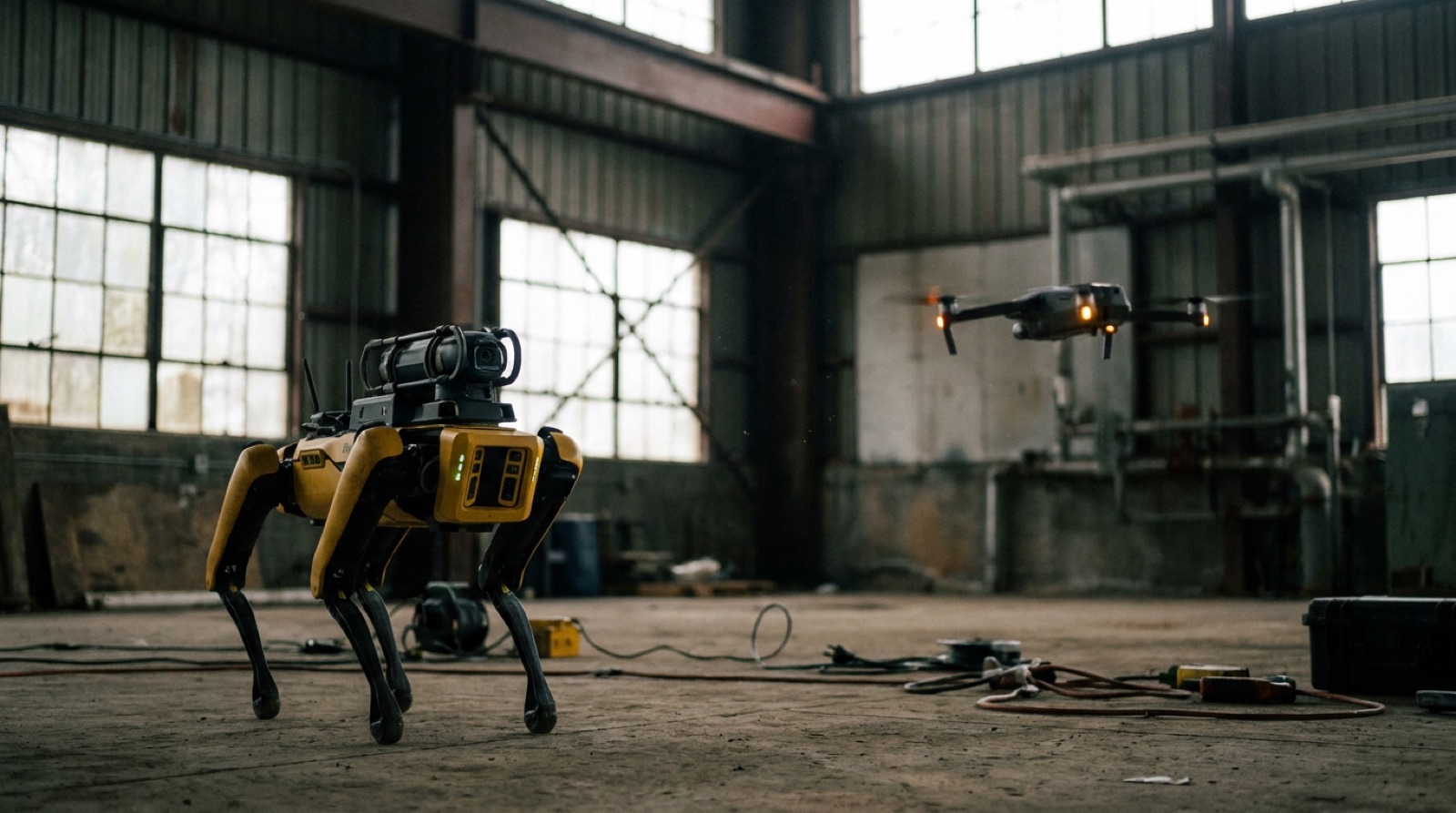
A 90-day playbook to deploy autonomous inspection rounds
From platform delivery through first scheduled autonomous round: site mapping, route design, payload commissioning, and data pipeline

Why 90 days matters
The canonical failure story for a quadruped inspection program is not a technical failure — it is a timeline failure. The robot arrives. Operator training happens. A few manual teleop rounds are run to impress stakeholders. Then a series of seemingly small dependencies — a section of the facility that needs temporary scaffolding removed before mapping, an IT ticket for firewall rules to let the robot's data reach the CMMS, a calibration interval for the thermal payload that nobody scheduled — stretch the path to first autonomous round from the planned 8 weeks to 9 months.
A structured 90-day plan with explicit milestones and dependency tracking prevents this drift. The playbook below is organized into three 30-day phases. Each phase has defined outputs that must be complete before the next phase begins.
This playbook assumes a single-robot, single-site deployment on an enterprise inspection platform with a commercial autonomy software package. Adjust timelines for multi-robot deployments or lower-cost platforms requiring additional engineering investment.
Pre-deployment checklist (Weeks 0–1, before hardware arrives)
These items must be resolved before the robot is powered on. Resolving them after delivery adds weeks.
Site readiness:
- Primary inspection routes identified and documented (list of asset points, floor path, stairwell or elevation changes)
- Temporary obstructions on planned routes removed or scheduled for removal
- Charging location identified with 110V/220V outlet accessible (confirm voltage with vendor)
- Docking station mounting location confirmed and floor space cleared
- Network access point within wireless range of dock location (confirm protocol with vendor: 5 GHz WiFi, LTE, or private LTE)
- IT network access granted for robot IP address range (outbound to vendor cloud or on-premise server as required)
Data destination readiness:
- CMMS or inspection platform integration scope defined (manual export, API, or full pipeline — see TCO article for options)
- Data format for inspection reports agreed with operations team (PDF, CSV, CMMS work-order trigger)
- Named data owner identified: who reviews inspection reports and takes action on anomalies
Team readiness:
- Primary operator named and scheduled for manufacturer training
- Backup operator named (minimum two people trained; single-person dependency is a program risk)
- Safety review completed: confirm no ATEX or confined-space entry procedure conflicts with planned routes
Phase 1: Platform commissioning and site mapping (Days 1–30)
Goal: The robot is operational on-site, operators are trained, and one full site map is complete covering all planned inspection routes.
Week 1–2: Delivery, setup, and operator training
Platform delivery typically includes manufacturer-led on-site setup and initial operator training. For enterprise platforms, this training is commonly 1–3 days and covers: powering on and off safely, emergency stop procedures, payload attachment and detachment, basic teleoperation, WiFi/network configuration, and an introduction to the autonomy software interface.
Do not shorten this training. The confidence to operate the robot safely in a real plant environment comes from hands-on practice, not from watching vendor videos. Schedule the training for both the primary and backup operator in the same session.
End of Week 2 milestone: Both operators can safely operate the robot in manual teleoperation mode and power-cycle it without assistance.
Week 3–4: Site mapping
Teach-and-repeat mapping — manually walking the robot along each planned inspection route at normal inspection speed while it builds a localization map using onboard SLAM sensors — is the foundation of autonomous operation. Every route to be run autonomously must be mapped this way.
Mapping best practices:
Map one route segment at a time. Break the full inspection area into logical segments (e.g., Level 1 motor room loop, Level 2 pipe rack, stairwell transition). Map and verify each segment before linking them.
Map at the intended inspection speed. If the robot will later pause for 15 seconds at each asset point to capture thermal data, pause for that duration during the mapping pass. The localization quality correlates with the match between mapping behavior and playback behavior.
Document map coverage explicitly. For each route segment, record: start point, end point, number of waypoints, assets captured, total route time, and any known environmental variables (doors that must be open, forklift traffic windows to avoid).
Test playback immediately after mapping. Run the mapped route in supervised mode — supervised mode means the robot runs autonomously while an operator monitors and is ready to stop it — within 24 hours of mapping. Identify any waypoints where the robot deviates from the intended path or requests operator confirmation. Resolve these before the mapping session is considered complete.
Common mapping problems and fixes:
- Robot deviates at a specific waypoint: Check for reflective surfaces (polished metal, mirror-glass) near the problem location; LIDAR-based localization can be confused by unexpected reflections. Add a physical reference marker if the environment permits.
- Route fails to replay after an environmental change: A moved piece of equipment, new scaffolding, or a palletized shipment stored near the route invalidates local map sections. Remap the affected segment.
- Stairwell transitions fail: Stairwell mapping requires careful control of gait parameters. Follow the manufacturer's specific guidance for stair mapping; it typically differs from flat-floor mapping.
End of Phase 1 milestone: All planned inspection routes are mapped and each route has been verified in supervised autonomous playback with no operator interventions required.
Phase 2: Payload commissioning and data pipeline (Days 31–60)
Goal: Each inspection payload is calibrated and verified, the robot captures usable inspection data at every planned asset point, and data reaches the named destination system in usable format.
Week 5–6: Payload installation and calibration
Each payload must be commissioned separately. For a thermal camera payload, commissioning includes:
- Physical mounting and cable connection per manufacturer specification
- Focal length and field-of-view verification for the planned inspection distances
- Non-uniformity correction (NUC — a calibration procedure that corrects thermal camera sensor offset non-uniformity, ensuring accurate temperature readings across the full image) run per the manufacturer's recommended interval
- Emissivity settings configured for the primary asset material (painted metal, bare aluminum, rubber, etc. have different emissivity values)
- Verification of temperature accuracy against a calibration reference target at the planned working distance
For acoustic imagers, calibration includes background noise baseline mapping at the site to establish a detection threshold above ambient noise.
For gas detectors, bump test — a quick functional check that exposes the sensor to a known concentration of test gas to verify the alarm triggers — and full calibration against certified reference gas must be performed per the manufacturer's interval before any inspection data is considered valid.
Do not skip payload calibration. A thermal image from an uncalibrated camera produces a visually impressive report with numerically meaningless temperatures.
Week 7–8: Data capture verification
With payloads calibrated, run each inspection route in supervised mode and verify data quality at every asset point:
- Thermal images: correct framing on the asset, no motion blur, temperature readings in expected range for normal-operating assets
- Acoustic captures: background subtracted, frequency range configured for target leak type
- Visual images: correct framing, adequate lighting, no lens flare
Document the expected output for each asset point in normal operating condition. This baseline is what future inspection rounds will compare against to detect changes.
Data pipeline commissioning:
Simultaneously with data capture verification, confirm that inspection data is reaching the destination system:
- Run one complete inspection round and export the full data package
- Confirm the package is received by the named data consumer (CMMS, inspection platform, or named person)
- Confirm the format is usable: images open correctly, temperature readings import without errors, reports render as intended
Fix any format, permission, or connectivity issues before Phase 3.
End of Phase 2 milestone: At least one complete supervised autonomous round has produced a full inspection dataset that has been verified for quality at every asset point and successfully delivered to the data destination system.
Phase 3: Scheduling, docking, and first autonomous round (Days 61–90)
Goal: The first fully scheduled, unsupervised autonomous inspection round runs successfully and produces a report that the operations team uses for maintenance decisions.
Week 9–10: Dock commissioning and autonomous handoff
The docking station must be commissioned before unattended autonomous operation is possible. Commissioning includes:
- Dock positioning: the robot must approach, align, and dock from the planned return path angle without operator guidance. Test this transition 10–15 times until it is reliable.
- Charging verification: confirm the robot charges to full between rounds in less time than the planned round interval
- Data offload: confirm that data captured during the round uploads from the robot to the destination system automatically upon docking
- Autonomous round start: configure the first scheduled round trigger in the autonomy software — this is typically a time-based schedule or an operator-initiated "run now" command that the robot executes without human accompaniment
Week 11: First fully autonomous round
Run the first round with no operator present, but with an operator available on-call and monitoring the software dashboard remotely.
After the round completes:
- Review the inspection report against the baseline established in Phase 2
- Check that every waypoint was captured (the software should log any waypoints skipped due to navigation failures or operator emergency stops)
- Check dock return and charging status
- Identify any route segments that required unexpected interventions or produced low-quality data
Expect at least one issue on the first autonomous round. This is normal; it is why the supervised-mode phases exist.
Week 12: Calibration, adjustment, and handoff
Resolve any issues identified in the first autonomous round. Common resolutions: re-map a specific route segment, adjust a waypoint position, modify the payload capture dwell time at a specific asset.
Run a second fully autonomous round to confirm the resolutions held.
End of Phase 3 milestone: Two consecutive fully autonomous rounds have completed without operator intervention, data quality has been verified, and the operations team has accepted the first inspection reports as the new standard for that asset group.
Post-90-day operations cadence
Route maintenance: Plan on 30–60 minutes of route re-mapping per quarter to address environmental changes. Assign this to the primary operator as a standing task.
Payload calibration intervals: Follow manufacturer-specified calibration intervals for each payload. Build these into the facility's instrument calibration schedule.
Battery management: Monitor battery cycle count and capacity per the manufacturer's guidance. Battery degradation affects range and round completion reliability before it affects a single round's performance; track it proactively.
Anomaly review process: Establish a standing process for reviewing flagged anomalies from inspection reports. A report that is generated but not reviewed provides no value; the human decision to act on an anomaly is what converts inspection data into maintenance outcomes.
With autonomous rounds running, the program is in maintenance mode rather than deployment mode. The final article in this series, The quadruped vendor RFP: questions and red flags, provides the evaluation framework for organizations still in the procurement phase — including the RFP questions that reveal whether a vendor's autonomy claims match the 90-day deployment reality described here.
Discussion
0 commentsNo comments yet. Sign in to be the first.