Quadruped vs drone vs fixed sensors for inspection
Decision logic for choosing a mobility platform — when legs beat rotors, and when fixed sensors beat both
The platform decision nobody frames correctly
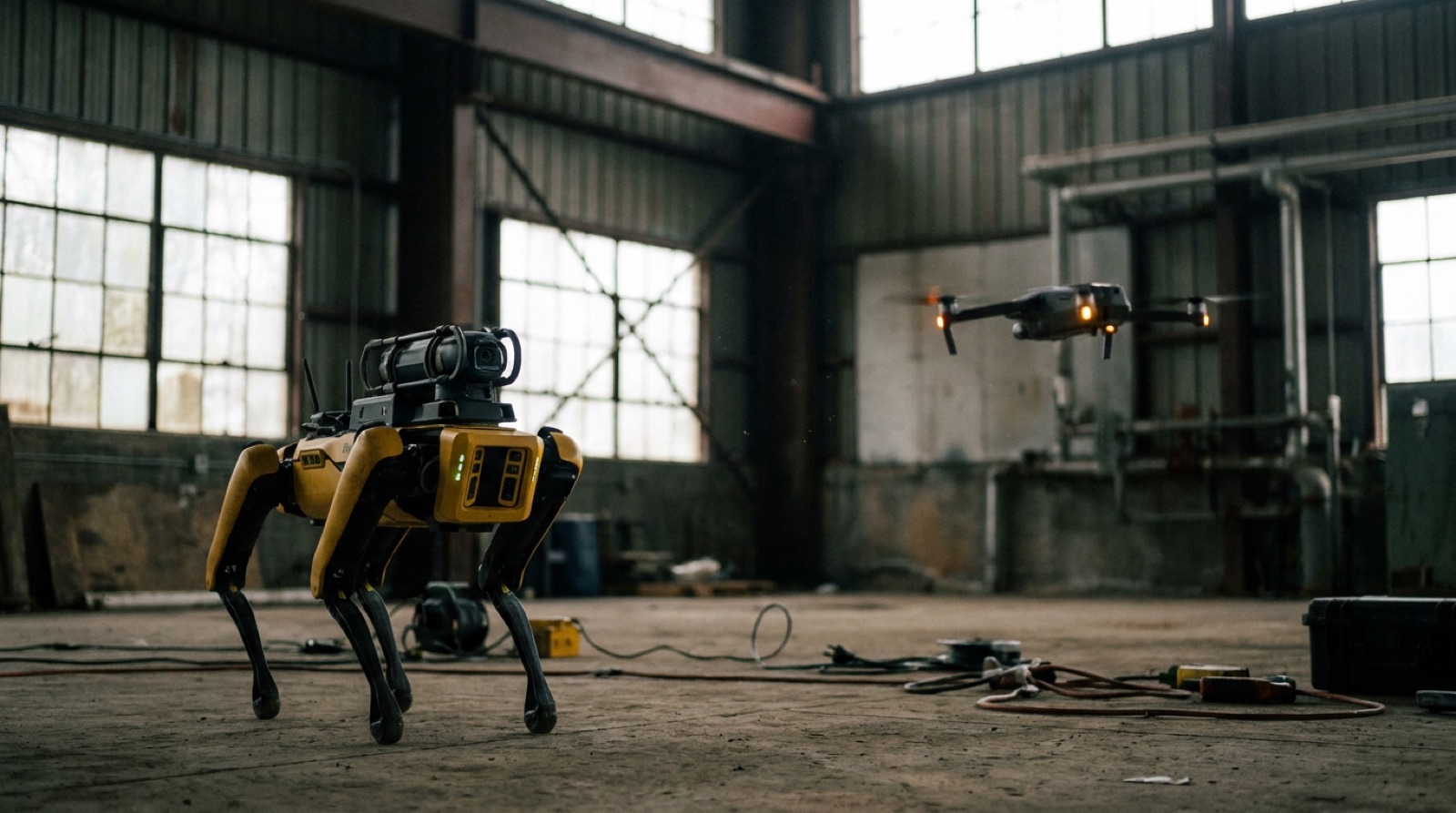
An asset integrity team at a large petrochemical facility is evaluating inspection technology. One vendor is pitching a quadruped that walks the pipe rack. Another is pitching a drone-in-a-box system — an autonomous drone permanently stationed in a weatherproof dock at the facility, capable of flying inspection routes without a human launch operator — for the outdoor storage tank farm. The controls engineer is quietly asking whether continuous-monitoring fixed sensors on the highest-priority assets would eliminate the need for either mobile platform.
All three are correct for different subsets of the problem. The question is never "which platform is best" in the abstract — it is which platform matches the geometry, sensor proximity requirement, inspection frequency, and regulatory context of each specific inspection task.
This article builds that matching logic. It also cross-references the drone-in-a-box economics covered in detail in the aerial inspection series; the comparison here focuses on the decision boundaries, not the full drone program TCO.
The three platform classes
Fixed sensors
Fixed sensors — permanently mounted instruments that monitor a specific point continuously — have no inspection cycle latency. They deliver readings 24/7/365 without dispatching anything. Modern wireless fixed sensors can transmit to a process historian or CMMS over industrial wireless protocols with battery lives measured in years.
Fixed sensors are optimal when: the asset count is small, the monitored parameter is well-defined and stable (temperature, vibration, pressure, gas concentration), and the value of continuous monitoring exceeds the cost of instrument purchase and network integration. They are not a replacement for mobile inspection in environments with hundreds or thousands of asset points, because the per-point capital cost becomes prohibitive, and because they cannot visually verify gauge readings, check valve positions, or detect novel anomalies that were not anticipated at instrument specification time.
Fixed sensors win when: high-criticality, high-consequence assets; continuous monitoring required; parameter is measurable with a single instrument type; asset count under approximately 50 monitored points.
Fixed sensors lose when: large asset populations; multi-parameter inspection required; visual condition assessment required; inspection intervals are irregular or event-driven.
Drones (aerial)
Drones excel at covering large outdoor areas rapidly. A drone can survey a tank farm roof, a substation perimeter, or a transmission corridor in a fraction of the time a ground vehicle would require. Drones are not constrained by ground obstacles, can achieve elevated vantage points that ground robots cannot reach, and are well-suited for large-area thermal or visual surveys from above.
The drone inspection series on this platform covers the regulatory, data, and operational constraints in depth. The relevant comparison points here:
Drones face significant limitations for indoor environments and confined spaces. The blade clearance required for safe indoor operation, the indoor GPS-denial challenge requiring SLAM or vision-based navigation — SLAM (Simultaneous Localization and Mapping) allows a robot to build a map of an unknown environment while tracking its position within that map, without relying on GPS — and the turbulence from spinning rotors near equipment surfaces constrain where drones can practically inspect.
Drones also cannot make physical contact with assets. Acoustic leak detection, vibration signature collection from physical contact, and close-proximity visual inspection of occluded surfaces are difficult or impossible from a hovering platform.
Drones win when: large outdoor survey areas; elevated assets (tank tops, tower structures, transmission lines); rapid wide-area coverage; access to areas unreachable from the ground; regulatory environment permits autonomous flight.
Drones lose when: indoor or confined-space inspection; sensor proximity to surface required; contact measurement needed; tight clearances or vibration-sensitive environments; areas where autonomous flight is not permitted.
Quadrupeds
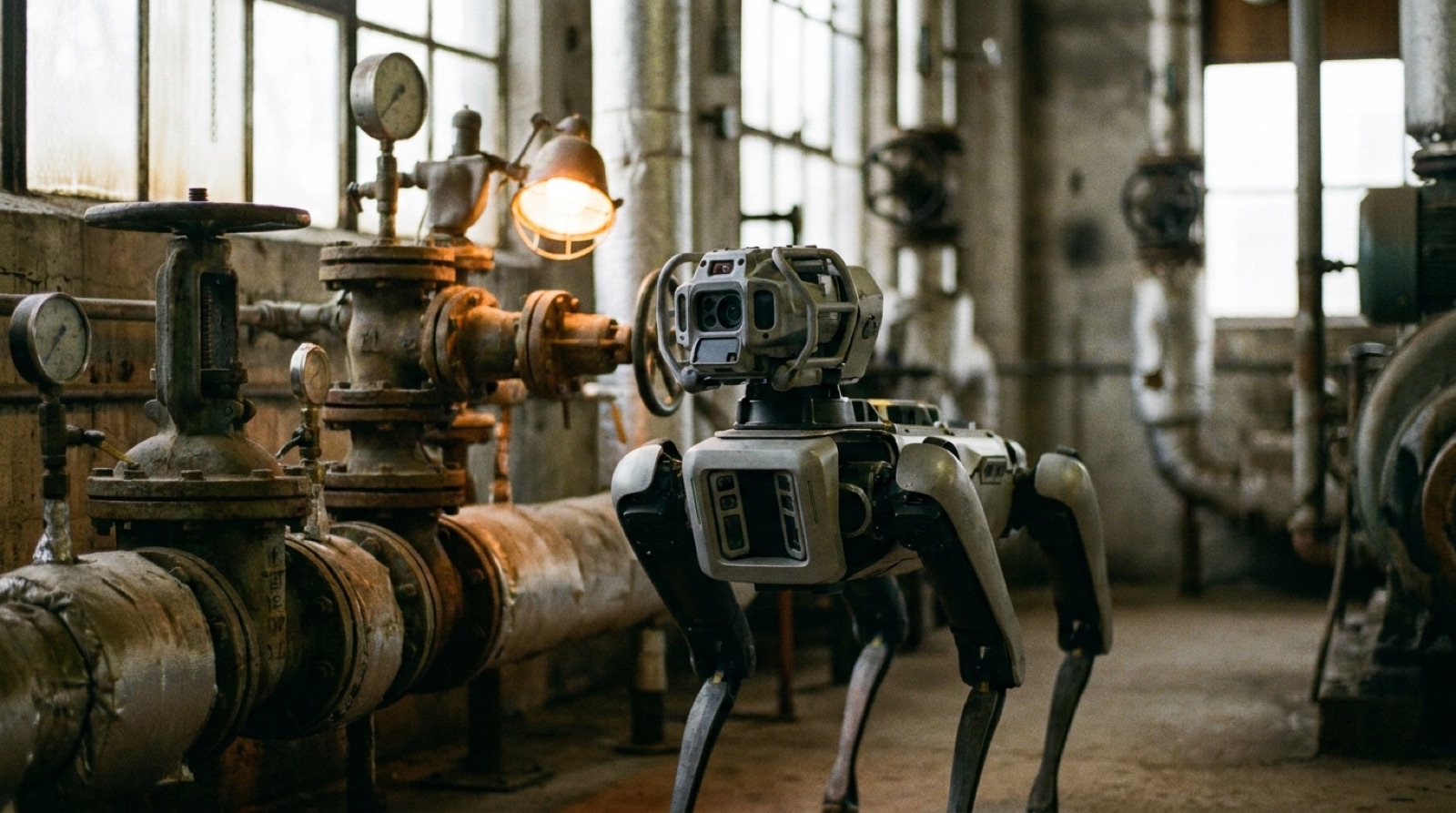
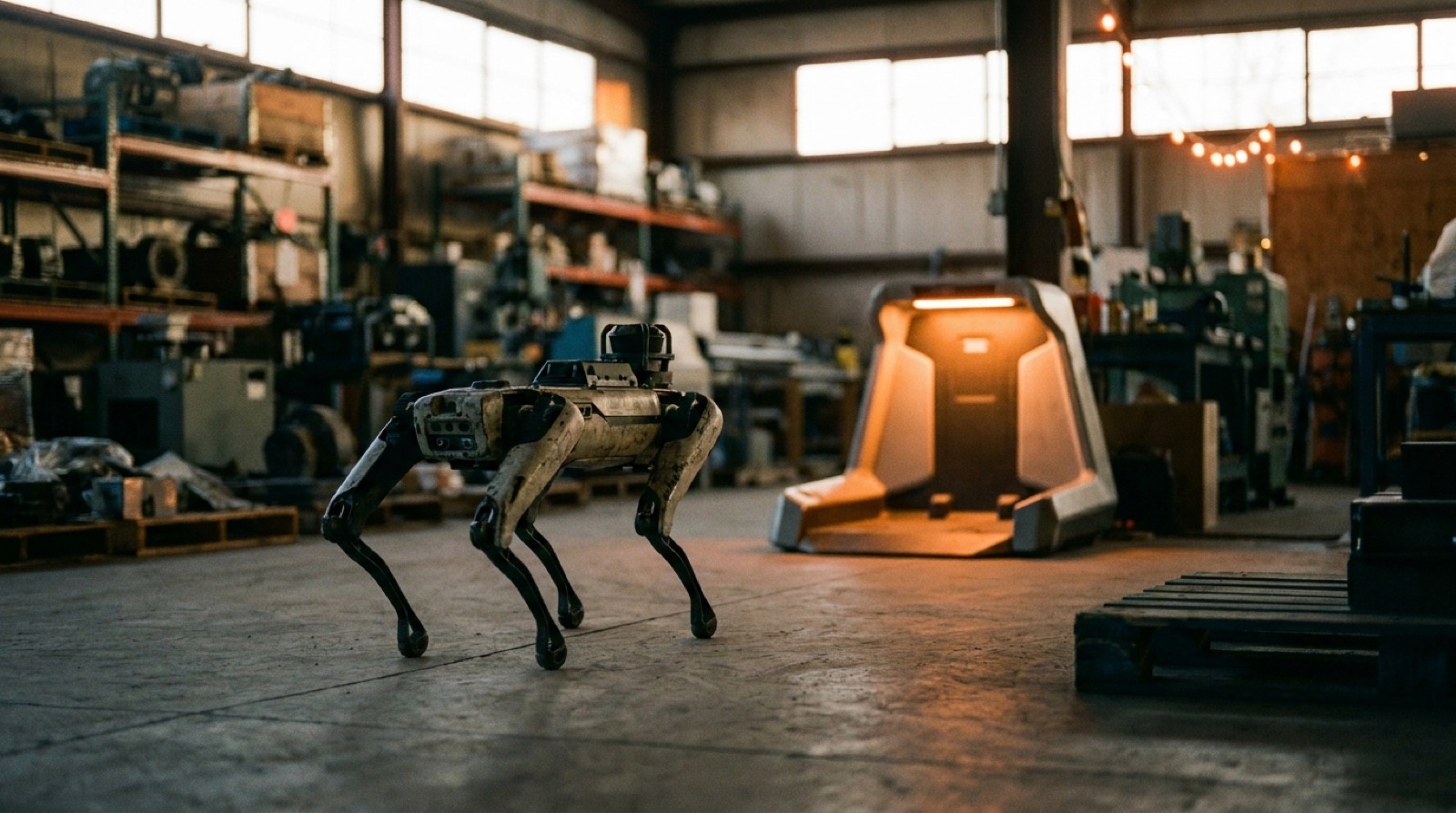
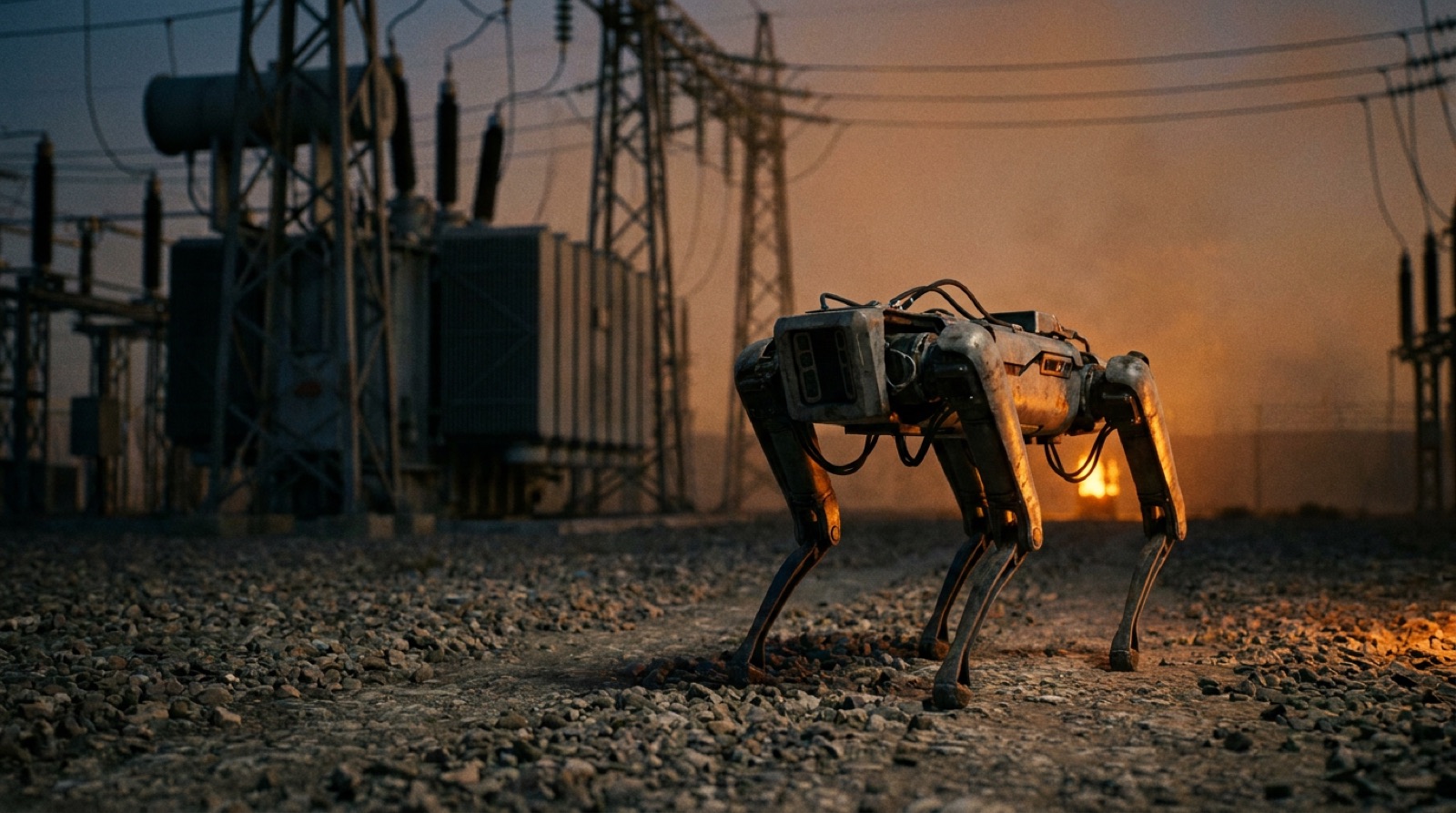
Quadrupeds — four-legged ground robots — are optimized for the environments where drones cannot safely fly and fixed sensors are too sparse to cover: indoor plant floors, pipe racks, pump houses, stairwells, and mixed indoor-outdoor facilities with changing terrain.
Their key differentiators:
Terrain traversal. A quadruped can climb stairs, step over cables and hoses, and maintain stable footing on grating, gravel, wet concrete, and uneven surfaces that would stop a wheeled vehicle. The dynamic gait control that makes this possible — gait control refers to the algorithm governing leg placement sequence and timing to maintain balance across terrain variations — is the primary engineering complexity that distinguishes quadrupeds from wheeled inspection robots and justifies their cost.
Sensor proximity. Because a quadruped walks the same floor path as a human inspector, it can position sensors at the same distances from assets that a human technician would use. Acoustic cameras require proximity of 0.5–2 meters to a leak source for reliable detection. Gas detectors need to sample air near the potential release point. Thermal cameras on a quadruped can be positioned at the same angle and distance as a handheld instrument.
Repeatable positioning. Teach-and-repeat autonomy — the process of manually walking the robot along a route once so it builds a localization map and can replay that route autonomously — produces inspection rounds that stop at the same coordinates on every cycle. This repeatability enables delta analysis: comparing this week's thermal image to last week's at the same position and distance.
Confined spaces and indoor environments. Unlike drones, quadrupeds do not create rotor wash, do not require airspace authorization, and do not face the clearance constraints that make indoor drone flight difficult in tight corridors or near machinery.
Quadrupeds win when: indoor industrial environments; stairwells and multi-level access; close-proximity sensor positioning; repeatable position-matched inspection; mixed terrain; environments where drones cannot fly.
Quadrupeds lose when: wide-area outdoor survey (too slow compared to drones); elevated access above the robot's reach; environments requiring continuous monitoring (too expensive vs. fixed sensors); environments with sustained water immersion or extreme chemical exposure beyond the platform's IP rating.
Head-to-head decision table
| Criterion | Fixed sensors | Drone | Quadruped |
|---|---|---|---|
| Indoor industrial floor | Poor (sparse) | Limited (clearance/rotors) | Excellent |
| Outdoor large area | Good (point coverage) | Excellent | Slow |
| Stairwells / multi-level | Poor | Poor | Good |
| Continuous monitoring | Excellent | Poor | Poor |
| Sensor proximity (< 1 m) | Excellent | Difficult | Excellent |
| Acoustic leak detection | Point sensors only | Poor (noise) | Excellent |
| Gas detection near source | Good (point) | Fair (BVLOS limits) | Good |
| Visual gauge reads | Poor | Fair (resolution/angle) | Good |
| Elevated asset tops | Poor | Excellent | Poor |
| ATEX / Ex-rated environments | Available | Limited models | Available (ANYmal Ex) |
| Regulatory friction | None | Moderate-high | None |
| Capex per inspection point | Low (high count) / High (low count) | Low (large area) | Medium |
| Speed of area coverage | N/A | Fast | Slow |
| Data repeatability | Continuous | Moderate | High (teach-and-repeat) |
Mixed-platform programs
Most facilities above a certain size deploy more than one platform class. A common architecture at a mid-to-large industrial site:
- Fixed sensors on the 20–30 highest-criticality assets (continuous monitoring, immediate alarm)
- A quadruped for indoor plant and stairwell inspection rounds (monthly or weekly autonomy)
- A drone for outdoor tank farm, perimeter, and elevated structure survey (quarterly or event-driven)
Each platform handles the task class it is optimized for. The data pipeline connects all three to the same CMMS or inspection platform.
The critical design discipline is to specify which tasks each platform covers before procurement, not after. Buying all three platforms and then sorting out coverage is how programs accumulate redundant capability and underutilized hardware.
Payback comparison
Inspection payback is driven by avoided costs: scaffold-and-climber mobilization avoided, maintenance failures caught before they become unplanned shutdowns, regulatory inspection documentation satisfied, and insurance premium adjustments for documented inspection programs.
Representative avoided cost benchmarks from facilities that have published or disclosed results: a single avoided scaffold mobilization at a process plant saves $5,000–$20,000 in direct costs. An unplanned shutdown avoided by catching a heat signature on a motor bearing before failure can save $50,000–$500,000 depending on process. These figures justify the cost of an inspection program for most industrial facilities with moderate asset density.
The platform comparison for payback: drones recover cost fastest on large outdoor facilities because they replace expensive manned aerial inspection (rope access, lift equipment). Quadrupeds recover cost fastest on dense indoor facilities where human inspection requires confined-space entry, gas-atmosphere monitoring, and scaffold mobilization. Fixed sensors have the fastest payback for the highest-criticality individual assets where continuous monitoring prevents single high-consequence events.
The next article, Decision framework: matching quadruped to terrain, mission, and autonomy maturity, goes deeper on the quadruped-specific selection criteria — including the enterprise versus low-cost platform decision and what the price gap actually buys.
Discussion
0 commentsNo comments yet. Sign in to be the first.