Payback and deployment models for security robots
Where patrol robots save guard hours — and where they add monitoring burden
Deployment model determines everything
The financial and operational case for a security robot is not uniform across deployment scenarios. A wheeled patrol robot replacing a foot-patrol route at a corporate campus will have a materially different payback timeline than the same robot added to a warehouse with a fixed guard post. A drone-based perimeter system at a utility substation will have entirely different economics from either of those.
Before running payback math, a buyer needs to identify which deployment archetype applies to their environment. Three archetypes account for the majority of commercial security robot deployments.
Archetype 1: Outdoor perimeter patrol
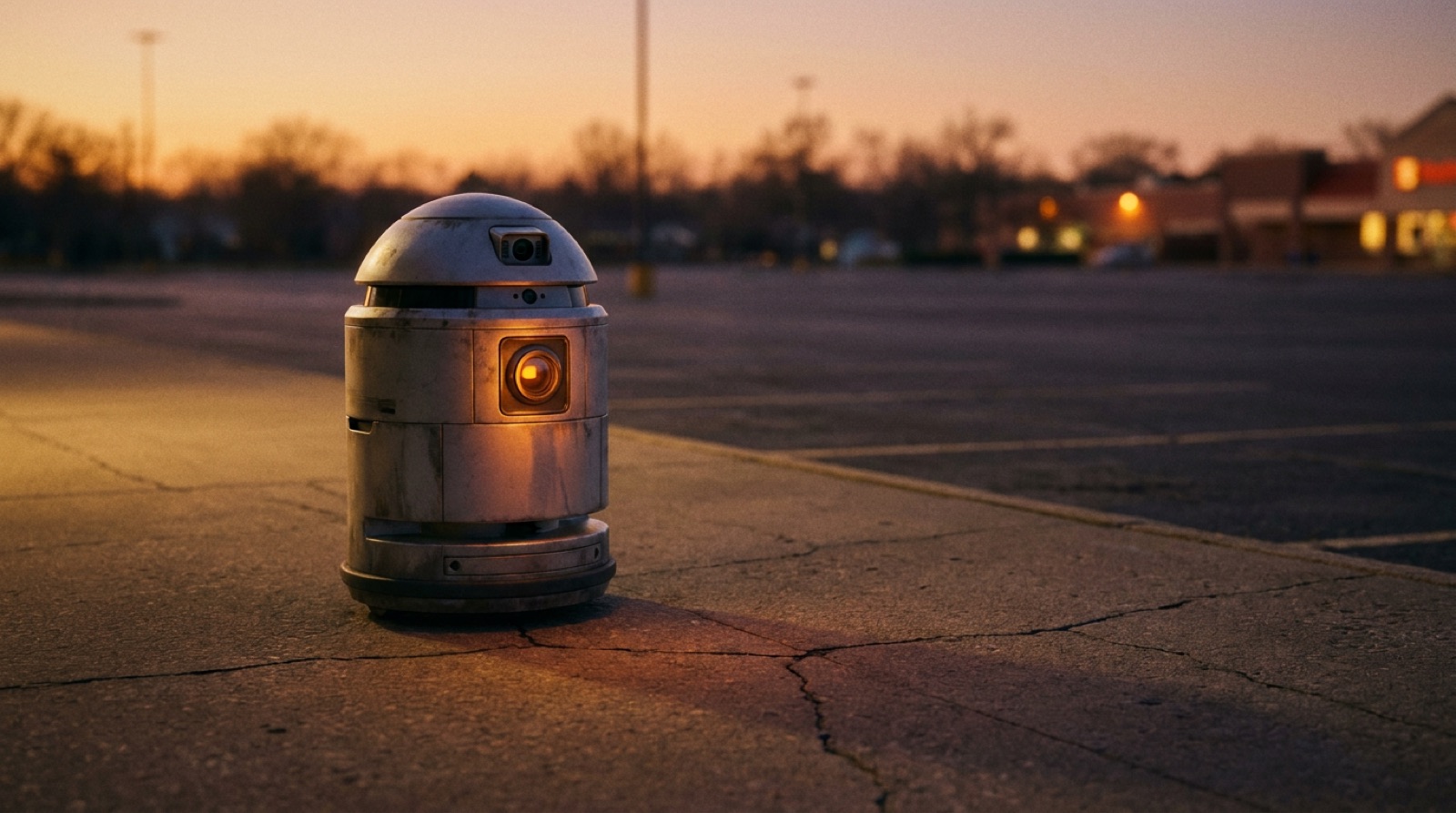
What it is. The robot operates on a defined outdoor route — perimeter road, parking lot, campus pathway — on a scheduled or continuous basis. Guards at fixed posts or in a patrol vehicle are the backup response layer.
Where this works. Large campuses, logistics parks, utility facilities, correctional perimeters, airport ground-side operations, and stadium or event venue security. Patrol routes of 0.5 miles or more, where a guard walking the same route would complete fewer than four to six circuits per shift.
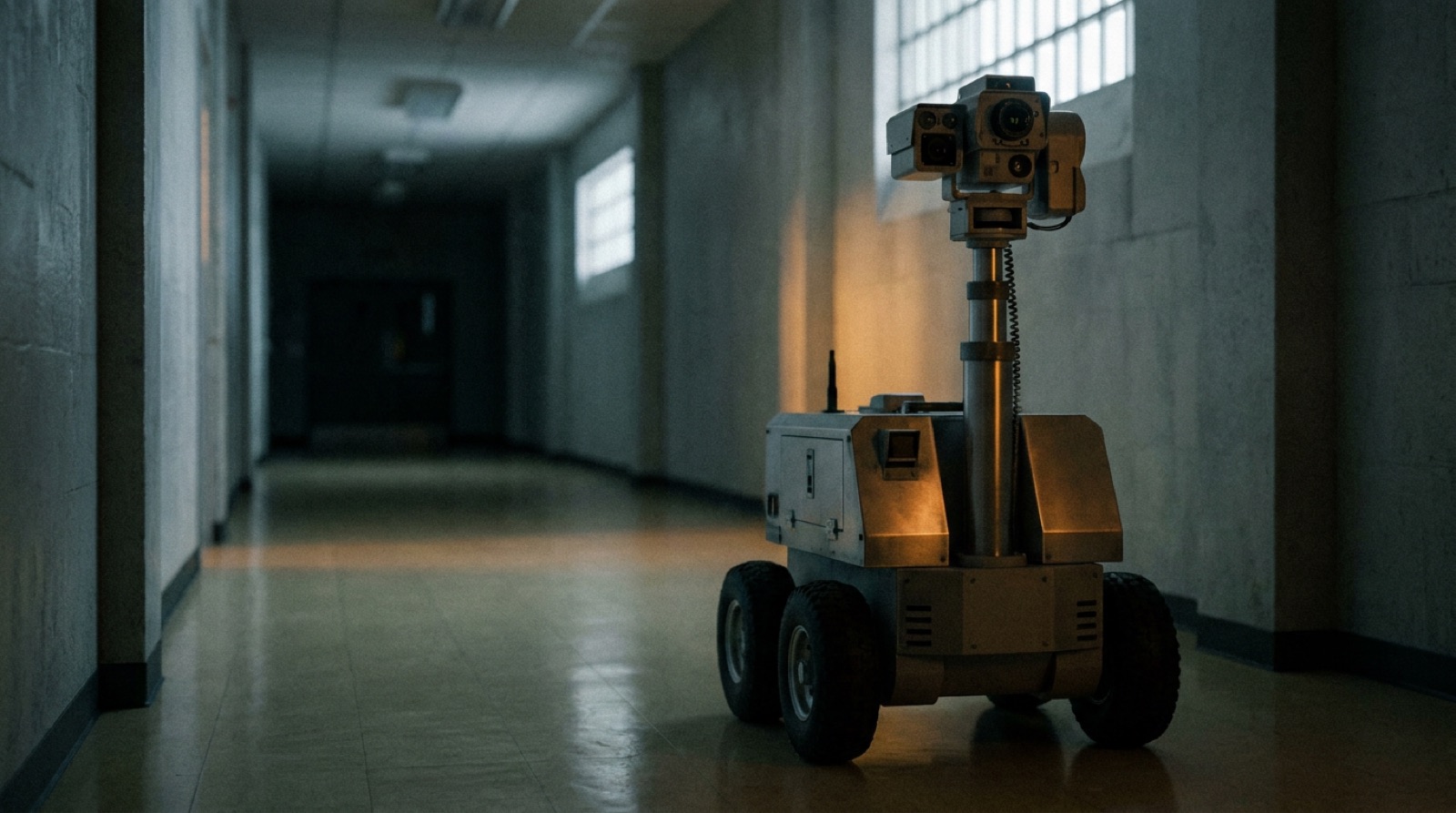
The guard-hour math. In a standard overnight shift, a single guard walking a 0.8-mile perimeter route completes roughly 10–12 circuits in eight hours. A continuously patrolling wheeled robot on the same route completes 30–50 circuits over the same period, depending on speed (most outdoor patrol robots operate at 2–4 mph on patrol routes) and charging cycle time. The robot's coverage consistency is provably higher; the guard's response capability is provably higher. The practical payback case is that the robot patrols while the guard remains available for response duties.
Representative platforms. The SMP Robotics Argus S5.3 is an outdoor-only wheeled platform designed for perimeter work. The Knightscope K5 operates on both indoor and outdoor flat surfaces. The Ascento Guard is a two-wheeled outdoor platform capable of handling mixed terrain including gravel, grass, and low curbs that defeats flat-wheeled platforms.
Payback timeline. In this archetype, payback is most naturally measured by guard-hour savings: if the robot enables a two-person overnight patrol to operate as a one-person plus robot configuration, the annual guard-cost savings are the gross benefit. At $75,000–$105,000 per guard-year for a contractor-supplied FTE, and assuming a mid-range RaaS fee of $90,000–$120,000 per year, the robot operates near-cost-neutral in year one and may generate net savings from year two onward as RaaS fees remain fixed while guard labor costs rise.
Payback is slower when: the robot requires a dedicated monitoring operator, the patrol route requires significant environmental prep, or the robot's charging cycle reduces operational coverage below the shift requirement.
Archetype 2: Fixed-post augmentation
What it is. The robot supplements a fixed guard post — a lobby, a loading dock, a server room corridor — by providing continuous coverage during periods when the guard is occupied elsewhere, documenting all activity in a zone, and alerting the guard to anomalies requiring attention.
Where this works. Corporate lobbies, data center facilities, healthcare campuses where guards are periodically pulled to assist clinical staff, and multi-building campuses where a single guard monitors multiple access points. The robot does not replace the post; it fills the gaps when the guard is called away.
The guard-hour math. A fixed-post guard is already stationary. The robot does not save guard patrol hours here — it saves response lag time when the guard is momentarily unavailable, and it provides a continuous video and sensor record that the guard does not. The economic justification in this archetype shifts from labor replacement to documentation quality, deterrence, and incident response speed.
Monitoring burden risk. Fixed-post augmentation is the archetype most likely to add monitoring burden rather than reduce it. A robot in a busy lobby or access corridor generates a high volume of motion events. Without well-calibrated alert thresholds and clear SOPs for what requires a guard response versus what should be logged and dismissed, the robot creates additional work for the guard it is supposed to be augmenting.
Payback timeline. Direct payback through guard-hour savings is limited in this archetype. The value case is best expressed in terms of coverage availability (the post is never unstaffed), documentation completeness (every event in the zone is timestamped and recorded), and liability reduction (incident reconstruction is reliable). Buyers who require a direct financial payback number in this archetype are likely in the wrong deployment model.
Archetype 3: Drone perimeter patrol
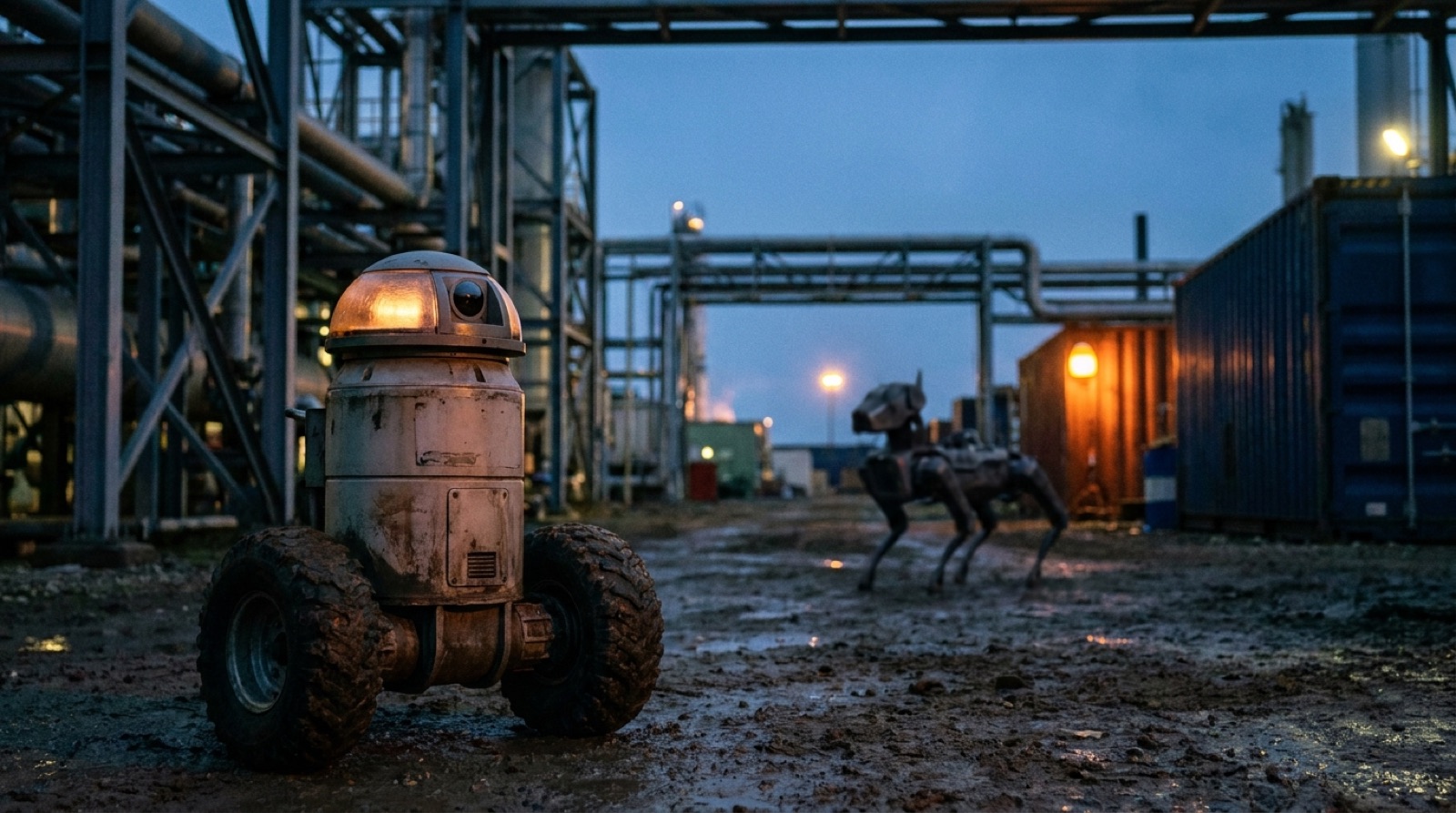
What it is. Autonomous drones or drone-dog hybrid systems patrol a defined perimeter — typically fence lines, open acreage, or coastline — from above, using thermal and optical sensors to detect intrusion. The Asylon platform includes both a ground robotic component (DroneDog) and an aerial component (Guardian Drone); these systems are often deployed as part of a layered perimeter detection system.
Where this works. Industrial perimeters, critical infrastructure (utility substations, water treatment, oil and gas sites), large agricultural or ranch properties, and military or government installations where fence-line detection is the primary security objective.
Key differences from wheeled patrol. Drone patrol covers area per hour that wheeled patrol cannot approach — a fixed-wing or multirotor drone at 30 mph covers a mile of fence line in two minutes. The tradeoff is complexity: drone deployments require FAA compliance for commercial operations, a defined battery cycle and docking protocol, weather windows (most commercial drones are rated to IP55 or lower, limiting operation in heavy rain, ice, or high wind), and a more sophisticated SOC integration to correlate aerial detections with ground-level response.
RaaS pricing. Drone-based perimeter systems typically carry higher RaaS fees than wheeled patrol platforms — representative ranges begin around $150,000 per year for a single-drone deployment with monitoring, and increase with fleet size and coverage area. The higher fee reflects greater system complexity and the monitoring overhead.
Payback timeline. The payback case for drone perimeter systems is most compelling at facilities where the alternative is multiple guards or guard vehicles patrolling a large perimeter continuously. A utility substation with a one-mile fence line, currently covered by two overnight guards plus a rover vehicle, can represent $200,000–$300,000 in annual guard-contract cost. A drone perimeter system at $150,000–$200,000 per year may produce positive payback in year two. The math is tighter than outdoor wheeled patrol and highly sensitive to monitoring costs.
RaaS pricing structures: what to know before you sign
RaaS contracts in security robotics are not standardized. The following structural points affect payback materially and should be reviewed before contract signature.
| Term | What to look for |
|---|---|
| Minimum contract length | Most vendors require 24–48 months. Shorter terms carry significant rate premiums. |
| Monitoring tier | Base RaaS may include hardware and connectivity only. SOC monitoring with alert triage is typically a separate tier. |
| Downtime SLA | Does the contract guarantee a replacement unit or a response time during outages? What is the credit mechanism if the SLA is missed? |
| End-of-term ownership | At the end of the RaaS term, do you own the hardware, return it, or renew at a revised rate? |
| Upgrade path | Robot software and hardware generations change. Is the contract locked to the current version or does it include upgrade rights? |
| Early termination | What is the financial penalty for early termination? This is critical if the deployment underperforms. |
Payback summary by archetype
| Archetype | Primary value driver | Typical payback horizon | Main risk |
|---|---|---|---|
| Outdoor perimeter patrol | Guard-hour savings on patrol route | 18–36 months at scale | Monitoring overhead negates savings |
| Fixed-post augmentation | Coverage availability + documentation | Qualitative; no direct payback | Adds monitoring burden without guard savings |
| Drone perimeter patrol | Guard-vehicle replacement on large perimeter | 24–48 months | Regulatory complexity, weather limits, high RaaS fees |
No archetype produces payback in year one on a single-unit deployment when monitoring labor is fully costed in. The earliest credible year-one payback scenarios involve multiple units at a single facility sharing one SOC operator, or a deployment that eliminates a guard position with a provable overlap in function.
For the full decision framework — how to match platform type to threat environment, what robots can and cannot do — continue with "Security robot platform decision framework."
Discussion
0 commentsNo comments yet. Sign in to be the first.