Security robot platform decision framework
Wheeled vs legged vs drone — matching the platform to your threat and environment
The capability gap that matters most
Before selecting a platform, buyers need to resolve one question that is more consequential than any hardware specification: what do you expect this robot to do when it detects something?
Security robots in the current commercial market are deterrence, detection, and documentation tools. They are not intervention tools. This is not a limitation that is narrowing quickly — it is a deliberate design and regulatory constraint that reflects the appropriate role of autonomous systems in civilian security operations.
Deterrence. A visible, moving robot on a patrol route changes the risk calculus for an opportunistic intruder. The deterrence effect is real and documented in security literature, though it diminishes against sophisticated adversaries who have studied the robot's patrol patterns.
Detection. Onboard sensors — visible-spectrum cameras, thermal imaging, LiDAR, acoustic sensors, and gas or environmental sensors on some platforms — generate alerts when preset thresholds are crossed. Detection quality is a function of sensor selection, environment calibration, and alert threshold tuning.
Documentation. A robot on a defined route creates a continuous, timestamped, GPS-logged record of the patrol. For incident reconstruction, liability management, and compliance documentation, this is often the most durable value delivered by a deployed robot.
What robots do not do. Commercially deployed security robots do not physically detain, physically intervene in an active incident, make armed or unarmed response decisions, administer first aid, or perform emergency evacuation functions. Buyers who scope the deployment with any of these expectations will be disappointed. The presence of an onboard speaker for verbal warnings — a feature on several platforms — does not change this analysis.
With this foundation established, platform selection becomes a matching exercise.
Platform type 1: Wheeled indoor patrol robots
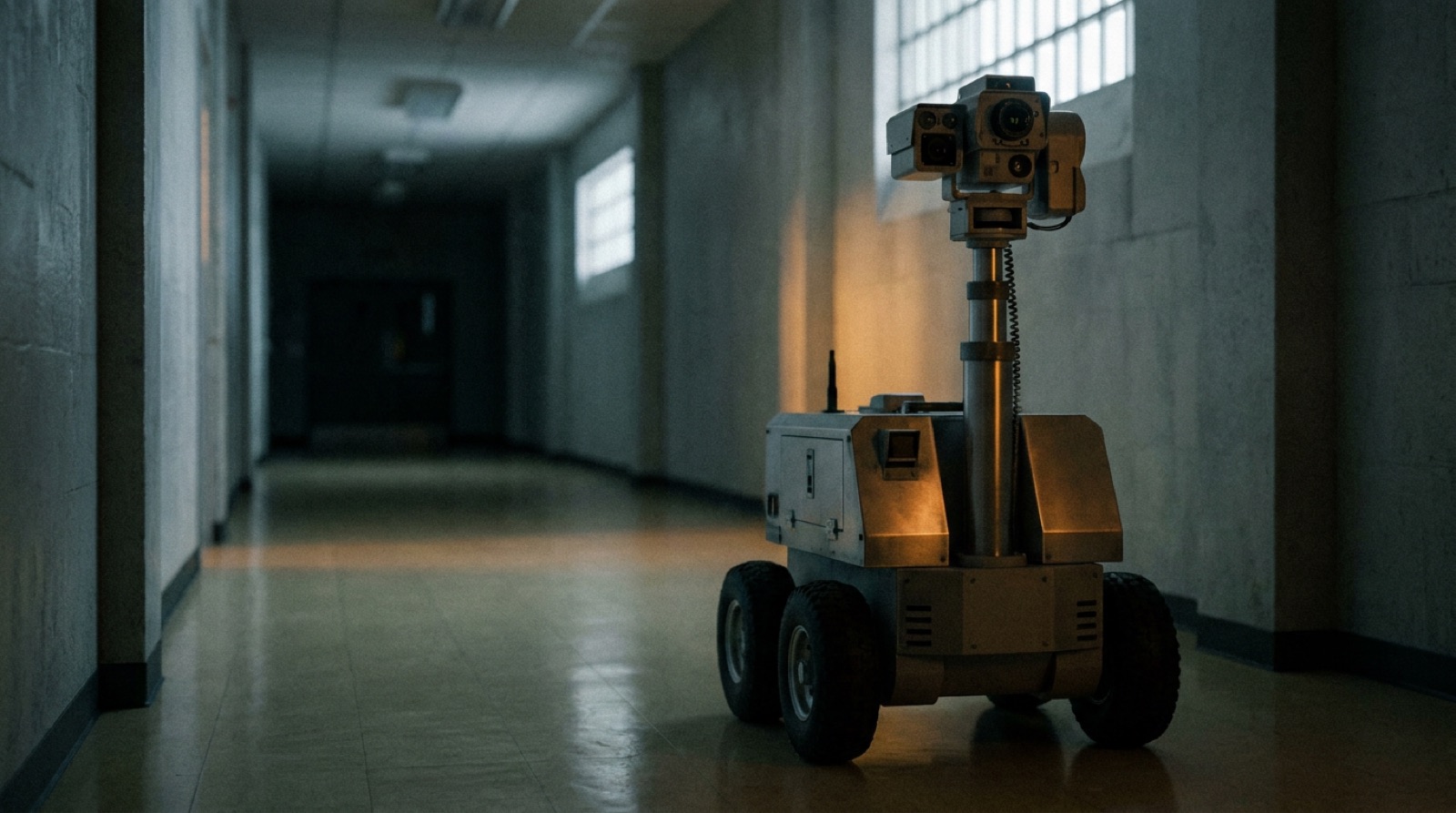
Mechanical characteristics. Four to six-wheeled differential-drive or omni-directional chassis. Designed for flat, smooth, or gently sloped indoor surfaces. Most platforms are rated for surfaces with transitions up to 2–3 cm and slopes up to 5–8 degrees. They are defeated by stairs, gravel, significant ramp grades, and wet or icy outdoor surfaces.
Sensor profile. Indoor patrol robots typically carry 2D or 3D LiDAR for navigation and obstacle detection, a fixed or pan-tilt camera array, and optional thermal. Audio pickup for glass-break and gunshot detection is available on select platforms.
IP rating and environment. Most wheeled indoor robots carry IP51 or IP54 ratings — splash-resistant but not suitable for outdoor deployment in rain. Operating temperature ranges are typically 0–40°C. Humidity tolerance varies.
Best-fit environments. Corporate lobbies, data centers, hospital corridors, shopping mall concourses, airport terminals, warehouse floors with smooth concrete, parking garages with flat decks.
Failure environments. Outdoor perimeters, facilities with significant debris or irregular surfaces, environments with temperature extremes, facilities where the robot must navigate stairs or multi-level access.
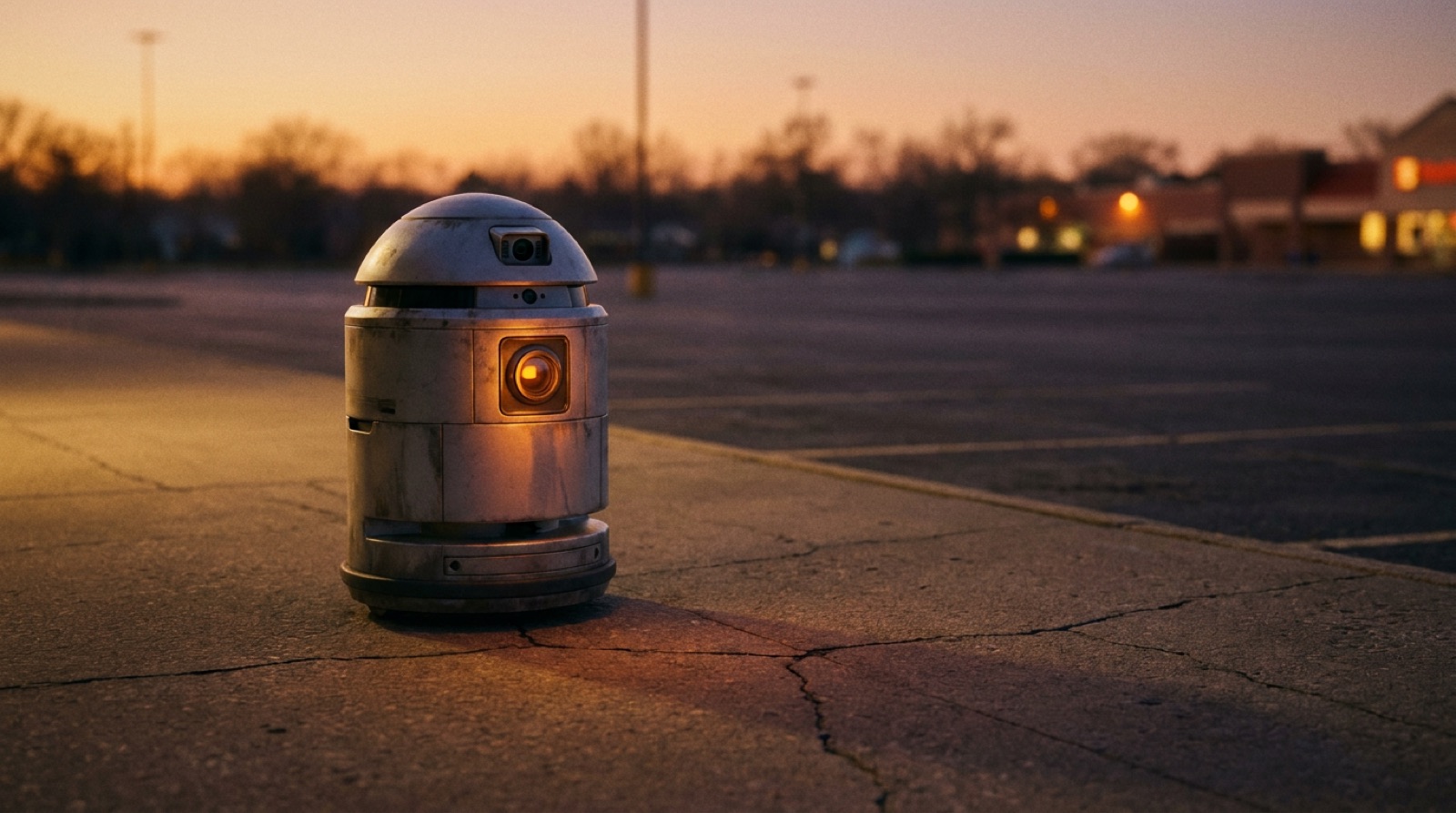
Representative platform. The Knightscope K5 is a wheeled indoor/outdoor-flat-surface robot with a 360-degree camera array, LiDAR, thermal imaging, and license plate recognition capability. It is designed for environments like campuses and parking lots rather than rough terrain.
Platform type 2: Wheeled outdoor patrol robots
Mechanical characteristics. Larger, heavier chassis than indoor platforms. Typically six-wheeled with differential or skid-steer drive. Designed for paved or graded outdoor surfaces — sidewalks, parking lots, perimeter roads — and some grass or gravel depending on wheel design.
Sensor profile. Expanded for outdoor environments: longer-range LiDAR, higher-resolution thermal imaging for detecting body heat against outdoor thermal background, GPS for route logging, and often cellular connectivity as primary network link rather than WiFi.
IP rating and environment. Outdoor robots should carry IP65 or higher for continuous outdoor operation. IP65 means dust-tight and protected against directed low-pressure water jets. IP66 adds protection against high-pressure jets. Outdoor platforms designed for all-weather operation may carry additional weatherization for temperature extremes (-20 to 50°C range is common in commercial outdoor security platforms).
Best-fit environments. Corporate campuses, logistics parks, utility substations, apartment complex perimeters, hospital campuses, large parking structures with exterior access.
Failure environments. Deep off-road terrain, significant grades (>15%), environments with standing water or flooding, facilities where the patrol route requires crossing driveways or streets without controlled traffic management.
Representative platforms. The SMP Robotics Argus S5.3 is an outdoor wheeled platform specifically designed for perimeter patrol on paved or graded surfaces. The Shark Robotics Colossus is a tracked outdoor platform originally designed for industrial and firefighting support applications, with sensor payloads adapted for security use.
Platform type 3: Legged outdoor robots
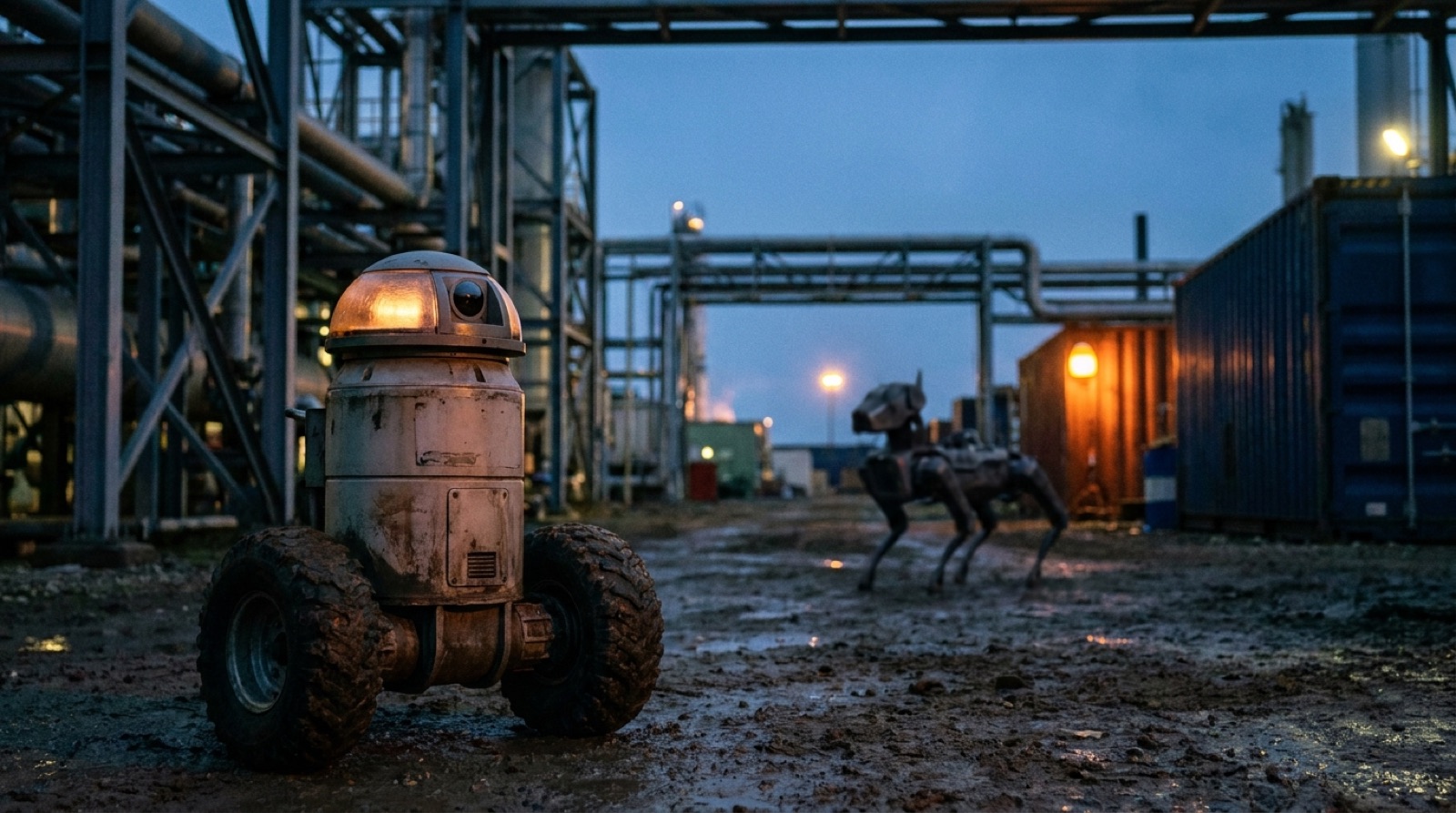
Mechanical characteristics. Legged or wheel-leg hybrid platforms navigate terrain that defeats wheeled platforms: stairs, curbs, gravel, grass, mud, and slopes. The Ascento Guard is a two-wheeled inverted-pendulum platform that crosses curbs and mixed outdoor surfaces. Boston Dynamics Spot-derived configurations are used in some industrial security deployments, though Spot itself is a general-purpose inspection platform, not a purpose-built security robot.
Sensor profile. Similar to outdoor wheeled platforms, with the addition that legged platforms typically have higher mounting points for sensors, providing better sight lines over obstacles.
IP rating and environment. Legged platforms designed for outdoor security typically carry IP54 or IP65. Verify for specific platforms.
Best-fit environments. Campuses with mixed terrain (stairs, curbs, grass), facilities with irregular outdoor surfaces, deployments requiring the robot to move between indoor and outdoor environments through standard doorways and thresholds.
Failure environments. Extremely rough terrain (construction sites, rocky perimeters), soft mud or deep snow, long-distance perimeter patrol where the speed of a wheeled platform is needed.
Platform type 4: Drone patrol systems
Mechanical characteristics. Multirotor or fixed-wing aircraft operating from a docking/charging station. Autonomous or semi-autonomous routing along defined waypoints. Altitude and speed capabilities vary significantly between platforms.
Regulatory requirements. Commercial drone operations in the US require FAA compliance under Part 107 or appropriate waivers. Persistent autonomous operations beyond visual line of sight (BVLOS) require a specific FAA waiver, which adds regulatory lead time and complexity. Operations in Class B, C, or D airspace near airports require additional coordination. Non-US deployments have equivalent regulatory frameworks that must be confirmed before procurement.
Sensor profile. Optical and thermal payload on the aircraft. Range and resolution are constrained by altitude and aircraft size. Most commercial security drones cannot identify facial features or read license plates from operational patrol altitude with current sensors.
IP rating and environment. Weather tolerance is a critical limitation. Most commercial security drones are rated to winds of 25–35 mph with reduced operational capability. Heavy rain, icing, and dense fog are operational no-go conditions. Buyers in coastal, mountain, or northern climates should model realistic annual operational availability against weather limits.
Best-fit environments. Large flat perimeters (utility, oil and gas, agriculture), coastlines, facilities where the alternative is a guard vehicle patrol.
Representative platform. The Asylon Guardian Drone is a tethered or free-flying aerial patrol system designed for critical infrastructure perimeter work, often deployed alongside ground robotics in a layered system configuration.
Capabilities comparison table
| Capability | Wheeled indoor | Wheeled outdoor | Legged outdoor | Drone |
|---|---|---|---|---|
| Flat indoor patrol | Excellent | Poor | Good | No |
| Outdoor flat patrol | Limited | Excellent | Good | No |
| Mixed terrain | No | Limited | Good | No |
| Aerial coverage | No | No | No | Excellent |
| Stairs/curbs | No | No | Good | No |
| All-weather outdoor | No | Good | Good | Limited |
| Speed (patrol) | 2–4 mph | 3–6 mph | 3–5 mph | 20–50 mph |
| Thermal detection | Good | Good | Good | Good |
| License plate reading | Yes (flat surface) | Yes | Limited | Limited |
| BVLOS compliance | N/A | N/A | N/A | Waiver required |
The environment-threat matrix
| Environment | Primary threat | Recommended platform | Notes |
|---|---|---|---|
| Corporate lobby / data center corridor | Unauthorized access, internal theft | Wheeled indoor | Fixed-post augmentation model; high false-alarm risk from foot traffic |
| Parking structure (flat) | Vehicle theft, assault, vandalism | Wheeled indoor/outdoor | Multi-level structures require elevator-capable or zone-per-level approach |
| Outdoor campus perimeter (paved) | Perimeter breach, vehicle intrusion | Wheeled outdoor | Knightscope K5 / Argus S5.3 archetype |
| Outdoor campus (mixed terrain) | Perimeter breach, irregular access points | Legged outdoor | Ascento Guard archetype; assess terrain specifics |
| Critical infrastructure fence line | Physical intrusion, sabotage | Drone or wheeled outdoor | Asylon archetype; FAA compliance required for drone |
| Large logistics facility (warehouse floor) | Internal theft, safety compliance | Wheeled indoor | Confirm floor surface, aisle width, debris management |
What to verify before you commit
Any security robot procurement should include a structured site assessment before the contract is signed. The assessment should document:
- Surface map. Exact patrol area dimensions, surface material, grades, and transitions. This determines platform eligibility.
- Network coverage. WiFi access point map or cellular signal strength across the patrol area. Gaps in coverage mean gaps in operation.
- Environmental conditions. Temperature range, precipitation, humidity, particulate environment. Determines IP rating requirement and weatherization costs.
- Obstacle inventory. Loading dock equipment, janitorial carts, delivery vehicles, and other moveable objects that will interact with the robot's navigation system.
- Regulatory constraints. If drone patrol is under consideration, confirm airspace classification and BVLOS waiver status for the specific location before budgeting.
For the operational side — how to actually get the robot working alongside your SOC in the first 90 days — continue with "A 90-day playbook to deploy a security robot."
Discussion
0 commentsNo comments yet. Sign in to be the first.