The real cost of a security robot versus a guard
An honest TCO breakdown — robots augment guards, they do not replace them
Why the vendor comparison slides are incomplete
Every security robot vendor publishes some version of the same slide: a licensed guard in your region costs $X per hour, which annualizes to $Y. Our robot costs $Z per month. The math appears compelling, particularly in markets where guard labor costs are rising.
The comparison is not wrong. It is incomplete in ways that matter significantly to a budget planning exercise.
This article reconstructs the full TCO (Total Cost of Ownership) for a security robot deployment over a three-year term — the most common RaaS contract horizon — and compares it against the loaded cost of a full-time guard on the same shift. The goal is not to make the robot look worse or better than it is. It is to present the cost inputs that buyers need to make an informed decision.
The full cost of a licensed guard
A licensed security guard's direct wage varies considerably by market, certification level, and role. For planning purposes, representative ranges in major US metros run from $18 to $28 per hour for unarmed patrol, and $24 to $40 per hour for armed or specialized roles. The following analysis uses $22 per hour as a baseline — mid-range unarmed patrol in a secondary US market.
| Cost component | Annual estimate |
|---|---|
| Base wages (2,080 hrs × $22) | $45,760 |
| Employer payroll taxes (~8%) | $3,661 |
| Benefits (health, PTO, workers' comp) | $8,000–$14,000 |
| Uniform, equipment, licensing | $500–$1,200 |
| Turnover and replacement costs (guard attrition in security typically runs 100%+ annually) | $2,000–$5,000 per replacement |
| Loaded annual cost per guard FTE | $60,000–$70,000 |
A guarding contractor engaged on a managed-services basis — where the contractor handles recruitment, licensing, scheduling, and supervision — typically marks this up 25–50%, yielding an all-in contract cost of $75,000–$105,000 per guard-year at $22/hr base.
This is the number the robot vendor is competing against. It is the right number to use for comparison purposes, but only if the robot genuinely replaces that guard's function — and that condition requires scrutiny.
The full cost of a security robot deployment
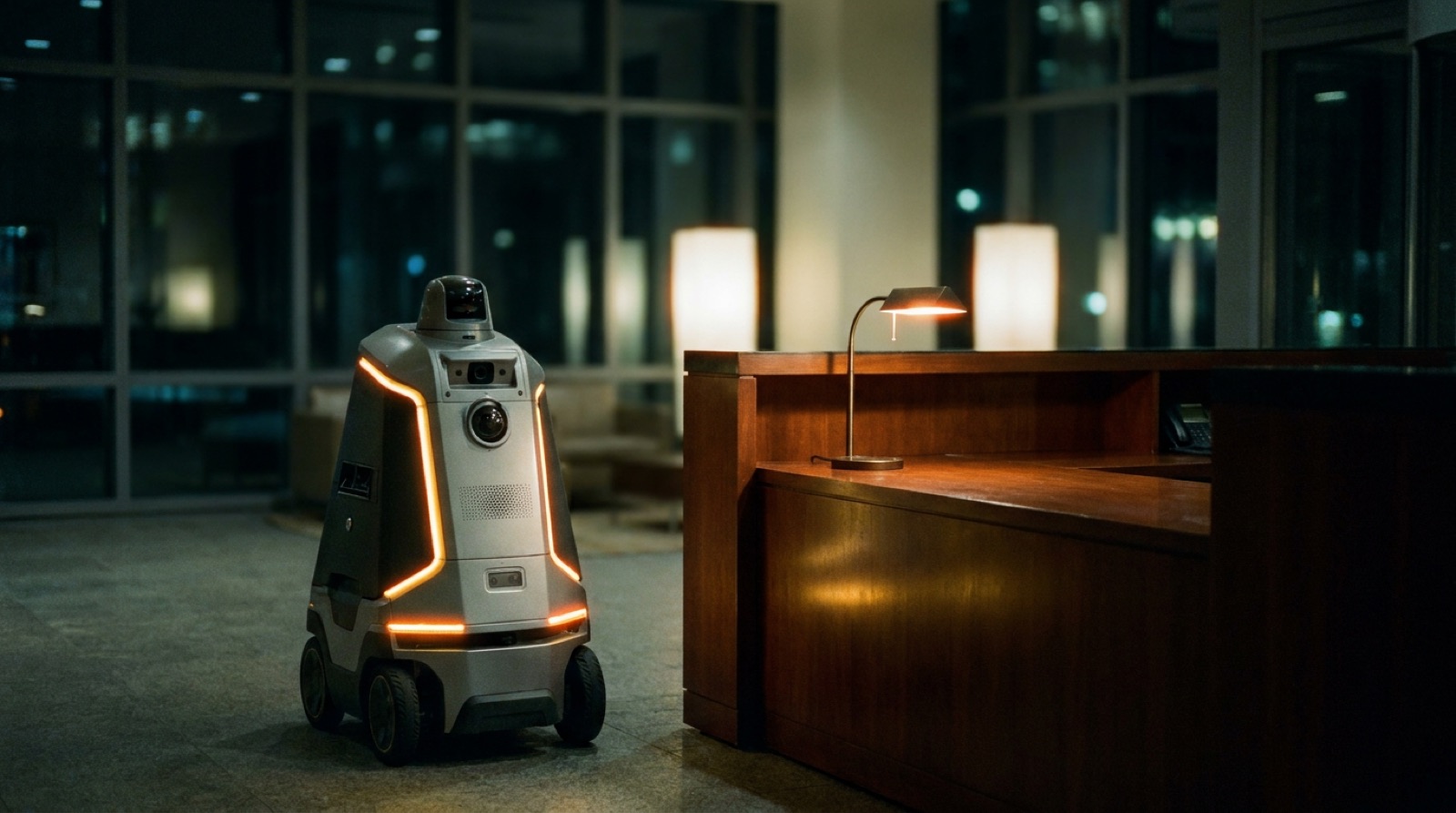
RaaS pricing for commercially deployed security robots covers the hardware lease, software subscription, remote monitoring from the vendor's NOC (Network Operations Center), and basic maintenance. Representative annual RaaS fees for wheeled patrol robots run in the range of $60,000–$120,000 per year per unit, depending on platform capability, monitoring tier, and contract length. Vendors rarely publish list prices; the ranges here are drawn from public contract disclosures and industry reporting.
RaaS pricing is not the full cost. The following components are routinely omitted from vendor-provided TCO comparisons.
On-site monitoring and SOC labor
A security robot generates alerts. Those alerts require a human to review, classify, and escalate. If the vendor's RaaS package includes 24/7 remote monitoring via their NOC, the cost is embedded in the fee. But "monitoring" in most RaaS contracts means that alerts are surfaced to a dashboard — it does not mean that a vendor operator is responsible for dispatching a response or making judgment calls about escalation thresholds. That decision-making layer remains with the buyer's security team or guarding contractor.
At minimum, plan for 1–2 hours per shift of SOC operator time dedicated to robot alert review, triage, and documentation. At a loaded cost of $35–$55/hr for a SOC analyst, this adds $13,000–$40,000 per year per robot — a line item that almost never appears in vendor comparisons.
Connectivity
Security robots require persistent, reliable network connectivity. Most platforms communicate over 4G/5G cellular or enterprise WiFi. In environments where cellular coverage is inconsistent (underground parking structures, large metal-racking warehouses, basement corridors), connectivity infrastructure investment may be required.
Cellular data plans for persistent video streaming typically run $200–$600 per month per robot. WiFi access point upgrades in large facilities can run $5,000–$25,000 as a one-time capital expense.
Environmental preparation and weatherization
Robots rated for outdoor use typically carry an IP (Ingress Protection) rating of IP65 or IP66, meaning they are dust-tight and protected against directed water jets. Deployment in environments with extreme temperature ranges, heavy precipitation, or high particulate environments (sawmills, grain elevators, coastal salt spray) may require additional protective measures, shelter for the docking station, or reduced operational hours.
Annual environmental maintenance costs — seal inspection, sensor cleaning, charging station weatherproofing — typically run $2,000–$8,000 per year depending on climate.
Maintenance and downtime
RaaS contracts typically include preventive maintenance and repair coverage. However, contracts vary significantly in what is covered, response time commitments, and whether a replacement unit is provided during downtime. A robot that is offline for maintenance cannot patrol.
When budgeting, plan for 5–15% annual downtime based on publicly available performance data from deployed platforms. For a robot covering a function that is operationally critical, the cost of guard coverage during downtime must be accounted for.
Transition and integration costs
SOC software integration, VMS API configuration, guard force retraining, SOP documentation, and the first-90-day calibration period carry real labor costs. Budget $15,000–$40,000 as a one-time integration cost for a single-unit deployment at a mid-sized facility. Multi-unit enterprise rollouts scale proportionally.
Three-year TCO comparison
The following table models a single-unit outdoor patrol robot deployment over a 36-month term against a single guard-year equivalent.
| Cost component | Robot (3-yr total) | Guard via contractor (3 yrs) |
|---|---|---|
| RaaS fee or contract wages | $180,000–$360,000 | $225,000–$315,000 |
| SOC/monitoring labor | $39,000–$120,000 | Included in guard role |
| Connectivity | $7,200–$21,600 | None |
| Environmental/weatherization | $6,000–$24,000 | None |
| Integration/transition (amortized) | $15,000–$40,000 | $6,000–$15,000 (onboarding) |
| Maintenance/downtime coverage | Included in RaaS (verify terms) | None |
| Three-year total | $247,000–$565,000 | $231,000–$330,000 |
At the lower end of robot RaaS pricing with minimal SOC overhead, the robot can be cost-competitive over a 36-month horizon. At mid-to-upper pricing with realistic SOC labor and connectivity costs, the robot is more expensive per coverage-shift than a guarding contractor.
The robot's economic case improves when:
- Coverage area is significantly larger than one guard can effectively patrol
- Guard attrition in the role is high (increasing the effective loaded cost per year)
- The deployment runs three or more concurrent units under a single SOC operator
- The robot enables a guard to be redeployed to a higher-value function rather than eliminated
The robot's economic case weakens when:
- SOC integration requires dedicated headcount
- The environment requires significant infrastructure investment
- Downtime coverage is not included in the RaaS contract
- The covered function cannot legally be performed by a robot alone (armed response, access control decisions, emergency intervention)
What a robot genuinely cannot cost-compare against a guard
Certain guard functions have no robot equivalent at current technology levels. These include physical intervention in an active security incident, meaningful engagement with an unauthorized person, making access control judgment calls that require human discretion, and performing first aid or emergency response. No commercially deployed security robot in this catalog category performs these functions. Deterrence, detection, and documentation — yes. Response — no.
This is not a criticism of the technology. It is the accurate framing that buyers need to make the right staffing model decision. A facility that routes the cost of response functions into the robot's TCO — expecting the robot to perform them — will arrive at the wrong numbers and the wrong deployment.
Where the math works and where it does not
TCO math typically works for: large outdoor perimeters with long guard patrol routes, multi-site operations with centralized SOC infrastructure already in place, facilities where a robot can cover three to four times the patrol area of a single guard, and environments with severe guard retention problems where turnover costs are compounding the loaded cost.
TCO math typically does not work for: single-unit pilot deployments without an existing SOC, facilities where cellular connectivity requires significant investment, environments requiring armed response capability, and any deployment where the monitoring labor costs are not explicitly modeled.
The honest summary: for a single unit at a single facility, the financial case for a security robot over a conventional guard contract is narrow and highly sensitive to assumptions. The financial case becomes more compelling at scale — multiple units, centralized monitoring, large patrol areas — and when the robot is explicitly positioned as coverage expansion rather than headcount reduction.
For a deeper look at where specific deployment models — outdoor patrol, fixed-post augmentation, drone perimeter — shift the payback math, continue with "Payback and deployment models for security robots."
Discussion
0 commentsNo comments yet. Sign in to be the first.